Summer Boarding Schools & Programs: Schools, Types and What to Expect
A summer boarding school gives a student several weeks of classes and residential life on a school campus during the summer break. Boarding school summer programs vary more than the name suggests, in who runs them, who teaches, and how much they reveal about the school itself.
This article covers the types of summer boarding programs, boarding schools with summer programs in the US, UK, Canada, and Europe, and what students study in them.
What Is a Summer Boarding School?
A summer boarding school is a residential academic program held during the summer break. Students live on campus, attend classes, and follow a set daily schedule of study, activities, and supervised evenings. The term covers three distinct arrangements, and the differences matter when comparing programs.
Year-round boarding schools with their own summer programs. A boarding school opens its campus in summer and runs a program under its own name. Families get the closest view of the school itself, since students live and study on its campus. Some programs are taught mainly by the school’s own teachers, and others mix in faculty from other schools and universities. Many accept students who do not attend the school during the year.
Dedicated summer-only schools. These schools exist only to run summer programs and have no year-round student body. Families choosing one are choosing the program itself, typically for coursework or skill-building. It offers no preview of a year-round school.
Summer boarding courses run by outside operators. A separate company uses a boarding school’s campus for the season and runs its own program there, often for international students, as in the UK. Students get the campus and boarding life, but the teaching and staff come from the operator, so the program says little about the host school.
Boarding Schools with Summer Programs in the US, UK, and Beyond
The schools below are a sample from each region, and each lists a summer program in the McMillan Education Boarding School Guide. Click any school name to view its full profile and program details, or use the link beneath each region for the complete list. Programs vary widely, from short language and arts sessions to five-week credit courses, and some enroll day students alongside boarders. To see every region at once, browse the complete list of boarding schools with summer programs.
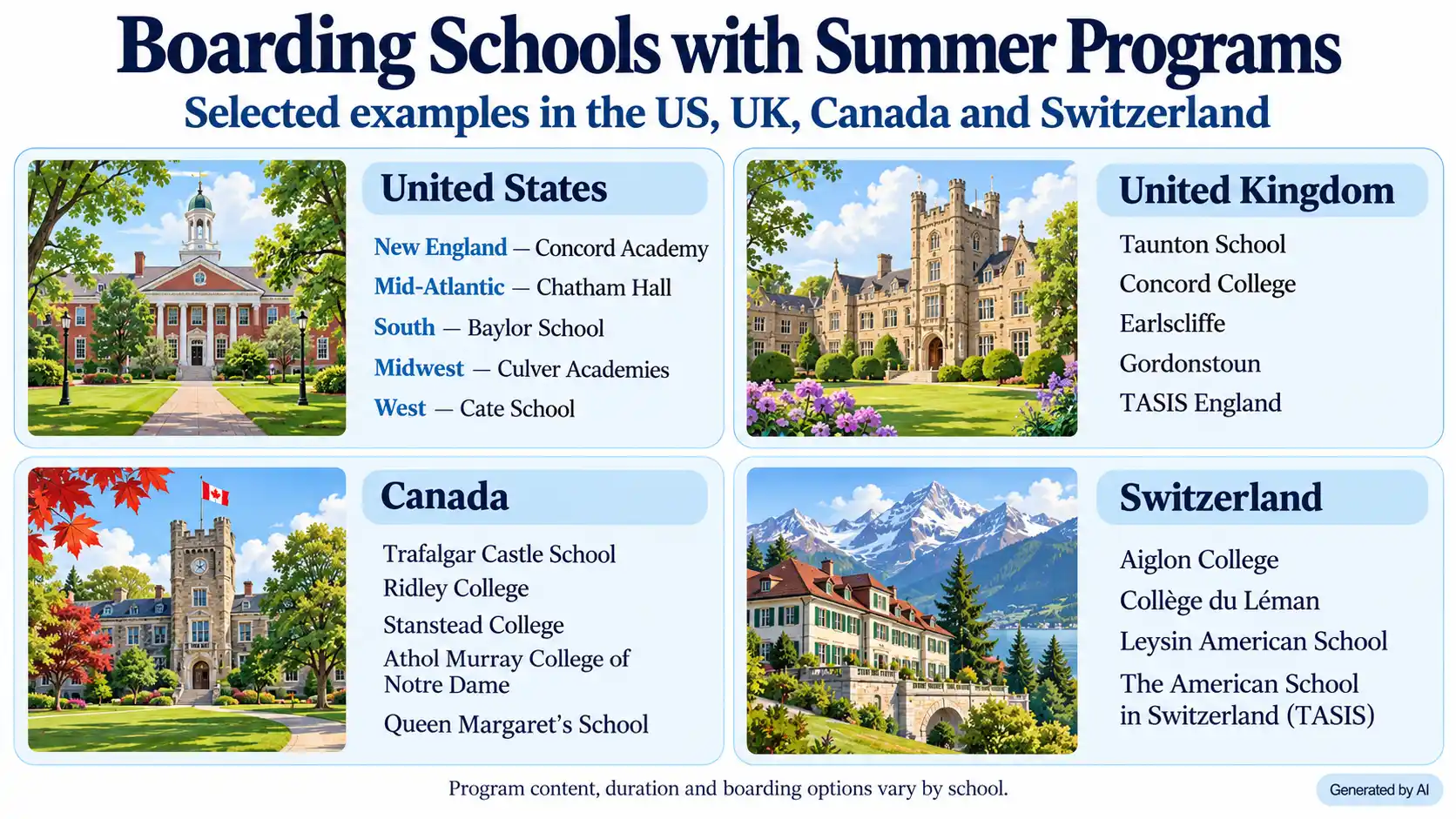
1. Summer Boarding Schools in the United States
Summer programs at boarding schools in the US are grouped below by region:
1.1 New England
Concord Academy (Concord, Massachusetts)
Gould Academy (Bethel, Maine)
Hotchkiss School (Lakeville, Connecticut)
Loomis Chaffee School (Windsor, Connecticut)
The Cambridge School of Weston (Weston, Massachusetts)
Washington Academy (East Machias, Maine)
See all boarding schools with summer programs in New England.
1.2 Mid-Atlantic
Chatham Hall (Chatham, Virginia)
Episcopal High School (Alexandria, Virginia)
Garrison Forest School (Owings Mills, Maryland)
The Madeira School (McLean, Virginia)
Saint James School (Hagerstown, Maryland)
See all boarding schools with summer programs in the Mid-Atlantic.
1.3 South
Baylor School (Chattanooga, Tennessee)
Currey Ingram Academy (Brentwood, Tennessee)
See all boarding schools with summer programs in the South.
1.4 Midwest
Culver Academies (Culver, Indiana)
La Lumiere School (La Porte, Indiana)
Lake Forest Academy (Lake Forest, Illinois)
Interlochen Arts Academy (Interlochen, Michigan)
Western Reserve Academy (Hudson, Ohio)
See all boarding schools with summer programs in the Midwest.
1.5 West
Annie Wright Schools (Tacoma, Washington)
Cate School (Carpinteria, California)
Hawaiʻi Preparatory Academy (Kamuela, Hawaii)
Idyllwild Arts Academy (Idyllwild, California)
Stevenson School (Pebble Beach, California)
The Webb Schools (Claremont, California)
See all boarding schools with summer programs in the West.
Families looking at US schools for the academic year can find the full process in how to apply to US boarding schools.
2. Summer Boarding Schools in the United Kingdom
Many UK summer programs are English language courses for international students, run either by the schools themselves or by outside operators on school campuses.
Taunton School (Taunton, Somerset)
Concord College (Shrewsbury, Shropshire)
Earlscliffe (Folkestone, Kent)
Gordonstoun (Duffus, Moray, Scotland)
TASIS England (Thorpe, Surrey)
See all boarding schools with summer programs in the UK.
Families weighing UK schools against American ones can compare the two in British schools vs. American schools, and the application process is covered in how to apply to UK boarding schools.
3. Summer Boarding Schools in Canada
Trafalgar Castle School (Whitby, Ontario)
Ridley College (St. Catharines, Ontario)
Stanstead College (Stanstead, Quebec)
Athol Murray College of Notre Dame (Wilcox, Saskatchewan)
Queen Margaret’s School (North Cowichan, British Columbia)
See all boarding schools with summer programs in Canada.
For the application process, see how to apply to boarding schools in Canada.
4. Summer Boarding Schools in Switzerland and Europe
Aiglon College (Chesières, Switzerland)
Collège du Léman (Versoix, Switzerland)
Leysin American School (Leysin, Switzerland)
The American School in Switzerland (TASIS) (Montagnola, Switzerland)
See all boarding schools with summer programs in Switzerland and Europe.
For the application process, see how to apply to Swiss boarding schools.
What Students Study in Boarding School Summer Programs
Most summer programs at boarding schools offer some mix of the coursework below, and which kind makes sense depends on what a family wants the summer to accomplish. Many programs combine them, with core classes in the morning and arts, sports, or electives in the afternoon.
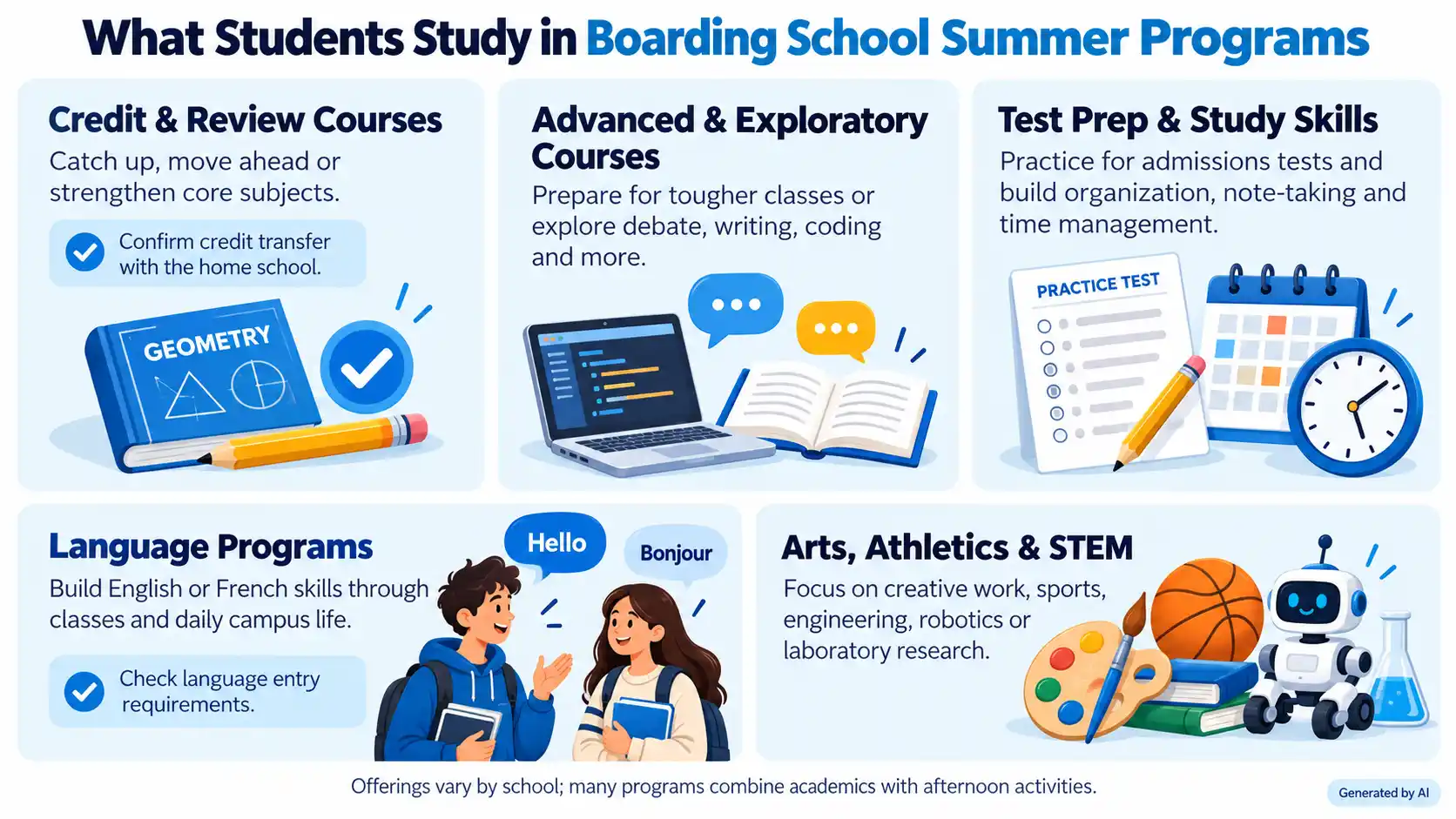
1. Credit and Review Courses
At US schools, credit courses are the most practical option for a student who needs to catch up or move ahead. Some programs compress a full year of a subject into about five weeks. A student can, for example, finish geometry over the summer and start Algebra 2 in the fall.
The catch is transfer. The student’s home school decides whether summer credit counts, so families confirm approval before enrolling. Some summer boarding school programs grant no credit at all.
Review courses serve a different student: one who passed a subject, most often math or English, but struggled with it. A few weeks of review means starting the next grade on firmer ground. Research from the Education Endowment Foundation finds that students in academically focused summer schools make about three months’ additional progress on average.
Outside the US, where schools do not use course credits, summer catch-up courses serve the same purpose. In Switzerland, some schools run short sessions on core subjects in the weeks before the school year.
2. Advanced and Exploratory Courses
Advanced courses suit students preparing for a demanding year ahead, such as intensive precalculus before AP Calculus.
Exploratory courses suit students curious about subjects their school does not offer, including debate, creative writing, coding, economics, Model United Nations, and, more recently, AI and data science. Many are non-credit, so a student can try a subject without it affecting their record at home.
3. Test Prep and Study Skills
For a student applying to boarding schools in the US or Canada, many summer programs offer SSAT preparation, often alongside SAT and ACT prep for older students. UK schools assess international applicants differently, most often through UKiset, which tests academic ability and English.
Study skills courses serve students moving to a more demanding school or a new grade level. They cover organization, note-taking, time management, and study habits, the skills a boarding school’s evening study hours assume a student already has.
4. Language Programs
For international students, a language program is often the most direct preparation for study abroad. Most programs teach English, and in Switzerland many also offer French. These programs are a core offering of many summer boarding courses, particularly in the UK.
Students take a placement test and join a class at their level. Many English programs add academic subjects or TOEFL and IELTS preparation. Several weeks of classes and dorm life in the language of instruction also show a family how ready a student is for a full academic year.
One caution: some academic summer programs offer no English instruction and expect full proficiency on arrival. During the school year, English language instruction varies widely by school, and the directory classifies it in four levels, from mainstream-only to full bridge programs.
5. Arts, Athletics, and STEM Tracks
For a student with a defined interest, a specialized track offers several weeks of focused work in one discipline. Arts tracks cover theater, music, dance, and visual art, and many end with a performance or exhibition. Athletic programs range from sport-specific training to daily sports alongside classes, and students who want the same focus year-round can look at boarding schools for athletes and equestrian boarding schools. STEM tracks cover engineering, robotics, coding, and laboratory research.
Summer Boarding School vs. Summer Boarding Camp vs. Private Summer Schools
A family searching for a summer at boarding school will meet three labels: summer boarding school, summer boarding camp, and private summer school. They sound interchangeable. They describe three quite different summers, and choosing among them starts with deciding what the summer is meant to show.
A summer boarding school offers the fullest preview of a boarding school term. Students attend classes on most weekdays and live in dorms, with study hours, activities, and weekend trips filling out the schedule. Academics and residential life are tested together, which is as close as a summer comes to the real thing.
A summer boarding camp shows how a student handles time away from home, and research from the American Camp Association with more than 5,000 families found lasting gains in independence, confidence, and social skills. Days center on sports, outdoor programs, and excursions, and the pace is looser. Traditional US camps usually include no classes, though many camps in Switzerland and the UK pair daily language lessons with the activities.
A private summer school tests the academic side alone. The coursework often resembles a summer boarding school’s, but many programs are day programs, and students return home each evening. For a student who has never lived away from home, that is a useful trial of the classroom and no trial of the dorm.
Previewing a Boarding School Through Its Summer Program
A boarding school can be described in a brochure and sampled on a tour, but neither shows what an ordinary day there feels like. Summer programs at boarding schools that run their own sessions give a family that view, with several weeks of classes, meals, dorm life, and weekends in which a student can form a real opinion of the place. How much the summer reveals depends on how closely it reflects the school year.
1. What a Summer Program Shows About a School
Much of what gives a boarding school its character carries over. The dorms, the dining hall, the classrooms, and the daily schedule belong to the school, and a student who spends several weeks among them comes away knowing how the place works on an ordinary Tuesday. When the summer courses follow the school’s year-round method, whether discussion-based seminars or small classes, the student also experiences the teaching directly, which says a good deal more than any description of it.
Some things remain out of view. Summer faculty often include teachers from other schools and universities, many classmates are visitors, and the traditions that define a school arrive in September, so a July campus tells only part of the story. Programs run by outside operators share the buildings and little else, which makes them a pleasant taste of boarding life and a limited view of the host school.
2. Choosing and Timing a Summer Program
For a family using the summer as a preview, the most revealing option is usually a session the school runs itself, with its own teachers, in its own dorms. The calendar then offers two natural moments. The summer before the application year is a season of discovery: a student who spends several weeks on a campus arrives at application season knowing at least one school from the inside, with a far sharper sense of what to look for in the others.
The summer after acceptance is a season of preparation, when some schools run short orientation and language sessions so international students can settle into the classroom and the dorm before the first day.
Early planning keeps every option open, since some programs begin accepting applications as early as December. Families hoping for credit will want to confirm with the home school that it transfers before enrolling.
Find a Boarding School with a Summer Program
For families ready to start building a shortlist, McMillan Education’s Boarding School Guide lists boarding schools with summer programs that can be narrowed by region, campus size, gender, and other criteria.
The school quiz adds a student’s goals to the search, and the comparison tool puts a few schools side by side once the shortlist is down to a handful.
For families who want guidance on choosing a summer program and timing it well, McMillan Education’s boarding school consultants bring seven decades of experience and a close knowledge of the schools themselves. That knowledge extends from which summer programs a school runs with its own faculty to where a summer belongs in the year ahead.
Speak with a boarding school admissions consultant to start planning.
Frequently Asked Questions
1. Can you go to boarding school just for the summer?
Yes. Most boarding school summer programs welcome students who do not attend the school during the year, and some schools exist only to run summer sessions. For a student curious about boarding life, a summer is often the most natural first step.
2. What is a summer boarding school?
A summer boarding school is a residential program held during the summer break, where students live on campus, attend classes, and follow a set daily schedule. The term covers programs run by year-round boarding schools, schools that operate only in summer, and summer boarding courses run by outside operators on school campuses.
3. What is the difference between a summer boarding school and a summer camp?
A summer boarding school centers on coursework, with classes on most weekdays and dorm life built around them. A summer camp centers on sports, outdoor programs, and excursions. Traditional US camps usually hold no classes, while many camps in Switzerland and the UK include daily language lessons.
4. Do you have to attend the school to join its summer program?
No. Boarding school summer programs enroll students from many schools and countries, and most summer students return to their own schools in the fall.
5. How long do boarding school summer programs last?
Most run between two and six weeks. Academic sessions at US boarding schools often last about five weeks, while many language programs in the UK and Switzerland run in blocks of two to four weeks.
6. What is the most prestigious summer program?
No single ranking exists, and the strongest program for a student is the one that serves the purpose behind the summer, whether previewing a school, earning credit, building language skills, or developing a talent. A long-established name matters less than who teaches the program and how closely it is tied to the school. The same holds for older students building toward college, where summer programs for US college applications are read for what the student produced, and the program’s name carries little weight.