Swiss Boarding School Admissions: A Step-by-Step Guide for International Families
Swiss boarding school admissions have no centralized application platform, no single standardized test required across schools, and no universal deadline. Each school runs its own process, sets its own entrance assessments, and fills places on its own timeline.
That makes the Swiss admissions landscape harder to read from the outside. A family applying to three boarding schools in Switzerland may face three entirely different sets of requirements, three different assessment formats, and three different decision windows. Some schools fill places well ahead of the academic year. Others accept applications on a rolling basis into the spring.
This article walks through the full Swiss boarding school admissions process from start to finish: when to begin, what schools require, how entrance assessments and interviews work, and what to expect after an offer arrives.
Before You Apply: Choosing the Right Swiss Boarding School
Switzerland is one of the most established boarding school destinations in Europe, with schools spread across distinct regions, from the lake towns of the west to the Alpine settings of the central and eastern cantons. They differ in curriculum (IB, A-Levels, Swiss Maturité, French Baccalauréat, American High School Diploma), campus culture, enrollment size, and the age groups they serve.
Before starting any application, families should be clear on a few foundational questions: What curriculum track aligns with where the student plans to attend university? What age range does each school accept, and does the student's entry point align with a natural intake year?
The McMillan Education Boarding School Guide can help answer those questions.
The school finding tool lets families filter Swiss boarding schools by location, curriculum, age range, campus size, and boarding type.
The school matching quiz takes families through a short set of questions about their child's goals, age, and learning needs, then generates a list of schools most closely aligned with their profile.
The comparison tool lets families place up to three schools side by side across academics, boarding culture, admissions, and campus life.
The schools on a family's initial list will shape every decision that follows, from the documents prepared to the preparation required for each school's admissions process.
At What Age Can Students Enroll in a Swiss Boarding School?
Swiss boarding schools accept students from junior level through upper secondary, with entry points spread across several distinct stages. The table below shows how those stages break down.
|
Age |
Typical Stage |
Notes |
|
7–10 |
Junior/primary boarding |
Available at a small number of schools. Places are limited. |
|
11–13 |
Early secondary entry |
A common and natural starting point. Students enter before curriculum tracks narrow. |
|
14–15 |
Mid-secondary entry |
Still widely available, though some adjustment may be needed depending on the curriculum already in progress. |
|
16–17 |
Upper secondary / diploma entry |
Aligns with the start of the IB Diploma, A-Levels, or other two-year programmes. |
For a closer look at what age students can start boarding school and what that decision involves, see our article on boarding school age.
The Swiss Boarding School Admissions Timeline: When to Start
Swiss boarding school admissions timelines vary significantly. Some schools fill places more than a year before the academic year starts. Others accept applications on a rolling basis. Starting early keeps more options open.
The timeline below covers the general sequence. Always confirm exact dates directly with each school.
|
When |
What |
|
18–24 months before entry |
Research, shortlisting, language preparation. No formal school contact yet. |
|
12–15 months before entry |
Initial contact with admissions offices. School visits where permitted. |
|
10–12 months before entry |
Application submission. Most schools accept applications up to one year before the intended start date. |
|
6–10 months before entry |
Entrance assessments and interviews. Scheduling varies by school. |
|
4–6 months before entry |
Offers, deposits, and enrollment contracts. |
|
2–4 months before entry |
Visa applications, guardianship arrangements, and pre-arrival logistics. |
For selective schools with limited places, earlier is always the stronger position. For schools with rolling admissions, the process is more flexible.
What Swiss Boarding Schools Require in an Application
Requirements vary between schools, so families should always confirm directly with each admissions office. The documents below are common across most Swiss boarding school applications.
1. Academic Records
Most schools require official transcripts covering the last two to three years of study. Some ask for end-of-year grades only. Others request interim reports as well. Le Rosey reviews transcripts for consistent academic performance across subjects. Schools offering the IB or A-Levels will pay particular attention to subject choices and grades in related areas.
2. Language Proficiency
Most Swiss boarding schools teach in English, French, or both. For non-native English speakers, evidence of language proficiency is required at most schools, though how that is assessed varies.
Aiglon College requires a 45–60 minute English Proficiency Test for non-native speakers, administered as part of the application process.
TASIS requires non-native speakers to complete an English proficiency test before their application is reviewed.
Collège du Léman may request an online English placement test prior to acceptance.
Leysin American School accepts IELTS, TOEFL, or Duolingo scores, and also administers its own placement test.
Brillantmont International School requires all applicants to complete online placement assessments in English and mathematics; for non-native speakers, English results determine stream placement rather than acting as a hard admissions barrier.
Schools with EAL programmes in place will factor proficiency test results into stream placement rather than using them as a hard admissions barrier. Families should check each school's specific threshold requirements directly.
3. Teacher References
Most schools ask for at least one academic reference. Le Rosey requires a signed Academic Recommendation Form from the student's headteacher or dean. Other schools accept direct letters from subject teachers, typically in English and mathematics.
4. Supporting Documents
Beyond transcripts and references, families should expect to provide a copy of the student's passport, a medical report completed by the family's doctor, and an application fee. Some schools also require a personal statement or motivation letter from the student, and a smaller number ask for supplementary materials showcasing talent in sport, music, or the arts.
How to Apply: The Swiss Boarding School Admissions Process
Swiss boarding schools do not use a centralized application platform. Each school manages its own admissions process. The steps below apply broadly, but the exact sequence and requirements differ from school to school – something McMillan Education International’s Swiss boarding school admissions consultants work through with families on a case-by-case basis.
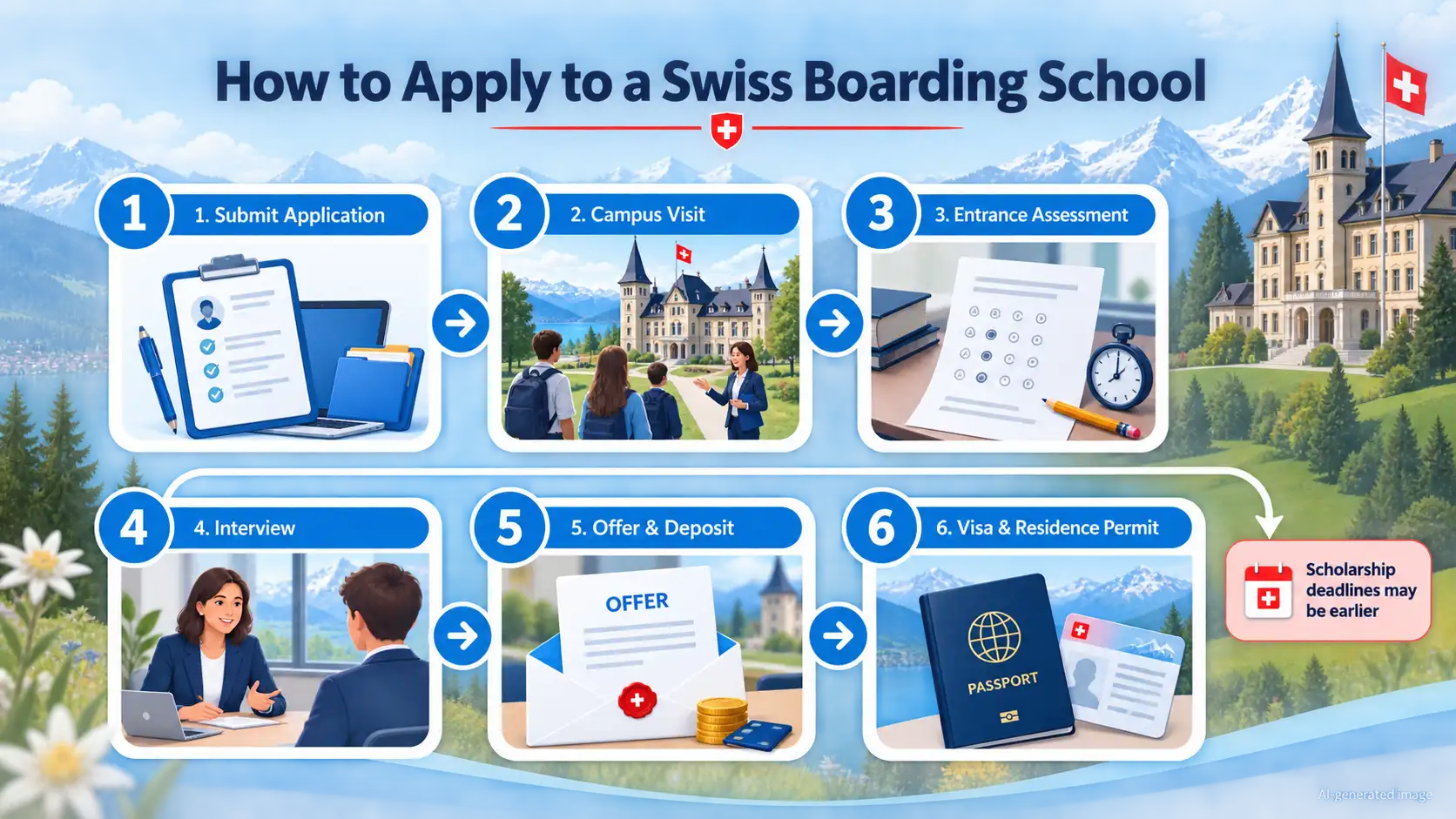
1. Submitting Your Application
Applications are submitted directly to each school, typically through an online admissions portal. Most schools require the full application package before scheduling any next steps:
Le Rosey will not review a dossier until all required documents and the CHF 3,000 registration fee have been received.
Aiglon College requires school reports, teacher references, a passport scan, and the CHF 3,000 registration fee before the process moves forward.
TASIS accepts applications on a rolling basis through its online admissions portal; candidates are notified of the committee's decision promptly after submission.
Brillantmont International School requires families to complete a pre-registration form to access the admissions portal before submitting documents. A non-refundable CHF 2,000 registration fee is required before the admissions file is reviewed.
Collège du Léman charges a non-refundable CHF 500 application fee; if a place is available, an offer is typically issued within five working days of the application being reviewed.
Collège Alpin Beau Soleil charges a CHF 3,000 application fee and operates rolling admissions. The school advises applying between September and December, as availability narrows as the year progresses.
Lyceum Alpinum Zuoz reviews applications on receipt. Once documents and the registration fee are received, the school schedules the interview and assessment stage.
Families applying to more than one school should plan to manage separate applications, separate portals, and separate timelines simultaneously.
2. Campus Visits and Taster Days
Campus visits are a central part of Swiss boarding school admissions. At many schools, the visit is where assessments, interviews, and the admissions decision all come together.
Aiglon College offers two visit types: an Initial Enquiry Visit (approximately 1.5 hours, campus tour and admissions discussion) and a Full Admissions Visit (3–4 hours, includes assessments and interview). Year 12 applicants must complete the Full Admissions Visit in person.
Le Rosey invites candidates to spend a full day on campus, during which they take entrance tests and are interviewed by an academic advisor. Visits can be scheduled no earlier than 15 months before the intended start date.
TASIS invites families to schedule a personalised campus tour or video call directly with its admissions team, with dates available throughout the year.
Brillantmont International School offers individual campus visits in Lausanne, including a school tour and meetings with admissions staff and a student from the same age group, or a Zoom interview for families who cannot travel.
Institut Montana Zugerberg offers prospective students a free trial day on campus, joining actual lessons and meeting future classmates. Virtual meetings are available for families unable to visit in person.
Collège Alpin Beau Soleil in Villars-sur-Ollon invites families to a guided campus tour, a virtual discovery meeting, or a regional meeting with its admissions team.
For families who cannot visit in person, some schools offer remote assessments and interviews, though an on-campus visit is always preferred.
3. Entrance Assessments
Swiss boarding schools do not require the ISEE, SSAT, or other standardized tests used in US admissions. Each school administers its own assessments, in its own format, at its own stage of the process.
Le Rosey tests candidates in mathematics, English or French, and their mother tongue.
Aiglon assesses problem solving, mathematical reasoning, logical thinking, and literacy. IB Diploma applicants also sit a separate maths test. For non-Year 12 students, assessments can be completed online.
Leysin American School's entrance evaluation centers on the English language proficiency requirements covered above, rather than a separate subject-based test.
TASIS The American School in Switzerland requires academic placement assessments in English and mathematics as part of its admissions evaluation.
Brillantmont International School requires all applicants to complete online assessments in mathematics and English.
Institut Montana Zugerberg uses the CAT4 cognitive ability test alongside language placement assessments to evaluate each applicant's academic level and appropriate programme.
Collège Alpin Beau Soleil requires placement exams in mathematics and English as part of the application process.
Lyceum Alpinum Zuoz administers pre-admission assessment tests alongside a language level evaluation, used to determine stream placement into the IB Diploma or Swiss Matura programme.
Preparation needs to be tailored to each school individually.
4. The Interview
Interviews are standard across most Swiss boarding school admissions processes. At schools like Aiglon and Le Rosey, the interview happens during the campus visit and is not a separate stage.
Aiglon runs a conversation between the family, the Director of Admissions, and the Head of School, covering the student's interests, strengths, goals, and readiness for boarding life. Non-Year 12 applicants can interview online; Year 12 applicants must attend in person.
Collège du Léman asks boarding applicants to complete a video questionnaire as part of the application.
TASIS conducts interviews as part of the admissions process; these can be arranged remotely for international families.
Institut Montana Zugerberg conducts a short interview with its Heads of Programmes as part of the assessment process; the specific format depends on the applicant's year group and intended curriculum track.
Brillantmont International School schedules a Zoom interview or in-person campus interview after the initial application is submitted.
In most cases, the interview is as much an opportunity for the family to evaluate the school as it is for the school to evaluate the student.
5. Offers, Deposits, and Enrollment Contracts
Once a school decides to offer a place, families receive an offer letter and an enrollment contract. Response windows are short, typically 10 to 30 days, and deposits often cover a full term's fees upfront.
Cancellation policies vary. At some schools, the deposit is entirely non-refundable from the moment it is paid. At others, the terms depend on when the withdrawal is made relative to the start of the academic year.
Families applying to multiple schools frequently face overlapping offer windows, which means committing financially to one school before hearing back from another. Understanding each school's deposit structure and cancellation policy before offers arrive is a critical part of the planning process.
6. Visa and Residence Permits
Non-EU families need a Swiss student visa, applied for through the Swiss embassy or consulate in the family's country of residence. Processing may take 8 to 12 weeks, and applications cannot be submitted until the school issues a formal offer. EU and EFTA citizens register with local authorities within 14 days of arrival. Some boarding schools handle the Swiss residence permit on the student's behalf once they arrive.
Scholarships and Financial Aid at Swiss Boarding Schools
Financial aid is available at a number of Swiss boarding schools, though options are limited and vary from school to school. The article on boarding school financial aid covers how aid packages are typically structured and what families should ask before applying.
Several of the Swiss boarding schools offer scholarship programmes:
Aiglon College offers fully funded scholarships for students entering Year 11 or Year 12. These are merit-based and need-based, covering tuition, boarding, meals, healthcare, extracurriculars, and expeditions. Applications go through a separate scholarship pathway.
Leysin American School awards the LAS Global Scholarship, a two-year full-tuition IB scholarship including room and board. The programme is merit-based and means-assessed. Approximately 40% of LAS students receive some form of financial aid.
TASIS allocates approximately CHF 2 million annually in financial aid, with around 20% of students receiving support. Aid is awarded on the basis of need and merit.
Le Rosey offers 3 to 5 partial scholarships per year for students in Classes 3 to 1. Le Rosey does not offer full scholarships. A separate CHF 500 application fee applies for scholarship candidates.
Scholarship timelines often run ahead of general admissions deadlines, and eligibility requirements differ enough between schools that families can easily miss programmes they qualify for. An educational consultant with knowledge of the Swiss boarding schools can map out which scholarships are relevant before the process begins.
What to Know Beyond the Application
Swiss boarding schools' admissions process is only part of the picture. Before committing to a school, families should understand what follows an offer and how those pieces interact across multiple applications.
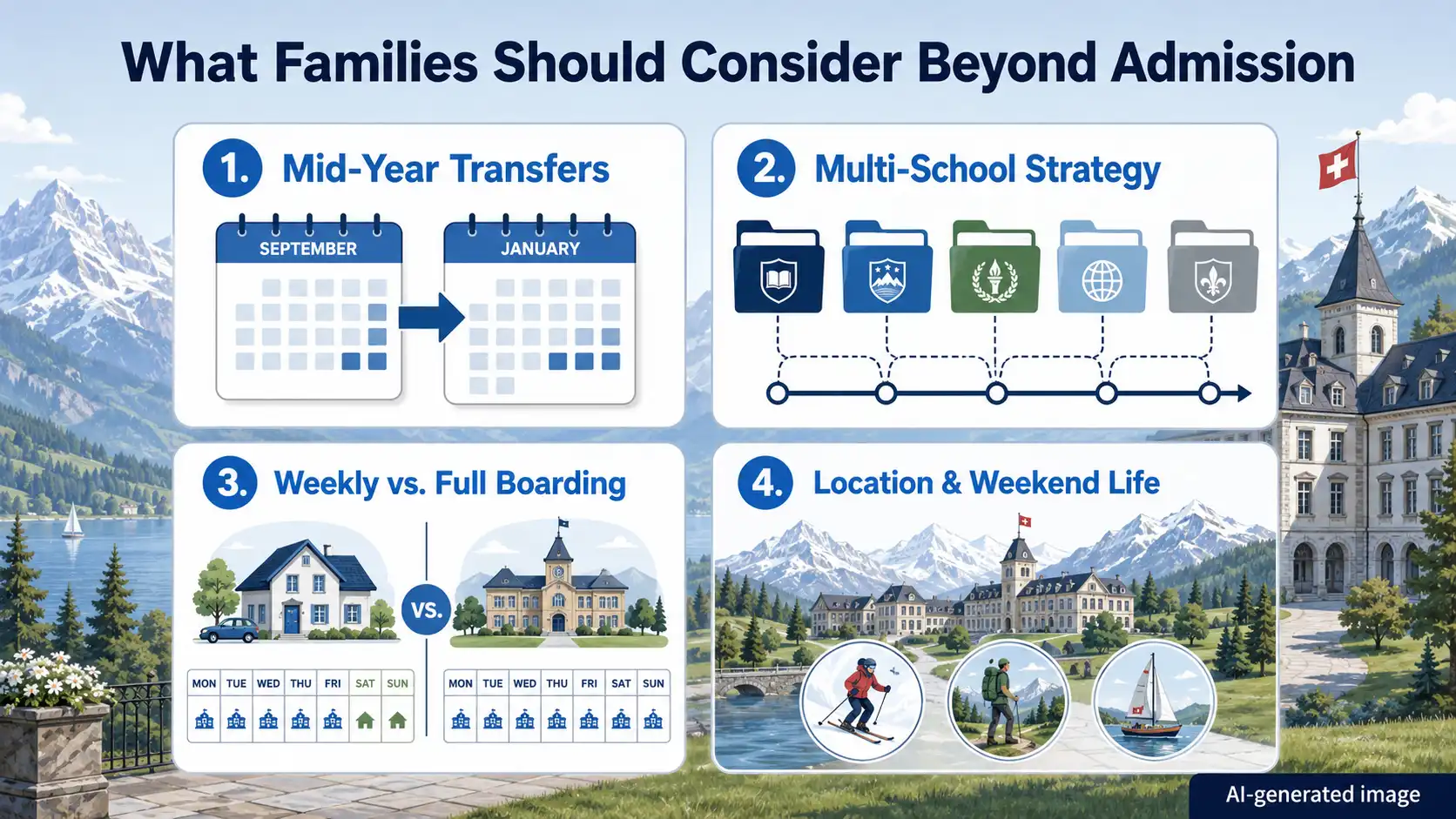
1. Mid-Year Transfers
Some Swiss boarding schools with rolling admissions consider mid-year transfers if places are available. Others do not. For students on structured programmes like the IB Diploma or A-Levels, mid-year entry is often not possible once the two-year cycle has started. Families whose relocation timing does not align with a September intake should check each school's mid-year policy before shortlisting.
2. Multi-School Application Strategy
Applying to a single boarding school in Switzerland leaves families exposed if the application is unsuccessful and applying to too many spreads preparation too thin. A shortlist of three to five schools is the most common approach, but the sequencing is important. Schools with earlier deadlines should be prepared first, and offer response windows from one school may arrive before another school has completed its assessments.
3. Weekly vs. Full Boarding
Not all Swiss boarding schools operate on the same weekly structure. Some offer full boarding only, meaning students remain on campus every weekend. Others offer weekly boarding, where students return home or to a guardian on Friday and come back on Sunday evening. The distinction changes the practical experience of school life significantly, and should be confirmed before an application is submitted.
4. Location, Sports, and Weekend Life
Families planning to study in Swiss boarding schools should also consider the environment each school sits in. Alpine schools offer ski programmes, hiking, and outdoor pursuits built into the weekly schedule. Lakeside schools closer to Geneva or Lausanne offer easier access to airports, cities, and cultural life. Sports programmes vary sharply: some schools are known for pre-professional athletics, others for arts or music.
Start Your Swiss Boarding School Application
The McMillan Education Boarding School Guide lets families search boarding schools by location, curriculum, age range, and campus size, and compare schools side by side before applying.
Families who already have a sense of their priorities can also use the school matching quiz to get a personalized list of schools based on their child's goals, age, and learning needs.
For those who want expert guidance through the full admissions process, McMillan Education’s consultants have placed students in more than 300 schools worldwide and have decades of experience working with Swiss institutions specifically.
Schedule a free consultation to discuss your child's options.
Frequently Asked Questions
When should we start the Swiss boarding school admissions process?
For selective schools, 12 to 18 months before the intended start date is a strong starting point. Research and shortlisting can begin earlier. Schools with rolling admissions offer more flexibility, but strong candidates still move early.
1. Do Swiss boarding schools require the SSAT?
No. Swiss boarding schools do not use the SSAT, ISEE, or other US standardized tests. Most schools administer their own internal assessments in subjects like mathematics, English, and logical reasoning. Formats vary between schools.
2. What documents do I need for a Swiss boarding school application?
Most schools require official academic transcripts (two to three years), evidence of English or French language proficiency, at least one teacher reference, a copy of the student's passport, a medical report, and an application fee. Some schools also ask for a personal statement.
3. How much are Swiss boarding school application fees?
Application and registration fees vary. Le Rosey and Aiglon College both charge CHF 3,000 at the application stage. Other schools charge less. Le Rosey charges an additional CHF 500 for scholarship applications.
4. Can we apply to more than one Swiss boarding school at the same time?
Yes. There is no centralized application system, so families can apply to as many schools as they choose. Each application is managed separately through the school's own portal.
5. Are scholarships available at Swiss boarding schools?
Yes, though options are limited and competition can be high. Several schools allocate dedicated scholarship budgets each year, covering everything from partial bursaries to fully funded places including boarding and extras. Eligibility criteria, deadlines, and application routes vary by school. The Scholarships and Financial Aid section above covers each school's programme in detail.
6. Does attending a Swiss boarding school lead to Swiss citizenship?
No. A student visa does not count toward the residency requirements for Swiss citizenship. Students would need to undergo the standard naturalization process, which requires at least ten years of residence in Switzerland among other requirements.
7. Can students transfer mid-year to a Swiss boarding school?
It depends on the school and the programme. Schools with rolling admissions are generally more flexible; fixed two-year programmes like the IB Diploma usually are not. See Mid-Year Transfers above for details.