How to Apply to Boarding Schools in Canada
Canadian boarding school admissions is a school-by-school process shaped, in part, by province. A student at an Ontario school graduates with the Ontario Secondary School Diploma. The same student in BC graduates with the BC Dogwood Certificate. Quebec's secondary system ends at Grade 11, not Grade 12, before CÉGEP. Different credentials, different timelines, and for international students, different immigration steps on top of the standard application.
This article covers the full admissions process: how to find the right school, what schools require, how assessments and interviews work, what international students need to arrange separately, and what happens after an offer arrives.
How to Find the Right Boarding School in Canada
Start with the basics: co-ed or single-gender, secular or faith-based, city or countryside. From there, look at what the school builds its program around. Some lean heavily into outdoor education and use Canada's seasons as part of student life. Others are known for the arts, athletics, or a specific academic track like IB or AP.
Language is worth a specific look here. Several Canadian boarding schools offer full or partial French immersion alongside the English curriculum, a feature rare among US and UK boarding schools. If bilingual education matters to your family, filter for it early.
CAIS accreditation helps narrow a shortlist, but it is often misunderstood. People searching "CAIS admission" are usually looking for a shared application system, and there isn't one. CAIS accreditation means a school has gone through a rigorous, peer-reviewed process against national standards. Twenty-nine boarding schools currently hold it. Plenty of strong Canadian boarding schools operate outside CAIS too, and accreditation does not change how any individual school runs its admissions.
McMillan Education's Boarding School Guide – the school finder, school matching quiz, and comparison tool – is the starting point for building a Canadian boarding school shortlist.
What Age Can You Start a Canadian Boarding School?
Most Canadian boarding schools accept boarding students from age 13 to 14, which corresponds to Grade 9. This is the primary entry point and the most competitive one. At sought-after schools, places fill 12 to 18 months ahead of the academic year.
A smaller number of schools accept boarders from age 12 or 13, at the Grade 7 and 8 level. Admission at this age tends to be less competitive, with more timing flexibility. A few schools take boarders from as young as age 11, though options at that level are limited.
Province matters here too. Quebec's secondary system runs from age 12 through 16 or 17, one year shorter than Ontario and BC. A student entering a Quebec boarding school at 14 graduates at 16 or 17, moves into CÉGEP rather than Grade 12, and is on a different university application timeline. That affects school selection as much as it affects the application itself.
|
Age Range |
Canadian Grade |
Availability |
|
11–12 |
Grade 6 |
Select schools only |
|
12–13 |
Grade 7 |
Less competitive, flexible timing |
|
13–14 |
Grade 8 |
Less competitive, flexible timing |
|
14–15 |
Grade 9 |
Primary entry point, most competitive |
|
15–16 |
Grade 10 |
Available, fewer openings |
|
16–17 |
Grade 11 |
Limited (final year in Quebec) |
|
17–18 |
Grade 12 |
Rare, case-by-case |
For a full breakdown of boarding school entry ages across Canada and other countries, see our boarding school age guide.
Canadian Boarding School Application Requirements
Requirements vary from school to school, but the core documents are consistent across Canadian boarding school applications. Knowing what to gather before starting any application saves time, especially for families applying to multiple schools simultaneously.
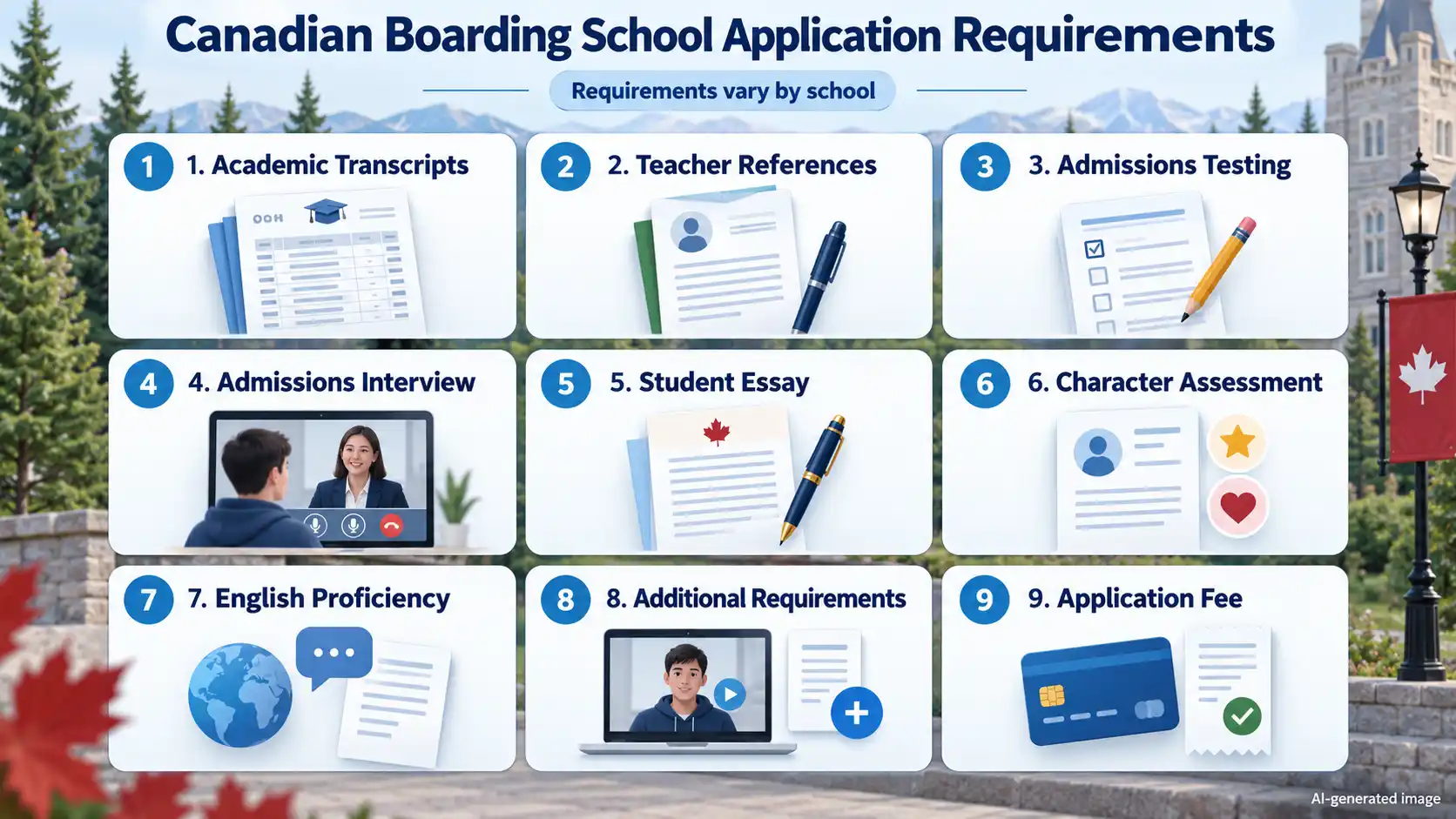
1. Academic Transcripts
Canadian schools generally require two to three years of past and current report cards. These must often be sent directly from the student's current school. Because some admissions offices specifically ask for end-of-year grades rather than mid-term reports, it is worth confirming the preferred format with each institution.
2. Teacher References
Most schools in Canada ask for one or two letters of recommendation, typically from a core subject teacher and an individual who can speak to the student's character, such as a coach, counselor, or head of year. Schools are often specific about these requirements. Ridley College, for example, prefers a classroom teacher over a private tutor or family friend. Bishop Strachan School does not require or accept recommendation letters or teacher references as part of the application.
3. Admissions Testing
Standardized testing requirements vary across Canadian boarding schools. Many require applicants to take the SSAT, though some schools design and administer their own internal academic or aptitude tests. Others use the Canadian Achievement Test (CAT), which assesses curriculum-based knowledge rather than reasoning ability. Others require no standardized test at all.
4. The Admissions Interview
A formal interview is a standard step in Canadian boarding school admissions. Conducted either in person during a campus visit or virtually, this conversation allows the admissions team to assess the applicant's character and interests. Many schools require both a student interview and a parent interview.
5. Student Essay or Personal Statement
While not universal, a personal statement is common. Prompt topics and required lengths vary by school. Where required, the essay gives the student an opportunity to speak in their own voice about interests, goals, and reasons for applying. Some schools ask for a graded piece of schoolwork the student is proud of, in addition to a formal personal statement or occasionally in place of one.
6. Character Assessments
Some Canadian boarding schools use standardized character evaluations such as the Character Skills Snapshot, which gives admissions teams a more complete picture of the applicant's personal attributes and soft skills alongside academic metrics.
7. English Language Proficiency
Applicants whose first language is not English are required to demonstrate language proficiency. Accepted tests typically include IELTS, TOEFL, and the Duolingo English Test, though some schools run their own internal English assessments. Specific score thresholds and recognized tests vary, so checking each school's admissions page directly is essential.
8. Additional Requirements
Some schools go beyond the standard document checklist. Branksome Hall, for example, requires boarding applicants to submit a mandatory two-minute introduction video as part of the application. Requirements of this kind are school-specific and will be communicated during the application process.
9. Application Fee
Most Canadian boarding schools charge a non-refundable application fee at the time of submission. Fees vary by institution, and some schools use tiered structures based on submission date. Confirm the amount and payment timing directly with each school's admissions office before applying.
How to Apply to a Canadian Boarding School: Step by Step
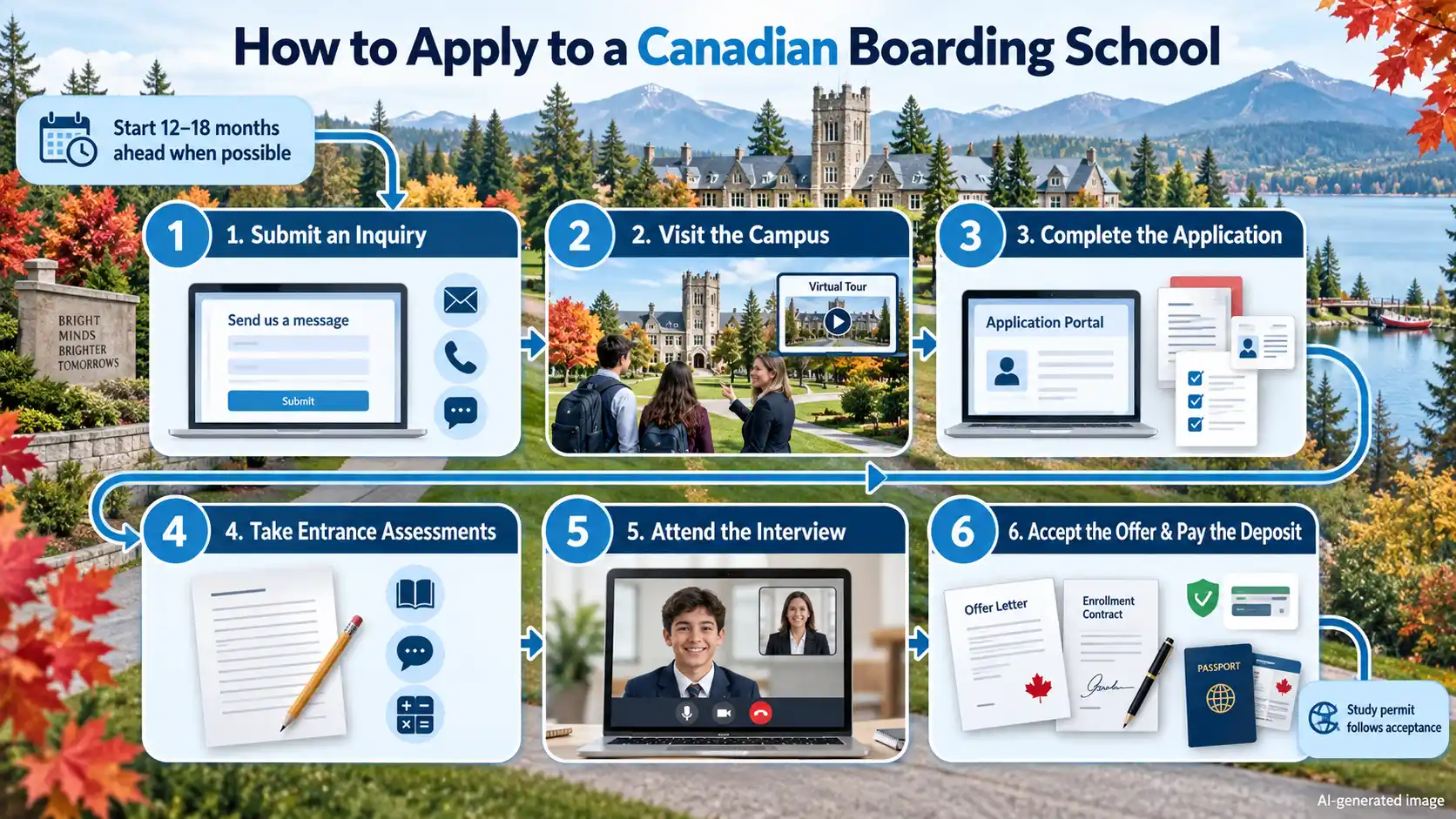
Step 1: Submit an Inquiry
Start with an inquiry to the school's admissions office, through the inquiry form on the school's website, by email, or by phone. Include the student's full name, current grade, intended entry year, citizenship status, and a brief note on academic or extracurricular interests. The admissions team will confirm availability, outline school-specific requirements, and schedule a campus visit or virtual tour.
Rolling admissions means inquiries are accepted year-round at most schools, but timing still matters. For Grade 9 entry at competitive schools, reaching out 12 to 18 months before the intended start date is a reasonable benchmark. The window for Grades 7 and 8 is more flexible. Bishop Strachan School, for example, continues accepting boarding applications on a rolling basis from Grade 8 through Grade 11 even after its day student deadline has closed.
For international families, the inquiry stage is the right time to ask whether the school arranges custodianship directly or expects the family to organize it independently.
Step 2: Visit the Campus
Book a campus visit three to four weeks in advance, either through the admissions office or the school's online booking portal. Once there, ask to speak with current boarding students, ask about typical weekend schedules, and ask to see the dorms.
Visits typically include a tour, a classroom observation, a meal in the dining hall, and sometimes a shadow day alongside current boarders. Some schools go further: Trafalgar Castle School runs a "Day Visit" program that pairs prospective students with a current student in their grade for a full day.
International families who cannot visit in person are not disadvantaged. Virtual visits are a standard alternative at most Canadian boarding schools. For schools in more remote locations, such as Rothesay Netherwood School in New Brunswick, families should factor travel logistics into their campus visit planning.
Step 3: Complete the Application
Start by creating an account on the school's own application portal and paying the application fee, which typically unlocks the required forms. Contact teachers for references before entering their emails into the portal, since this usually triggers an automated request to them directly. Portals generally save progress, so documents can be uploaded as they arrive, though the file won't be reviewed until it is complete.
Some schools, including Brentwood College School, accept the SSAT Standard Application Online (SAO), which allows families to submit documents to multiple participating schools through one platform. Others require a direct application through their own portal. Confirm with each school's admissions office which system they use before starting any application.
Requirements can also differ in unexpected ways. Most schools ask for one or two teacher references, though not all schools do.
For international families, this is the stage to prepare study permit supporting documents and confirm custodianship arrangements, rather than something to leave until after an offer arrives. Families considering a Quebec boarding school such as Stanstead College should also confirm the CAQ requirement now, since it adds processing time on top of the federal study permit
Step 4: Take Entrance Assessments
If the SSAT is required, register at ssat.org at least a month before the target test date. Scores typically take up to two weeks to release. If results will miss a school's deadline, notify the admissions office directly, since most will hold a file open if the rest of the application is complete.
Assuming the SSAT is required everywhere is a mistake. Bishop Strachan School uses its own internal assessment covering math, reading comprehension, critical thinking, and writing, with no SSAT requirement at all. Ridley College only requires the SSAT for merit-based scholarship applicants, not for general admission. And Ashbury College factors the Canadian Achievement Test (CAT) into admissions scoring alongside the SSAT.
International applicants whose first language is not English may also need to submit IELTS, TOEFL, or Duolingo English Test results at this stage. Score thresholds vary by school.
Step 5: Attend the Interview
Contact the admissions office to schedule the interview once the application and fee are submitted. Expect a 30 to 45 minute conversation. Prepare by researching the school's specific programs and bringing a short list of informed questions.
Most schools include a student conversation and, at some, a separate or joint conversation with parents. For international applicants, the interview is almost always conducted by video, which does not disadvantage the applicant.
Schools are looking for genuine engagement over rehearsed answers, regardless of where the interview takes place.
Step 6: Respond to the Offer and Pay the Deposit
Offers typically arrive by email alert and a formal letter in the application portal. Families usually have one to three weeks to respond and secure the place with a deposit, paid by wire transfer, credit card, or an international payment platform like Flywire.
Families weighing a decision from another school can usually request a short extension, though highly competitive schools rarely grant more than a few extra days.
Read the enrollment contract carefully before signing. Deposit amounts, cancellation clauses, and additional fees vary significantly between schools.
For international families, accepting the offer triggers the study permit application. Processing times currently range from 3 to 16 weeks depending on country of origin, so submitting promptly matters.
Families who want the full admissions process planned and managed from school selection through enrollment can connect with McMillan Education International's Canadian boarding school admissions consultants directly.
Scholarships and Financial Aid at Canadian Boarding Schools
Financial aid at Canadian boarding schools is school-specific. There is no national scholarship program, and each school runs its own aid process independently. CAIS-accredited schools publish the most detailed aid data collectively. In a recent reporting year, CAIS member schools distributed over CAD 106 million in financial aid across their 90+ institutions, day and boarding combined, with over 7,700 students receiving some form of assistance.
The boarding school share of that figure is not published separately, but most CAIS boarding schools maintain dedicated financial aid programs with significant annual budgets. Shawnigan Lake School, for example, allocates CAD 6 million per year for financial aid and scholarships alone. Non-CAIS boarding schools also offer aid but publish less centralized information about it, so families should ask each school directly.
Financial aid applications at boarding schools usually run alongside the main admissions application and require separate financial disclosure, including income, tax returns, and asset documentation. Aid rarely covers full tuition. Partial awards in the 25 to 50 percent range are more common, though full awards do exist at select schools.
Applying early matters here too. Aid budgets are limited, and at most schools, funds are allocated on a rolling basis until exhausted.
Ready to Apply to a Canadian Boarding School?
For families ready to start building a shortlist, McMillan Education's Boarding School Guide’s school finder, school matching quiz, and comparison tool are the right starting point.
For those who want the full Canadian boarding school admissions process planned and managed from school selection through enrollment, schedule a free consultation with McMillan Education’s educational consultants.
Frequently Asked Questions
1. Can a US citizen child go to school in Canada?
Yes, but US citizens still need a study permit. The admissions process is the same as for any other international applicant. US applicants typically have shorter processing times, but the permit must be applied for after receiving the school's acceptance letter.
2. What is CAIS accreditation and what does it mean for admissions?
CAIS is Canada's national accreditation body for independent schools, similar to NAIS in the United States. There are currently 29 CAIS-accredited boarding schools. Accreditation is a quality signal, not an application system. There is no CAIS application form. Each member school runs its own admissions process independently.
3. Do Canadian boarding schools require the SSAT?
Not universally. The SSAT is widely accepted but not standard everywhere. Some schools use their own internal assessments. Others require no standardized test at all. Confirm the requirement directly with each school before registering for any test.
4. Is there a single application for all Canadian boarding schools?
No single platform covers all schools. Some accept the SSAT Standard Application Online (SAO), which allows families to submit documents to multiple participating schools at once. Others use their own independent portals. Confirm with each school which system they use before starting.
5. When should families start the Canadian boarding school admissions process?
For Grade 9 entry at competitive schools, 12 to 18 months ahead is a practical benchmark. For Grades 7 and 8, the window is more flexible, but rolling admissions fills on a continuous basis. International families should add time for study permit and custodianship arrangements.
6. Is it too late to apply to boarding school in Canada?
Most Canadian boarding schools operate rolling admissions, which means applications are accepted year-round until each school is fully enrolled. If a school still has spaces in the relevant grade, a late application is worth submitting. That said, the most competitive schools and the most popular entry grades fill well ahead of the academic year. The only way to know whether space is still available is to contact the school's admissions office directly.
7. Do international students need a study permit for a Canadian boarding school?
Yes. A study permit is required for all international students, regardless of nationality. The application is submitted after receiving the school's acceptance letter. Processing times range from 3 to 16 weeks depending on country of origin.
8. Do K-12 boarding school students need a Provincial Attestation Letter?
No. K-12 students, including those attending boarding schools, are exempt from the Provincial Attestation Letter (PAL) requirement. The PAL was introduced in 2024 as part of Canada's international student cap system, but the exemption for primary and secondary students has been maintained through 2026. Post-secondary applicants still need a PAL for most programs, but boarding school families do not.
9. How much does boarding school cost in Canada?
Tuition at Canadian boarding schools typically ranges from CAD 25,000 to CAD 60,000 or more per academic year, depending on the school, province, and whether the student is domestic or international. That figure generally covers academics, accommodation, and meals, though additional costs such as health insurance, uniforms, and travel should be factored in. Canadian boarding schools are often more affordable than comparable options in the UK or Switzerland while offering similar academic standards. Financial aid and bursaries are available at most schools. Confirm current fees directly with each school's admissions office.