Boarding Schools with Equestrian Programs: Riding, Facilities, and Competition
For families whose children love to ride and want to fold horses into daily life, a boarding school with an equestrian program is a great choice, and usually, there are two types of equestrian boarding schools: small campus barns where riding is one activity among many, and dedicated equestrian centers with a full herd of horses, professional coaches, and a full competition schedule.
In this article, we walk through boarding schools with equestrian programs, explain what makes a school an equestrian boarding school, and cover the facilities, disciplines, and different types of riding programs.
Boarding Schools with Equestrian Programs Worldwide
The schools listed below all have a structured equestrian program, either on campus or through a school-managed partnership with a nearby barn. Click on any school name to view their full profile and detailed program information. These are illustrative examples; there are many more boarding schools with equestrian programs around the world. Programs vary widely, from riding as an afternoon co-curricular to competitive teams with school-owned horses and full show schedules. Browse the schools in each region below, or click here to see the complete list of equestrian boarding schools.
1. Equestrian Boarding Schools in the US
1.1 New England
See all equestrian boarding schools in New England →
1.2 Mid-Atlantic
See all equestrian boarding schools in the Mid-Atlantic →
1.3 West
See all equestrian boarding schools in the West →
1.4 South
See all equestrian boarding schools in the South →
1.5 Midwest
See all equestrian boarding schools in the Midwest →
2. Equestrian Boarding Schools in the UK
See all equestrian boarding schools in the UK →
What Counts as an Equestrian Boarding School
An equestrian boarding school is a boarding school with a structured riding program, either on campus or through a school-managed partnership with a nearby barn. Within that category, on-campus equestrian centers are a distinct and especially deep expression of the model: a full herd of school-owned horses, dedicated riding coaches on staff, an indoor riding ring for year-round instruction, and a competition schedule that shapes the school calendar. Elsewhere, schools without their own equestrian center partner with a nearby professional facility, giving students access to comparable coaching and horses without the program living directly on campus. And at the smaller end, some schools offer horses as an optional co-curricular, where riding sits alongside other afternoon activities, and the barn operates at a smaller scale.
The distinction is important because the daily experience of a rider at each type of school is not the same, and the school decision often comes down to matching the program depth to what the student actually wants from riding during their high school years.
Horse riding boarding schools also differ from equestrian-only schools and riding academies. A boarding school with an equestrian program is first a boarding school, meaning the academic program, dorm life, and other athletics and activities carry the same weight as at any traditional boarding school.
Horse Riding Programs at Boarding Schools
Riding programs at boarding schools generally follow one of two tracks: recreational, where students ride for enjoyment and skill development, or competitive, where students train toward interscholastic shows, regional circuits, and sometimes college recruiting.
1. Beginner and Recreational Riding
Recreational riding programs at boarding schools are built for students at every level, from first-time riders through intermediate and instruction covers foundational horsemanship and riding position, without pressure to move toward competition. Many established programs maintain school horses, allowing students to participate without bringing or leasing a horse.
This way, students learn to groom, tack, and care for the horses they ride, which is often the part of the experience they remember longest.
2. Competitive and Pre-Professional Riding
Competitive equestrian programs serve riders who arrive already training seriously, or who develop into competition-level riders during their high school years, with more concentrated coaching and a competition calendar that runs across the academic year.
Interscholastic riding competition in the US operates primarily through the Interscholastic Equestrian Association (IEA), which serves students in grades 4 through 12 – middle school teams for grades 4–8 and upper school teams for grades 9–12 – across Hunt Seat, Western, and Dressage, and allows riders to compete on horses provided at each show rather than transporting their own. This removes the horse ownership barrier that has historically kept competitive riding out of reach for many students.
Boarding School Equestrian Facilities
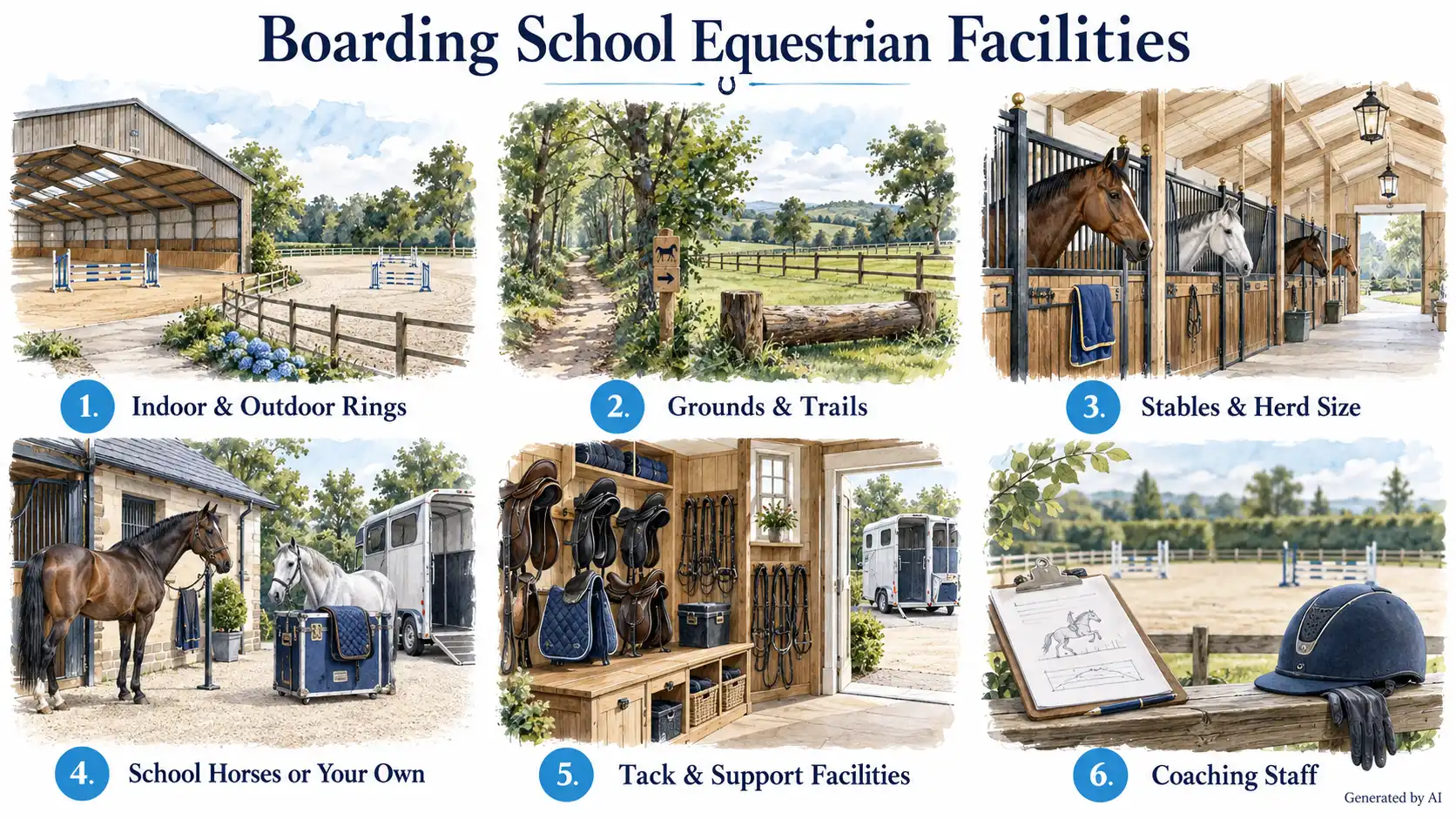
There are many types of equestrian facilities. Below are some of the key ones, and what to look at when comparing schools.
1. Indoor and Outdoor Riding Rings
An indoor riding ring is probably the most important facility to look at, especially for boarding schools in cold or wet climates, because it determines whether riding continues year-round or stops through the winter. Serious programs in New England, the Mid-Atlantic, and the Midwest almost always have one, and the number of separate training spaces matters more than the appearance of any single ring.
2. Outdoor Facilities and Grounds
Cross-country courses, hacking trails, turnout paddocks, and outdoor arenas all add to the daily riding experience and matter a lot for students interested in eventing. Schools on larger campuses tend to have more of these, and it is worth asking specifically what outdoor terrain is available before visiting.
3. Stables and Herd Size
The size of a boarding school's horse herd shapes both instruction quality and how many riders the program can take. A larger herd means more riders can be scheduled into lessons without horses being overworked, and the school can maintain horses at different levels, from steady schoolmasters for beginners to more forward horses for advanced riders. At established boarding schools with equestrian centers, school-owned herds commonly land in the 25 to 40 horse range, with the largest programs supporting 50 or more.
4. School-Owned Horses vs. Bring Your Own Horse
One of the most practical decisions when comparing boarding schools with horses is whether to rely on the school's herd or bring the student's own horse. Riding school-owned horses builds versatility and translates directly to IEA competition, where riders are assigned horses at random. Bringing a personally owned horse makes sense when a student has been riding seriously for years and wants continuity in that partnership, though schools that accept privately owned horses charge separately for boarding and care, and not every school accepts them.
5. Tack Rooms and Support Infrastructure
Tack rooms and support infrastructure are the less visible parts of an equestrian program, but they shape day-to-day life at the barn. For competitive programs, this extends to trailers for transporting horses to shows and coaching staff who travel with the team, and these are the details that separate a program that competes casually from one that competes seriously.
6. Coaching Staff
Facilities matter, but coaching staff is what shapes a rider's development most. A coach with a real competitive background, whether IEA experience in the US or British Horse Society credentials in the UK, brings knowledge that directly affects how far a student can progress. When researching boarding schools with equestrian programs, look at who the coaches are, how long they have been at the school, and whether they have experience working with riders at the level the student is aiming for.
Riding Disciplines at Boarding Schools
Boarding schools with equestrian programs offer instruction across different disciplines, and students can often try more than one during their time at school. The disciplines below are the most commonly offered, though not every school covers every discipline in depth.
1. Hunter/Jumper
Hunter/jumper and hunt-seat equitation are especially common among US boarding schools with riding programs, and both sit under IEA's Hunt Seat competition category. Hunter classes emphasize the horse's style, form over fences, and consistent rhythm, judged on a subjective standard of what a hunter should look like. Jumper classes are judged objectively on speed and clear rounds. The two disciplines share the same foundational riding skills, and students typically train in both during their time at school.
2. Dressage
Dressage focuses on the horse's precision and responsiveness, working through progressively more difficult tests in a marked arena. It is offered on both sides of the Atlantic, and the schools with strong dressage programs tend to have coaches who ride the discipline themselves at a competitive level.
3. Eventing
Eventing combines three phases, dressage, cross-country, and show jumping, tested across one or more days of competition. It is common at both US and UK boarding schools and is the most physically demanding of the mainstream disciplines. Eventing requires facility access to both an arena and cross-country schooling terrain. Schools with eventing programs typically sit on larger campuses with room for a cross-country course, or with access to nearby eventing facilities.
4. Show Jumping
Show jumping is particularly strong at UK boarding schools, where it has a long competitive tradition within independent school sport. Unlike hunter classes, which are judged on style, show jumping is judged purely on clear rounds and speed. Several UK boarding schools compete at a national level through the National Schools Equestrian Association (NSEA).
5. Western
Western riding is offered at a smaller number of boarding schools, mostly concentrated in the western United States and at schools with ranch traditions. Western programs cover trail riding, reining, and sometimes rodeo events like barrel racing. For students coming from a Western background, or for students interested in learning Western as a second discipline, the number of options is smaller but the programs at Western-strong schools are often distinctive.
6. Polo
Polo is rare at boarding schools but worth noting. Culver Academies is one of a small number of boarding schools in the US offering polo, with its own mounted program and facilities. In the UK, where polo has deep roots in independent school culture, Millfield in Somerset is one of the few boarding schools with its own polo facilities on campus, including a dedicated polo ground at its Kingweston Estate.
How to Choose an Equestrian Boarding School
1. Recreational or Competitive?
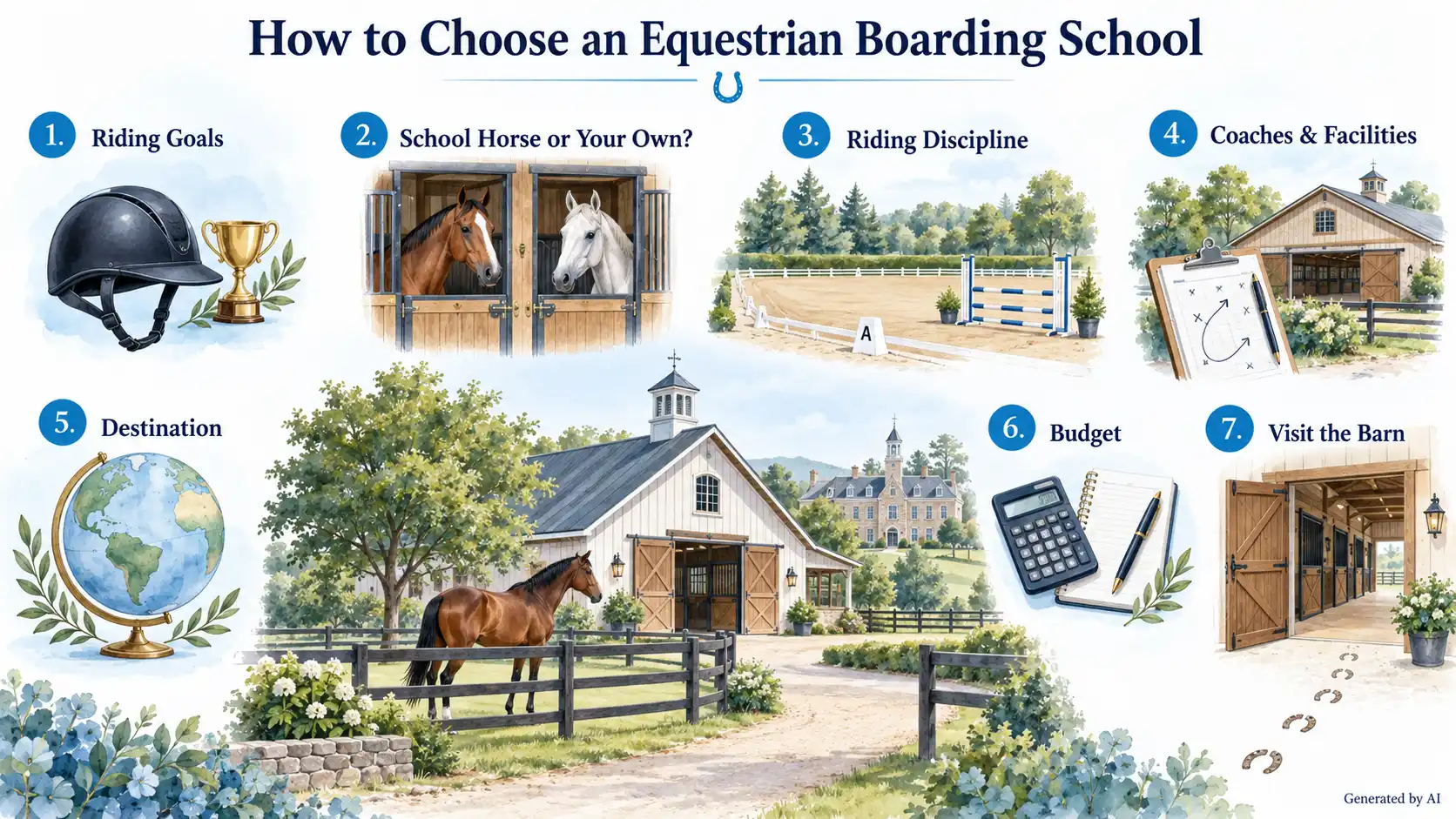
The first question to settle is whether the student wants to ride recreationally or competitively. Everything else follows from that. A student who wants to keep competing seriously needs a school with a deep program, strong coaches, and a competition calendar. A student who wants to ride for enjoyment needs a school with school-owned horses and a welcoming barn culture, not necessarily a flagship equestrian center.
2. School-Owned Horses or Bring Your Own?
If the student has their own horse, the shortlist narrows quickly to schools that accept privately owned horses and have the stable capacity to take them. If not, the focus shifts to the quality and size of the school's herd.
3. Which Discipline?
Not every boarding school with an equestrian program covers every discipline in depth. A student focused on dressage needs a school with a coach who rides dressage seriously. A student interested in eventing needs cross-country terrain on campus or nearby.
4. Program Depth vs. Facility Quality
A school can have beautiful facilities and a weak coaching staff, or modest facilities and coaches who bring out the best in every rider. Both matter, but they are not the same thing, and it is easy to focus too much on how polished a barn looks. Ask about the coaches first, then look at the facilities.
5. Which Destination?
US and UK boarding schools operate different competition systems and have different program traditions. European boarding schools with equestrian programs exist too, and for international families they are worth looking at alongside US and UK options.
6. Budget
Boarding a horse on campus is an added cost on top of tuition, and it covers things like feed, farrier visits, and veterinary care. Even families relying on the school's own herd should ask what, if anything, is included in tuition versus billed separately, since this varies by school.
7. Visit the Barn
A campus tour covers the academic buildings and dorms, but the barn tells you a lot about how seriously a school takes its equestrian program. The condition of the stables, the horses, and the facilities, and a conversation with the coaching staff, will tell you more than any brochure.
Ready to Start Looking?
For families ready to start building a shortlist, McMillan Education's Boarding School Guide lets you browse boarding schools with equestrian programs and narrow by region, campus size, gender, and other criteria. The comparison tool makes it easy to put a few schools side by side once the shortlist is down to a handful.
For families who want guidance through the admissions process and the decision between programs, our boarding school admissions consultants have decades of experience placing students in boarding schools with specialized equestrian programs.
Speak with a boarding school admissions consultant to start planning.
Frequently Asked Questions
1. What is an equestrian boarding school?
An equestrian boarding school is a boarding school that offers riding as a structured part of school life, either through an on-campus facility or a school-managed partnership with a nearby barn, not something students arrange off campus on their own. Most have stables and at least one riding ring on site, along with coaches who work with students regularly. Programs range from a modest barn tucked into a bigger boarding school to a full equestrian center that shapes the school's identity.
2. Do I need my own horse to join an equestrian program at boarding school?
No. Most equestrian boarding schools keep a herd of school horses that any student can ride, so a family doesn't need to own or lease a horse to get a student into lessons or even competition. Schools that do accept privately owned horses bill boarding and care separately from tuition.
3. What riding disciplines are offered at boarding schools?
Hunter/jumper and hunt-seat equitation are especially common at US schools, with dressage and eventing offered at a smaller number of programs that have the coaching and facilities to support them. UK schools lean more toward show jumping and, at a few schools, polo. Western riding shows up mainly at schools in the western US or with a ranch background.
4. Can beginner riders join an equestrian program at boarding school?
Yes, most programs are set up to take riders at any level, including students who have never been on a horse. Coaching is grouped by skill level, so beginners aren't thrown in with students who already compete.
5. How does riding fit into the boarding school daily schedule?
Riding usually happens during the same afternoon block used for other sports and activities at boarding school. Students on the recreational track might ride a few afternoons a week, while students on the competitive track add weekend training and travel for shows during their season.
6. Are equestrian boarding schools only in the US?
No. The US has the most schools with equestrian centers, concentrated in New England, the Mid-Atlantic, and the western states, but the UK has its own strong tradition, and there are options in continental Europe as well. Families researching internationally have real choices beyond the US.