Boarding Schools for Athletes: How to Find the Right Sport, Program, and Level for Your Child
Families searching for boarding schools for athletes are usually asking one of two different questions. Some want to know if a school takes their child's sport seriously enough to keep them competing and improving. Others want to know if their child can simply keep playing a sport they love, without being pushed into a recruiting track they never wanted. Both questions are common, and sports in private schools cover a wide range of programs built to answer each one.
This article breaks down boarding school sports by category across the US and internationally, explains the difference between a participatory athletic program and a competitive one, covers how the recruiting process actually works, and points to what to look for once a family narrows down which kind of program fits their child best.
Boarding Schools Offering Team Sports
Boarding schools with team sports programs span the full range, from sports available at nearly every school to those offered at only a handful. Browse the table to find schools offering your child's sport.
|
Sport |
US Boarding Schools Offering Program |
|
105 schools |
|
|
104 schools |
|
|
85 schools |
|
|
76 schools |
|
|
67 schools |
|
|
52 schools |
|
|
47 schools |
|
|
9 schools |
|
|
4 schools |
|
|
2 schools |
|
|
1 school |
Boarding Schools Offering Individual Sports
Several individual sports, including squash and fencing, are almost exclusively available within private school settings. Browse the table to find schools offering your child's sport.
|
Sport |
US Boarding Schools Offering Program |
|
101 schools |
|
|
96 schools |
|
|
81 schools |
|
|
71 schools |
|
|
44 schools |
|
|
12 schools |
|
|
2 schools |
Boarding Schools Offering Water Sports
Water sports concentrate at schools where campus geography makes them possible, from widely available swimming programs to sailing at only a small number of coastal campuses. Browse the table to find schools offering your child's sport.
|
Sport |
US Boarding Schools Offering Program |
|
53 schools |
|
|
46 schools |
|
|
3 schools |
|
|
2 schools |
Boarding Schools Offering Winter and Mountain Sports
Winter and mountain sports depend on geography more than any other category in boarding school athletics, concentrated at schools in northern states with access to ice and mountain terrain. Browse the table to find schools offering your child's sport.
|
Sport |
US Boarding Schools Offering Program |
|
44 schools |
|
|
7 schools |
|
|
3 schools |
|
|
1 school |
Participatory and Competitive Boarding School Sports
Boarding school athletes generally pursue their sport along one of two paths:
Some play because sport is central to who they are as students, and boarding school gives them the structure and infrastructure to keep playing at a serious level. This is the participatory track, also commonly called recreational.
Others arrive already training toward college recruiting, an elite competitive circuit, or a pre-professional pathway. This is the competitive track.
The school decisions that serve each path well are different, and knowing which path applies is where most boarding school athletic research should start.
Sports in private boarding schools are a required part of the daily schedule at most boarding schools, built into a dedicated afternoon block that runs across the academic year. Schools maintain teams at multiple levels within the same sport: varsity at the top, followed by junior varsity (JV) and, at many schools, a third level sometimes called thirds, reserves, or developmental. A student who is not in contention for a varsity spot plays the sport on a real school team, with structured practices and scheduled games against other schools.
At most public and day schools, sub-varsity participation is limited by roster caps and cut structures. Boarding schools operate differently. Because afternoon athletic participation is a school-wide expectation, teams exist at every level, and the sport becomes part of the daily rhythm of school life.
1. Participatory Sports at Boarding Schools
Sports that suit the participatory track fall into three broad categories across the boarding school landscape. Some are widely offered across all team tiers: soccer, basketball, lacrosse, tennis, cross country, and swimming give students a clear place to play regardless of ability level, from varsity through to thirds.
Others are difficult to access outside a private school setting: rowing, sailing, fencing, and squash are sports a student can learn and play at boarding school without any intention of competing at the college level, because the infrastructure, boat houses, courts, and coaches, is already part of daily campus life.
A third category is tied to geography: skiing, mountain biking, and ice hockey at schools with on-campus rinks or mountain proximity give students access to programs that most public schools cannot sustain.
1.1 Finding Schools for Participatory Athletes
When researching schools for a student on the participatory athletic track, the clearest thing to look for is how deep a school goes within each sport, not how well its top team performs.
How many teams the school fields in each sport. A school fielding varsity, JV, and thirds is building athletic culture across the student body.
Whether the afternoon requirement includes open-participation options alongside varsity teams.
What the school emphasizes on its athletics pages. Schools that lead with participation rates and multi-tier programs are telling families something concrete about how they approach sport across all ability levels.
Browse boarding schools by sport.
2. Competitive Sports at Boarding Schools
Some students arrive at boarding school already training toward college recruiting, an elite competitive circuit, or a pre-professional pathway. Boarding schools serve this student through more concentrated coaching, more demanding competition schedules, and a school day structured so that training and academics reinforce each other. Private boarding schools can and do recruit athletes into their student body, and this is common in ice hockey, football, lacrosse, and basketball at schools known for those programs.
Competitive-track students play at the varsity level, competing in leagues sanctioned by organizations such as the New England Preparatory School Athletic Council (NEPSAC), which serves preparatory schools across New England, or equivalent regional associations outside New England. Some schools specialize further, running programs that function as pre-professional development environments in a single sport, structuring the academic calendar around competition and training, and regularly accepting PG students seeking an additional year of development before college.
Sports with the strongest competitive infrastructure at the boarding school level are those with well-established college recruiting pipelines, such as lacrosse, ice hockey, football, rowing, and squash, where schools participate actively in the showcase and tournament circuit where college coaches evaluate candidates.
Sports with specialized facility requirements, skiing, sailing, and rowing among them, concentrate their competitive programs at a smaller number of schools where the infrastructure exists, and for a student competing seriously in one of these sports, facility access often drives the school decision as much as coaching does.
2.1 Finding Schools for Competitive Athletes
When researching schools for a student on the competitive athletic track, the most useful place to start is the school's recent college placement in the specific sport, not its general athletic reputation.
The head coach's background and tenure. Coaches with college coaching experience or active recruiting relationships with college programs bring a level of access and credibility that directly affects a student's recruiting visibility.
The league and classification level in which the school competes. NEPSAC and comparable associations classify schools by competition level within each sport, and league affiliation reflects the standard the program operates at.
The school's recent college placement in the specific sport. Schools that publish sport-by-sport varsity matriculation lists are providing the most direct evidence of where their athletes go.
Whether the school offers a PG year in the sport. This signals that the school has the infrastructure and commitment to support athletes beyond the standard four-year program.
Browse boarding schools for student athletes.
The Boarding School Athletic Recruiting Process
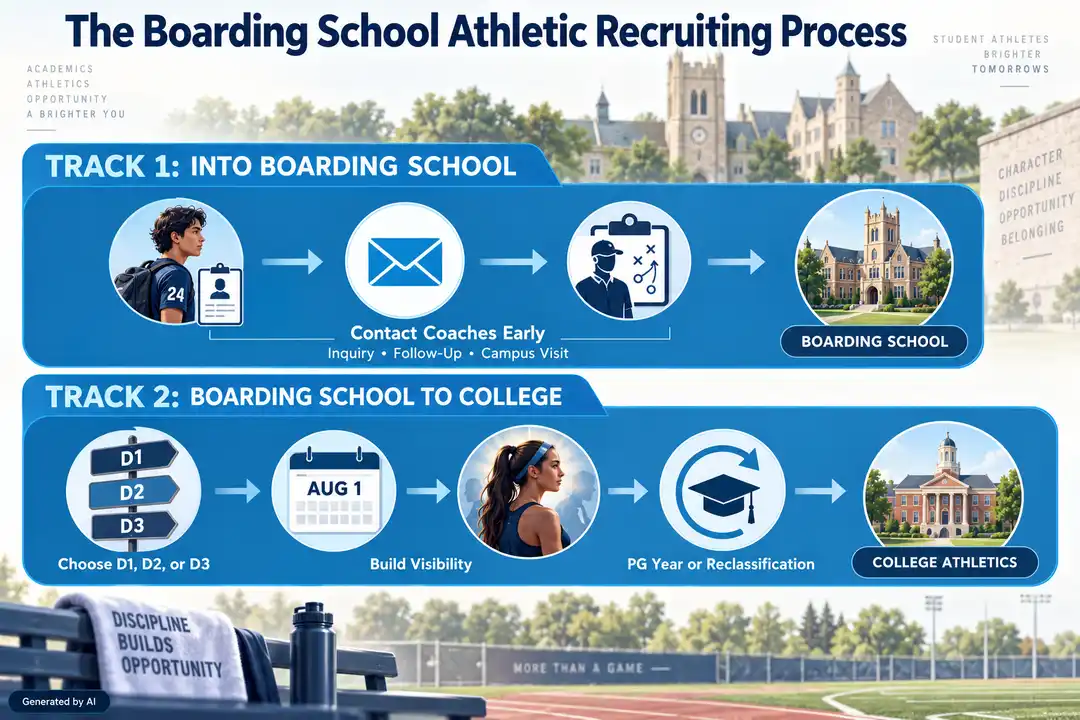
Athletic recruiting at the boarding school level runs on two separate tracks: getting recruited into a boarding school as an athlete, and getting recruited from boarding school into college. Both have their own process, and understanding each one separately is where to start.
1. Reach Out to Coaches Early
The first step for a student being recruited into a boarding school is contacting the athletic program directly, either through the athlete inquiry form on the school's athletics page or by emailing the coach. Boarding school coaches receive high volumes of inquiries, particularly in competitive sports like ice hockey, so early outreach and consistent follow-up give candidates a meaningful advantage. Coaches who express interest will typically invite the student for a campus visit, a game, or a conversation before formally advocating for them in the admissions process.
2. Know Which College Division You Are Targeting
The NCAA divides member colleges into Division I, II, and III. Division I is where most athletic scholarships are concentrated. Division II offers a mix of scholarship and non-scholarship programs. Division III carries no athletic scholarships and is where the largest number of college athletes actually compete. Which division a student is realistically targeting shapes every program and school decision that follows.
3. Understand When College Recruiting Contact Can Begin
For most sports, direct coach-to-athlete communication opens on August 1 before the athlete's junior year, making sophomore and junior year the critical window for building visibility. Football, basketball, and men's ice hockey follow modified timelines.
4. Consider Whether a PG Year or Reclassification Makes Sense
The postgraduate (PG) year allows a student who has already completed high school to enroll at a boarding school for a fifth year before beginning college, gaining an additional competitive season and building further visibility with college programs. Reclassification, repeating a year before graduation rather than adding one afterward, produces a similar outcome within the standard four-year sequence.
Families can work through this process independently with the W.I.S.E. Admissions Playbook™ Athletic Recruiting course, or speak with an athletic recruiting consultant.
Sports at Boarding Schools Around the World
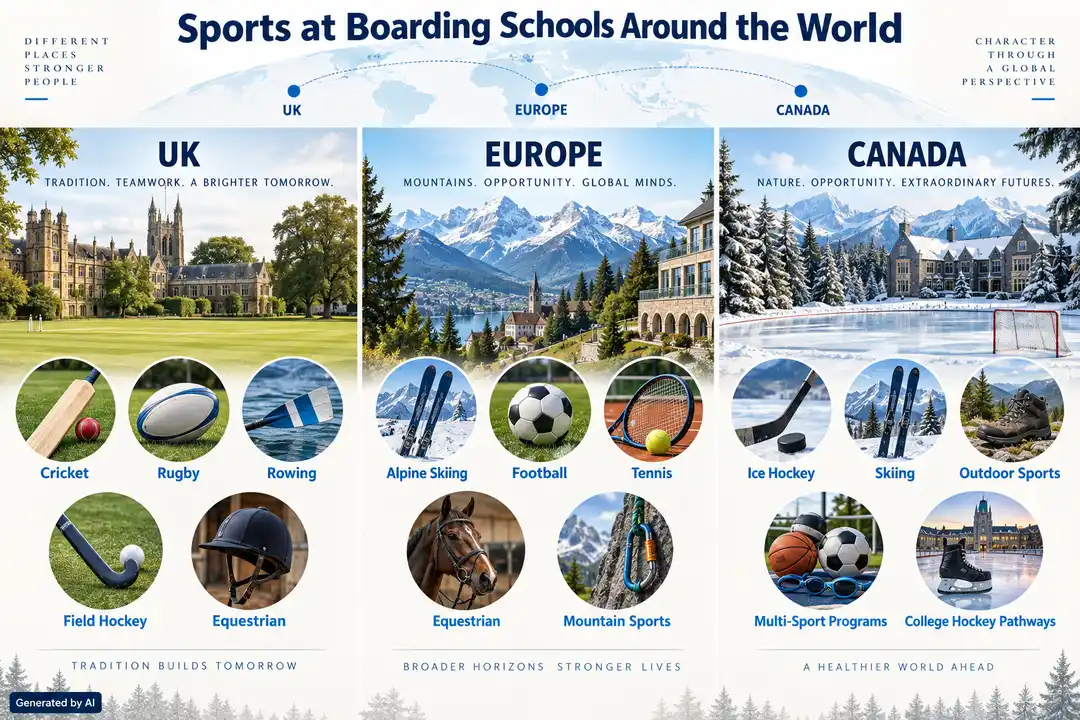
Boarding school athletics differs meaningfully by country. Sport traditions, competition structures, and program depth vary across regions, and families whose search is not US-limited can explore boarding school athletic programs across the UK, Europe, and Canada.
1. UK Boarding School Sports
UK boarding schools center their athletic programs on cricket, rugby, rowing, field hockey, and equestrian sports, with competition operating through independent school leagues and national school championships. Many of the most established schools maintain dedicated cricket grounds, rugby pitches, boat houses, and equestrian facilities on campus.
2. European Boarding School Sports
European boarding school athletics concentrate around country-specific strengths. Switzerland leads in alpine skiing and mountain sports, with several schools located near major ski resorts and structured to accommodate serious competitive skiing alongside academics. Across the rest of Europe, boarding schools compete in football, tennis, and equestrian disciplines, with facility access and geographic setting shaping which sports each school takes seriously.
Browse European boarding schools.
3. Canadian Boarding School Sports
Canadian boarding schools have strong ice hockey pipelines alongside broad multi-sport programs similar to the US prep school model. Several Canadian schools operate hockey programs recognized as feeders into US collegiate and junior hockey systems, and the country's geography supports strong skiing and outdoor sport traditions across schools in Ontario, Quebec, and British Columbia.
Browse Canadian boarding schools.
How to Choose a Boarding School Without a Single Sport in Mind
Some students play several sports without specializing. Others have not found a sport yet at all. Both situations call for a different search approach than starting with one sport in mind.
For a student who plays several sports without specializing, the more useful question is not which sport to search for, but how many sports a school lets a student rotate through across the year. Schools with strong participation across boarding school sports let a student play one sport in the fall, another in the winter, and another in the spring, without being pushed toward specializing before they are ready. A school built around one flagship program works differently, with athletic culture and coaching attention concentrated on a single sport.
For a student who has not found a sport yet, the more useful signal is a school with deep participatory infrastructure across many sports rather than one standout program. A school where multiple sports offer real varsity, JV, and thirds-level teams gives a student room to try different sports across seasons and years, and the right fit often becomes clear once a student is actually on campus experiencing the options.
In both cases, the school matching quiz is a useful starting point, factoring in athletic goals alongside academics, campus size, and other preferences without requiring a specific sport in the search.
Find a Boarding School for Your Athlete
For families ready to start building a shortlist, the Boarding School Guide's school finder, school matching quiz, and comparison tool are the right starting point.
For families who want guidance through the admissions process, the recruiting timeline, and the decision between programs, McMillan Education's consultants have spent decades placing students in boarding schools across the US and internationally. Speak with a boarding school admissions consultant to start planning.
Frequently Asked Questions
1. What makes boarding schools good for athletes?
Boarding school athletics is built into the daily schedule rather than treated as an after-school activity. At most boarding schools, every student participates in a sport or structured athletic activity during a dedicated afternoon block, schools maintain teams at multiple levels within the same sport, and coaching is often available across all tiers rather than concentrated only at the varsity level. For competitive athletes, boarding schools offer access to high-level competition leagues, college recruiting infrastructure, and in some cases pre-professional development programs that do not exist in the public school system.
2. What sports are available at boarding schools?
Boarding school sports cover a wide range, from widely available team sports like soccer, basketball, and lacrosse to specialized programs in rowing, sailing, fencing, squash, and skiing that are difficult to access outside a private school setting. The availability of each sport varies significantly by school and region. The tables in this article show exactly how many US boarding schools currently offer each sport, organized by category.
3. Are sports in private schools different from public schools?
In several ways, yes. Private boarding schools integrate athletics into the school day as a requirement rather than an optional after-school activity. They maintain tiered team structures that give students at every ability level a place to play. They also offer sports that require infrastructure most public schools cannot sustain, including rowing, sailing, equestrian, fencing, and squash. For competitive athletes, private boarding schools provide access to recruiting-focused leagues, coach networks, and postgraduate development programs that have no public school equivalent.
4. What are the best boarding schools in the US for sports?
The right boarding school for a specific athlete depends on the sport, the level of competition, and whether the student is on a participatory or competitive track. A school that is a strong choice for a competitive ice hockey player is not necessarily the right choice for a student who wants to row recreationally. The McMillan Education Boarding School Guide's school finder, school matching quiz, and comparison tool are built to surface the right schools for a specific student's situation rather than a generic ranked list.
5. Can private boarding schools recruit athletes?
Yes. Private boarding schools can and do recruit athletes into their student body, and this is common in sports like ice hockey, football, lacrosse, and basketball at schools with established programs in those sports. The process typically begins with a student contacting the coach directly through an inquiry form or email, and coaches who express interest in a candidate will advocate for them through the admissions process. Being recruited by a boarding school is distinct from being recruited by a college, and the two processes operate on separate timelines.
6. Does a student need prior experience to join a sport at boarding school?
For participatory-track sports, generally no. Boarding schools maintain teams at multiple levels precisely because afternoon athletic participation is a school-wide expectation, and they need room for students at every ability level. Some sports with limited public school access, such as rowing or sailing, welcome beginners at the sub-varsity level. For competitive-track programs and varsity spots, prior experience and demonstrated ability are expected, and coach contact before applying is the standard first step.