Full, Weekly, and Flexible (Flexi) Boarding Explained: Types of Boarding Around the World

Boarding school used to mean one arrangement: a student moved in at the start of term and came home for the holidays. That arrangement, full boarding, still exists, but schools now offer other options alongside it. Some students board from Monday to Friday and spend weekends at home, others live at home and sleep at school two or three nights a week, and some stay over only when a late rehearsal or an early match makes it easier. Schools call these weekly boarding, flexible (flexi) boarding, and occasional boarding, although the names, and what each one actually includes, change from school to school and from country to country.
This article explains each type of boarding and what it is called in the UK, Switzerland, the US, and Canada, compares full, weekly, and flexi boarding side by side, and sets out the questions that decide which arrangement works for a family.
What Are the Different Types of Boarding?
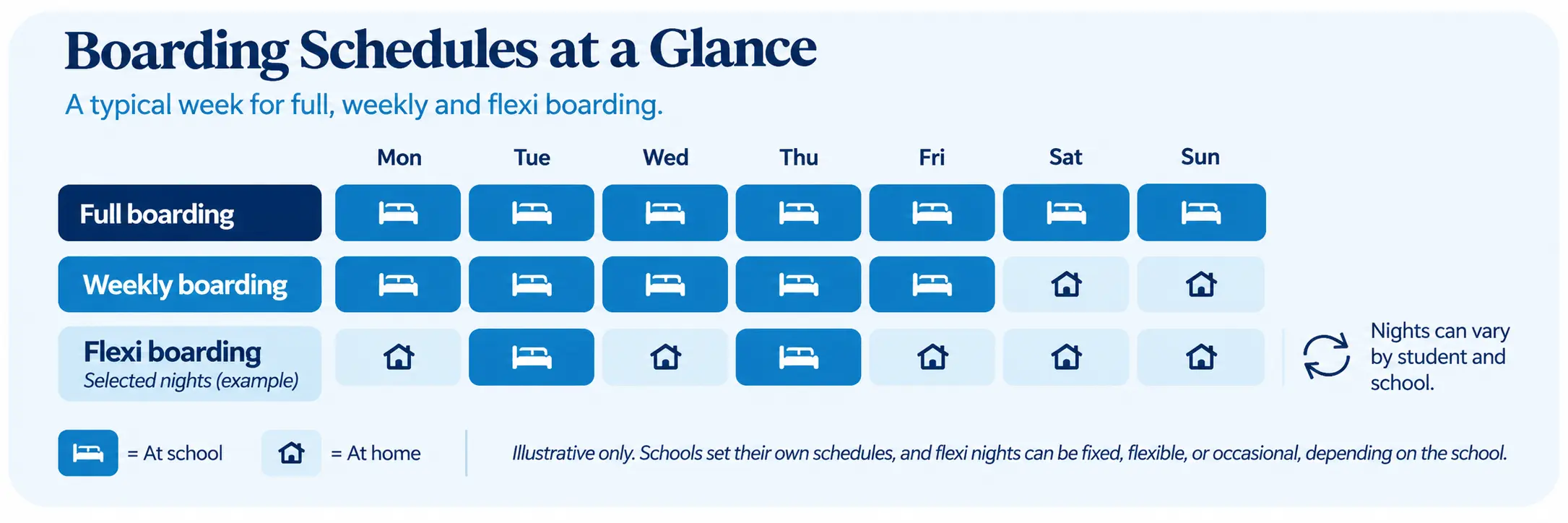
Boarding schools describe their options by how many nights a student sleeps on campus, and the main arrangements are:
Full boarding: every night of term, with weekends at school apart from scheduled weekends home and holidays.
Weekly boarding: school nights at school and weekends at home, known as 5-day boarding in the US and Canada.
Flexi boarding: a set number of nights at school each week, with the rest at home.
Occasional boarding: single nights booked when needed, depending on a free bed.
Day boarding: a long school day with dinner and supervised study, without an overnight stay.
The Same Arrangement Under Different Names
What a boarding arrangement is called depends largely on where the school is. UK schools speak of full, weekly, and flexi boarding, while schools in the US and Canada name boarding by the number of days a student spends on campus, so weekly boarding becomes 5-day boarding and full boarding becomes 7-day boarding, although “full boarding” appears in the US as well.
Swiss schools, with their mix of British and American school traditions, use both sets of terms. Within a single country, the vocabulary is looser still, since UK schools may describe flexi boarding as part-weekly or part-time boarding or give it a name of their own, and some US schools offer overnight stays to day students without calling it flexi boarding at all. Behind every label, the terms are set by each school.
| Arrangement | UK | Switzerland | US | Canada |
|---|---|---|---|---|
| Full | Full boarding | Full boarding or 7-day boarding | 7-day boarding or full boarding | 7-day boarding |
| Weekly | Weekly boarding | Weekly boarding or 5-day boarding | 5-day boarding | 5-day boarding |
| Flexi | Flexi (flexible), part-weekly, or part-time boarding | Flexi boarding at some schools | Overnight stays for day students at some schools | Part-week boarding at some schools |
| Occasional | Occasional or ad hoc boarding | No standard term | No standard term | No standard term |
What Is Full Boarding?
Full boarding means a student lives at school seven nights a week for the whole term. Full boarders go home for exeat weekends, which are scheduled weekends during term when boarders leave school, as well as for half-term breaks in the middle of each term and for holidays. Schools in the US and Canada call the same arrangement 7-day boarding. It remains the most common arrangement at UK independent schools, particularly among older students: according to the ISC Census 2026, 86% of sixth form boarders are full boarders.
For the student, a full boarding school makes the boarding house home for the term, weekends included. Of all the arrangements, full boarding gives a student the fullest share of the benefits of boarding schools, since the house, its routines, and its weekends become part of everyday life.
Full Boarding in the UK and Europe
In the UK, the boarding term is broken up by exeat weekends, scheduled weekends during term when boarders leave school to go home, much like a long weekend at a US school. Most terms also include a half-term break of about a week. Some schools let full boarders go home on other weekends too, with their parents’ consent. Boarding schools elsewhere in Europe, many of them international schools whose boarders come from abroad, build weekends around trips and activities on and off campus.
Browse boarding schools in the UK.
How to apply to UK boarding schools.
Browse boarding schools in Europe.
How to apply to Swiss boarding schools.
7-Day Boarding in the US and Canada
In the US and Canada, 7-day boarders stay on campus through weekends and go home for school vacations, with weekends shaped by the school’s own activities program. At some schools, 7-day boarding is the only arrangement open to international students, as at The Stony Brook School in New York, where students from overseas board seven days a week while domestic families can also choose a five-day option.
Browse boarding schools in the US.
How to apply to US boarding schools.
Browse boarding schools in Canada.
How to apply to boarding schools in Canada.
Weekend Life for Full Boarders
For a full boarder, weekends are as much a part of school life as the week itself. At many UK schools, Saturdays begin with lessons or sports matches, and the rest of the weekend fills with house events, trips, and time with friends, organized around the students who stay. Some schools run a full program of weekend activities for their boarders, some set aside weekends when every boarder stays in school, and others build trip weekends into the calendar. How full those weekends feel depends largely on how many students board, since a campus where most students live on site feels very different on a Sunday from one that empties after Saturday’s matches.
The schools in the McMillan Education Boarding School Guide show how wide that range is. Earlscliffe in Kent boards 103 of its 104 students, while Brighton College boards 505 of its 1,275, so full boarders at the two schools share their weekends with very different numbers of classmates. Boarding numbers can be checked on every school profile and set side by side in the comparison tool.
What Is Weekly Boarding?
Weekly boarding means a student lives at school during the school week and goes home at weekends. For the student, the week has the structure of boarding, with supervised evening study, house life, and activities, and no daily commute, while weekends are spent at home with family. Schools in the US and Canada offer the same arrangement as 5-day boarding, and each school sets the start and end of its own week.
Weekly Boarding Schools in the UK and Europe
At UK weekly boarding schools, the week runs from Sunday evening or Monday morning until Friday or Saturday, and the number of nights it covers varies from one school to the next. Some schools elsewhere in Europe offer the arrangement too, under the name weekly boarding or 5-day boarding. The schools below each offer weekly boarding and are listed in the McMillan Education Boarding School Guide. They are illustrative examples, with many more in the full directory, and each sets its own weekly pattern. Click any school name to view its full profile.
Brighton College (Brighton, East Sussex): weekly boarders can leave on Friday and return on Monday morning, and can also come back on Sunday or stay for additional weekends.
King’s School Rochester (Rochester, Kent): weekly boarders leave on Friday afternoon and return by 6 p.m. on Sunday, alongside flexi and occasional boarding options.
Lomond School (Helensburgh, Argyll and Bute, Scotland): weekly boarders leave on Friday evening and return on Sunday night or early Monday.
Pangbourne College (Pangbourne, Berkshire): weekly boarding covers six nights a week, with a four-night part-boarding option.
St Swithun’s School (Winchester, Hampshire): a girls’ school an hour’s drive from London, with a London bus on Friday afternoon and Sunday evening.
Taunton School (Taunton, Somerset): five-night weekly boarding alongside three-night flexi boarding.
Browse weekly boarding schools in the UK.
Browse weekly boarding schools in Europe.
5-Day Boarding Schools in the US and Canada
In the US and Canada, weekly boarding is called 5-day boarding, and schools design it for families within driving distance of campus. The schools below each offer 5-day boarding and are listed in the McMillan Education Boarding School Guide. They are illustrative examples, and each school sets its own schedule and eligibility. Click any school name to view its full profile.
The Masters School (Dobbs Ferry, New York): five-day boarders live on campus from Sunday evening through Friday.
Stoneleigh-Burnham School (Greenfield, Massachusetts): a girls’ school whose 5-day program is designed for families within about a 90-minute drive.
Blue Ridge School (St. George, Virginia): a boys’ school where five-day boarders leave at 3 p.m. on Friday and return by 5 p.m. on Sunday.
Fountain Valley School (Colorado Springs, Colorado): a 5-day program designed for Colorado families, particularly in the Front Range and Denver area.
Admiral Farragut Academy (St. Petersburg, Florida): five-day boarders stay Sunday through Thursday nights and return by 6 p.m. on Sunday.
Trafalgar Castle School (Whitby, Ontario): a girls’ school offering five-day boarding to Ontario families, with students on campus Sunday through Thursday nights.
Albert College (Belleville, Ontario): students can board from one to five days a week.
Browse 5-day boarding schools in the US.
Browse 5-day boarding schools in Canada.
Saturday Lessons and When Weekly Boarders Go Home
Saturday commitments decide how long a weekly boarder’s weekend lasts. At schools with Saturday lessons or sports, weekly boarders stay until those commitments end, and some schools keep them on campus on Friday night ahead of a Saturday game or class. Where nothing is scheduled for Saturday, the weekend can begin on Friday afternoon, and for a family comparing schools, that difference adds up to a full day at home each week.
Search schools with Saturday classes here.
Weekly Travel and Weekend Life
A weekly boarder belongs to two communities, the boarding house during the week and the family at weekends. From Sunday or Monday until the weekend, the student lives as a full member of the house, with the same evening study, meals, and activities as every other boarder. At weekends, the student steps away from the trips and house events that full boarders share. That suits a student with commitments at home, and can leave a student who wants the full social life of a school feeling that part of it happens without them.
Some schools keep weekly boarders connected to weekend life by inviting them to stay for particular weekends or to join weekend activities once a month. Each school profile in the McMillan Education Boarding School Guide describes weekend life in detail under Campus Life, so families can see what a weekly boarder would be leaving behind on Friday.
What Is Flexi Boarding?
Flexi boarding, also called flexible boarding, means a day student sleeps at school on a set number of nights each week, such as two or three, booked in advance. Families choose it when parents work late, when evening rehearsals or sports make the trip home impractical, or when a student wants to try boarding before committing to more nights.
For the student, flexi boarding offers a share of boarding life without leaving home. On boarding nights, a flexi boarder joins the house for dinner, supervised study, and evening activities, and returns to day-student life the next morning. What flexi boarding cannot offer is the continuity of living in the house, and how much of a place a flexi boarder has there depends on how the school runs it.
How Flexible Boarding Works: Three Common Models
Ask three schools about flexi boarding and you may get three different answers, because each school writes its own rules. Most of what families come across falls into one of three patterns:
Set nights each week, booked by the term: the student boards on the same nights every week, such as a three-night package booked at the start of each term.
An allowance of nights per term or year: the fee covers a number of stays, and the family uses them as needed.
Pay per night, booked as needed: families book and pay for individual nights, the model schools describe as occasional boarding.
A student who boards the same nights each week has a settled place in the house, and at some schools a bed of their own in the boarding school dorms, with space to leave belongings between stays. At other schools, flexi boarders may sleep wherever a bed is free and take their things home after each stay. How many nights the fee covers, whether a bed is reserved, and how far ahead nights must be booked are the questions that separate one school’s flexi boarding from another’s.
Occasional and Part-Time Boarding
Occasional boarding, an arrangement found mainly at UK schools, is part-time boarding at its lightest. A day student stays over for a single night when it makes life easier: a concert that runs late, a match with an early start, or a week when parents are traveling for work. There’s no commitment beyond that night, but there’s no guarantee either, since the stay depends on a bed being free.
Schools draw the line between this and flexi boarding by how regular the stays are, so a one-off night counts as occasional and the same night every week counts as flexi. Some schools even include a couple of free nights a term in the day fee.
Flexi Boarding Schools in the UK and Europe
Flexi boarding is most established in the UK, and particularly at prep schools, where it gives younger children their first nights away from home. Outside the UK, the same idea appears under other names, such as part-week boarding at some Canadian schools and overnight stays for day students at some US schools. The schools below each offer flexi or occasional boarding and are listed in the McMillan Education Boarding School Guide. They are illustrative examples, and each sets its own terms. Click any school name to view its full profile.
Embley (Romsey, Hampshire): flexi boarding from Year 7, with a bed and space kept for each flexi boarder between stays.
King’s School Rochester (Rochester, Kent): flexi and occasional boarding offered as separate options alongside weekly boarding.
Lomond School (Helensburgh, Argyll and Bute, Scotland): flexible stays booked on a regular basis or as one-off nights.
St Swithun’s School (Winchester, Hampshire): flexi boarding for day students from Year 7, subject to beds being available.
Taunton School (Taunton, Somerset): three-night flexi boarding alongside five-night weekly boarding.
Full vs. Weekly vs. Flexi Boarding: How They Compare
The table below compares full, weekly, and flexi boarding on the points that decide the choice for most families: nights at school, weekends, distance from home, fees, and who each arrangement suits.
| Full boarding | Weekly boarding | Flexi boarding | |
|---|---|---|---|
| Nights at school | Every night of term | 4–6 a week in the UK; 5 in the US and Canada | A set number each week, an allowance per term, or single nights |
| Weekends | At school, apart from exeats and holidays | At home, from Friday or after Saturday commitments | At home |
| Distance from home | Any, including overseas | Within driving distance for a weekly trip | Within daily commuting distance |
| A bed of their own | Yes | Yes | At some schools |
| Fees | The full boarding fee | The same as full boarding at some schools, lower at others | A termly fee based on nights, or a nightly charge |
| Open to families overseas | Yes | At some schools, only to families living in the same country | In practice, families living nearby |
| Most common among | Older students, especially in the sixth form | Students across age groups | Younger students, especially at prep schools |
Each school sets its own terms within these patterns, and the boarding options for every school are listed on its profile in the McMillan Education Boarding School Guide, with the comparison tool setting up to three schools side by side.
Which Boarding Type Suits Which Family?
Full boarding suits students who want the complete boarding experience, weekends included, and families who live far from school or overseas, for whom it is often the only arrangement on offer.
Weekly boarding suits families within a drive of school who want weekday structure without giving up weekends together.
Flexi boarding suits younger students taking their first steps into boarding, and families who need a few nights a week to make work or a busy schedule manageable.
Whichever arrangement a family has in mind, one check is worth making early: weekly and flexi places are limited and depend on available beds, so a school that offers them may have none open in a given year. Which schools hold those places, and when they fill, is the kind of detail boarding school consultants follow from year to year. When a child is ready to board at all is its own question, and boarding school age varies by country and school system.
Find a Full, Weekly, or Flexi Boarding School
For families ready to start building a shortlist, McMillan Education’s Boarding School Guide lets them browse boarding schools by boarding arrangement and narrow the list by region, campus size, gender, and other criteria.
The school matching quiz adds a student’s goals to the search, and the comparison tool puts a few schools side by side once the shortlist is down to a handful.
For families searching for a boarding school with a particular arrangement, whether full, weekly, or flexi, McMillan Education’s boarding school admissions consultants bring seven decades of experience and a close knowledge of the schools themselves, from which schools hold weekly and flexi places to how boarding life differs from one house to the next.
Speak with a boarding school admissions consultant to start planning.
Frequently Asked Questions
1. Is weekly boarding the same as 5-day boarding?
Yes, weekly boarding and 5-day boarding describe the same arrangement: boarding during the school week and going home at weekends. “Weekly boarding” is the UK term, while schools in the US and Canada say “5-day boarding.” The arrangement is more common in the UK than in the US, where boarding schools are mainly built around 7-day boarding, and some Canadian schools offer it too. In the US, 5-day boarding runs from Sunday evening to Friday, while UK weekly boarding can cover four to six nights.
2. Do boarding schools in the US offer flexi boarding?
US boarding schools rarely use the term flexi boarding, and they organize boarding mainly as 5-day and 7-day options. Some US schools let day students stay overnight on set nights each week, which works much like flexi boarding without the name.
3. What is the difference between flexi boarding and occasional boarding?
In the UK, flexi boarding means staying at school on regular nights booked in advance, such as two or three nights every week, while occasional boarding means staying a single night when needed, such as before an early trip, depending on a bed being free. Some Canadian schools offer a similar arrangement as part-week boarding, where students board for a set number of days each week.
4. What is an exeat weekend at boarding school?
An exeat weekend is a scheduled weekend during term when boarders leave school. Exeats are a feature of UK boarding schools and fall alongside half-term breaks, giving full boarders regular time away from school during the term. Most boarders go home, while international students often stay with British friends, with relatives, or with a guardian.
5. What is a day boarder?
A day boarder is a student who stays at school into the evening for dinner, activities, and supervised study, then goes home to sleep. Many schools in Canada, and a few in the US, offer the same arrangement as an extended day program, with students picked up in the evening.
6. At what age can a child start flexi boarding?
Flexi boarding can start at age seven or eight at some UK prep schools, where it gives younger children their first nights away from home. Senior schools set their own starting points, and many offer flexi boarding from Year 7, at age 11 or 12.
7. How far from school should a family live for weekly boarding?
Weekly boarding works best for families within about an hour to 90 minutes’ drive of school, since it involves two trips every weekend. Schools in the US design 5-day programs around similar distances, and families farther away, including those overseas, generally choose full boarding.
8. Is weekly boarding cheaper than full boarding?
Weekly boarding is cheaper than full boarding only at schools that set a separate weekly rate. Many schools charge one boarding fee regardless of the number of nights. Where weekly boarding costs less, the expense of two trips every weekend narrows the difference.