Sixth Form Boarding Schools in the UK: Pathways, Example Schools and Entry at 16
Sixth form boarding schools in the UK admit students at 16 for the two years of study that lead to university entrance, offering A-levels, the IB Diploma or vocational qualifications alongside full, weekly or flexi boarding. Schools differ in the pathways they offer, how many places they open to new students in Year 12, and how they house and guide sixth formers through university applications, and those differences decide which schools belong on a shortlist.
This article explains what sixth form is, presents example sixth form boarding schools in the UK by academic pathway, and sets out the admissions timeline for entry at 16, what boarding life looks like at this stage, and where to begin the search.
What Is Sixth Form?
Sixth form is the final two years of secondary education in England, Wales and Northern Ireland, covering Year 12 (Lower Sixth) and Year 13 (Upper Sixth), when students are 16 to 18 years old. It usually begins after GCSEs, the exams students typically sit at the end of Year 11. Students taking A-levels generally study three or four subjects in depth, while those taking the IB Diploma study a broader range. Both are Level 3 qualifications in the UK framework. Sixth form can be taken at a school that also teaches younger year groups or at a standalone sixth form college.
In the American system, sixth form corresponds to grades 11 and 12, the last two years of high school. The way students study at this stage is one of the clearest differences between British and American schools: a US high school student typically continues across a broad range of subjects until graduation, while an A-level student usually specializes in three or four. Scotland follows its own system, in which the final years are known as S5 and S6, and British-curriculum schools in other countries also run sixth forms.
Sixth Form Boarding Schools in the UK by Pathway
Sixth form is one of the main entry points to boarding. The schools below each offer sixth form boarding and are listed in the McMillan Education Boarding School Guide, grouped by the academic pathway they offer in the sixth form. They are illustrative examples, with many more in the full directory, and programs differ widely in size, subject range and the number of places open to new students at 16. Click any school name to view its full profile.
State boarding schools also admit sixth formers, with tuition free and families paying only for boarding, though places are limited to UK nationals and students with the right of residence in the UK.
A-Level Sixth Forms
A-levels remain the main route through sixth form, with students committing to a small set of subjects for two years and universities making offers on predicted grades and confirming them on final results. Several A-level sixth forms also offer BTECs, career-focused courses assessed through coursework and practical work, which students can take alongside A-levels. Examples of A-level boarding schools in the UK include:
Concord College (Shrewsbury, Shropshire): an academically selective school with an international community of more than 40 nationalities, where every boarder has a single study bedroom, and boarders stay on campus at weekends.
Gordonstoun (Elgin, Moray, Scotland): a co-ed full boarding school in the north of Scotland that follows the English examination system, with A-levels and BTECs in the sixth form and outdoor education, sail training and community service built into the curriculum.
Millfield School (Street, Somerset): a co-ed school for ages 13 to 18 with 19 boarding houses, two of them reserved for sixth formers, and single rooms for students in the Upper Sixth.
Bedales School (Petersfield, Hampshire): a co-ed school with no uniform and first-name terms between students and staff, where Year 13 boarders move into a co-ed house run closer to a university hall of residence.
St Swithun's School (Winchester, Hampshire): a girls' school an hour from London, where students can board full-time, during the week or on selected nights.
Radley College (Abingdon, Oxfordshire): a boys' full boarding school for ages 13 to 18, where each of the 11 boarding houses is run by a Tutor alongside a resident Sub-Tutor and a Pastoral Housemistress.
Cheltenham College (Cheltenham, Gloucestershire): a co-ed school for ages 13 to 18 where sixth formers choose from around 30 qualifications, including A-levels and BTECs, and every student completes a project-based qualification such as the Extended Project.
IB Sixth Forms
The IB Diploma asks students to carry six subjects for two years, together with the Extended Essay, Theory of Knowledge, and Creativity, Activity, Service (CAS), and some schools build their entire sixth form around it in place of A-levels. These schools also offer the IB Career-related Programme, which pairs IB courses with a career-related qualification. Examples of IB boarding schools in the UK include:
St Leonards (St Andrews, Fife, Scotland): a co-ed school for ages 4 to 18 that teaches the IB in place of A-levels, where sixth formers choose between the IB Diploma and the IB Career-related Programme, the latter combined with a BTEC in Business.
Lomond School (Helensburgh, Argyll and Bute, Scotland): a co-ed school for ages 3 to 18, minutes from Loch Lomond, where students in S5 and S6 can choose between the IB Diploma and the IB Career-related Programme, with career-related options that include a Higher National Certificate in Business or Engineering.
Dual-Pathway Sixth Forms
Dual-pathway schools teach the IB Diploma and A-levels side by side, so students choose their route at 16 within the same school and boarding house, and some international schools pair the IB with an American curriculum built around AP classes in the same way. Examples include:
St Edward's, Oxford (Oxford, Oxfordshire): a co-ed school for ages 13 to 18 where sixth formers choose between the IB Diploma and A-levels, and several boarding houses run co-ed sixth forms.
Taunton School (Taunton, Somerset): a co-ed school offering four sixth form pathways (A-levels, BTEC, the IB Diploma and an International Foundation Year), with a one-year GCSE program for international students arriving before sixth form.
TASIS England (Thorpe, Surrey): an American school boarding students from age 13, where students in the last two years of high school choose between the IB Diploma and an American high school diploma with Advanced Placement courses, a route for families planning both UK and US university admissions.
Independent Sixth Form Colleges
Independent sixth form colleges, including sixth-form-only boarding schools with residential provision for their students, focus on the 16 to 19 age range, and because most students start at the same point, the community forms around the sixth form intake itself.
Earlscliffe in Folkestone, Kent, is one example: an international sixth form college for students aged 15 to 19, offering a one-year GCSE program, a two-year A-level course and a one-year University Foundation Year, with an average class size of seven and guidance on applications to North American universities.
Families can browse the full list of boarding schools in the UK and narrow it by region, size, student body and sixth form pathway, then compare schools side by side across boarding numbers, academic offerings and admissions details. The steps that follow a shortlist are set out in how to apply to UK boarding schools.
Why Move to a Boarding Sixth Form?
Two years is a short time to spend at a school, and families considering sixth form boarding reasonably ask what a move at this stage achieves that staying put does not. The answer lies in four things the move changes: the range of subjects and pathways a student can choose from, how study is organized around the school day, how independently the student lives, and which school stands behind the university application.
A Wider Choice of Subjects and Pathways
A move at 16 widens the field, since a family is no longer limited to what one school can timetable and can choose from boarding sixth forms with long subject lists, schools running A-levels and the IB side by side, and sixth forms that add BTECs or career-related programs alongside academic courses. That breadth matters, since the subjects taken in sixth form decide which university courses a student can apply for, and a wider pool of schools makes it far easier to find a sixth form offering the pathway and combination a student’s university plans require.
A Structured Academic Routine
Sixth form study brings free periods, independent research such as the IB Extended Essay or the Extended Project, and mock exams that inform the predicted grades on a university application. A boarding sixth form builds structure around that workload: evening prep is built into the weekday schedule, sixth formers work in their boarding rooms or quiet study areas with staff on duty in the house, and in some cases with house staff living on site, help with an essay draft or a difficult topic is available beyond the timetable.
Independence Before University
For a sixth former, boarding is a practice run for university. Students manage their own study time, weekends and time off campus, while house staff and the rhythm of the school week keep them on track. After two years of that, the first term at university feels familiar. Independence is one of the clearest benefits of boarding schools, and at sixth form it comes exactly when it is needed.
Closer Guidance Through University Applications
University applications are made from sixth form, and the school a student attends shapes them directly. UK universities make offers on the predicted grades and school reference that sixth form teachers provide, and at a boarding school, those teachers and house staff see the student across the full school day. For families looking at universities in the US or elsewhere, the school’s own experience matters as much: a sixth form that sends students abroad each year knows the application systems, testing requirements and deadlines involved, and can guide a student through them alongside UCAS.
Boarding Sixth Form Admissions: Planning for Entry at 16+
Registration for 16+ entry at selective independent schools closes in the autumn of Year 11, almost a year before a student would start, so the work of choosing a boarding sixth form properly belongs in Year 10.
The Admissions Timeline
Each boarding school sets its own dates, though the steps toward sixth form entry follow the same order:
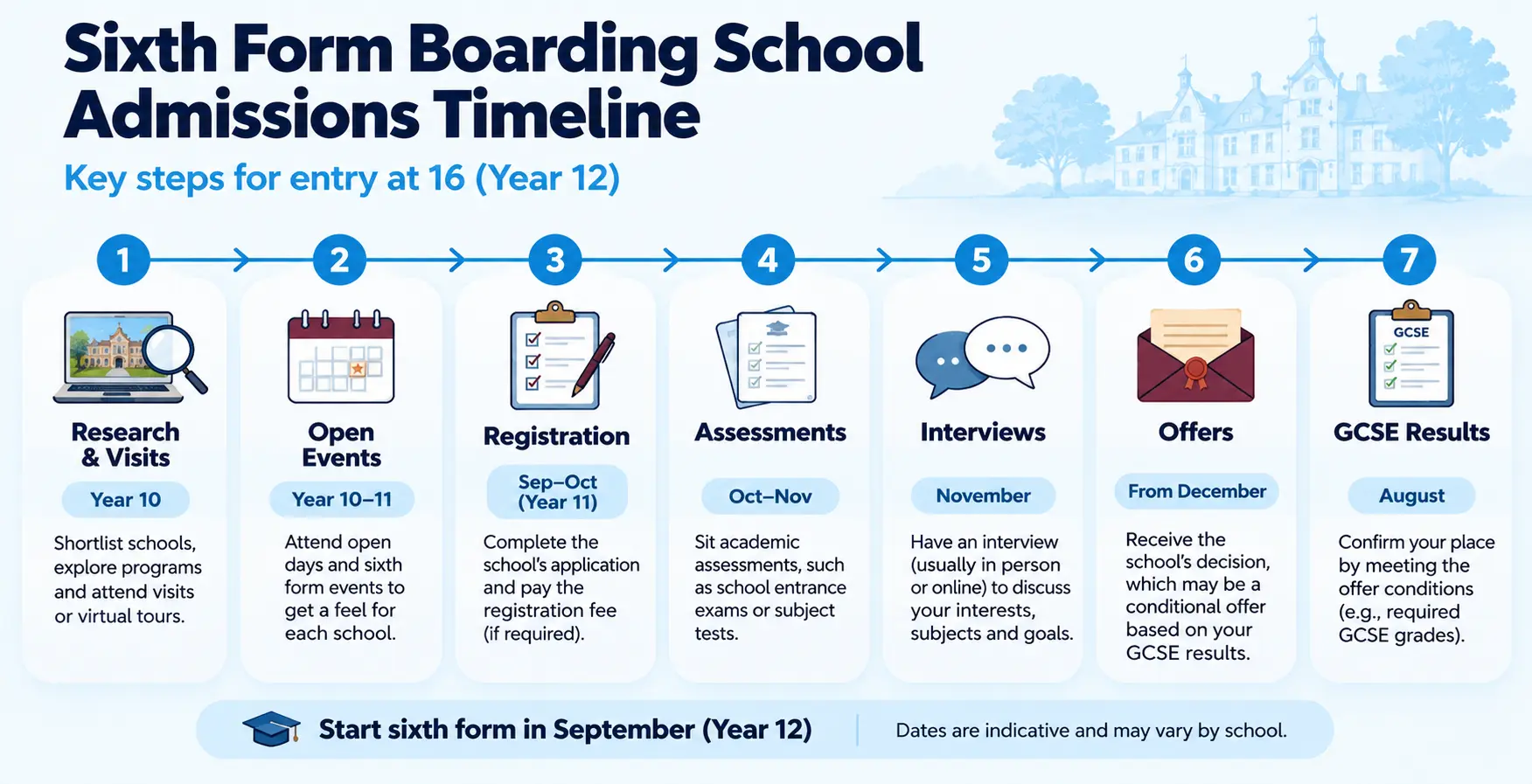
Research and visits (Year 10): families build a list of schools, compare pathways and subject offerings, and begin campus visits.
Open events (end of Year 10 to early autumn of Year 11): schools hold sixth form open mornings for prospective students.
Registration (September to October of Year 11): registration deadlines for 16+ entry at selective schools fall in early autumn.
Entrance assessments (October to November of Year 11): students sit online tests and written papers, which at some schools cover the subjects they plan to study in the sixth form.
Interviews (November of Year 11): schools interview candidates, often with subject teachers or the head of sixth form.
Offers (from December of Year 11): offers are made conditional on GCSE results or their equivalent.
Results (August after Year 11): GCSE results confirm the place, and the student joins in September.
Registration, assessments and interviews all land in the same few weeks of Year 11, on top of GCSE preparation. That is why boarding school admissions consultants work with families from Year 10, when the school list can still be shaped around a student’s subjects and university plans and the autumn of Year 11 can be spent on the assessments themselves.
Entry Requirements
Each school sets its own entry requirements for sixth form, expressed as a minimum number of GCSE passes together with higher grades in the subjects a student intends to take at A-level or IB Higher Level. Selective independent schools add their own entrance papers and interviews, while state boarding schools publish their own criteria. Families can confirm each school’s thresholds for every intended subject early, since a subject requirement missed at GCSE can close an A-level option even where the overall offer is met.
Applying from Outside the UK
International applicants planning a sixth form abroad in the UK work to the same calendar, but with more to arrange along the way. Students who have not taken GCSEs are assessed through a school’s own entrance tests and their current school record, and each school sets its own English language requirement, which can include a recognized test such as IELTS. The visa comes last: students aged 16 or 17 joining an independent school can apply for a Child Student or Student visa, depending on the course and the school’s sponsor licence, but only once the school has issued an unconditional offer.
McMillan Education’s international boarding school admissions consultants have guided families from 65 countries through this process, from the first school list to a confirmed place.
What Sixth Form Boarding Life Looks Like
A boarding sixth form becomes a student’s home for two years, and for a student who has never boarded, it is the first time living away from family. The sections below describe how that boarding life is organized, from where sixth formers live to how weekends are spent, and what parents go through when a child leaves for boarding school is a subject of its own.
Where Sixth Formers Live
Schools house sixth formers in one of two ways. Some keep students in the same house from entry to Year 13, while others move them into dedicated sixth form houses or separate floors and wings. Either way, sixth formers live in single study bedrooms, and some newer sixth form houses add en-suite rooms, shared kitchens and sixth form common rooms, run closer to a university hall of residence.
Room types and house arrangements are covered in more detail in our article about boarding school dorms.
Who Looks After Sixth Formers
Each boarding house is run by a housemaster or housemistress who lives in or beside the house, supported by house tutors and a matron responsible for health and day-to-day care. That team is the first point of contact for families throughout the two years, and it works alongside the school’s medical center and counselors when a student needs more than the house can provide.
Settling In as a New Sixth Former
A student joining at 16 arrives in a house where some of the year group has lived together for years, and how quickly a new sixth former settles depends largely on how many others join at the same time and how the house organizes the first weeks. Sixth formers are also the senior members of a house, taking on roles as prefects or house leaders, and those responsibilities give a new arrival an established place in the community early on.
Weekends and Time at Home
Most boarding sixth forms are built around full boarding: according to the ISC Census, 86% of sixth form boarders at ISC schools are full boarders, 8% board weekly and 5% are flexi boarders. Full boarders stay at school through the week and at weekends, which revolve around sports fixtures, trips and house events, and go home for exeats, half-terms and holidays. Weekly boarders return home each weekend, flexi boarders stay on selected nights, and some schools also teach on Saturday mornings. The mix shapes weekend life, since a house where most boarders stay runs a full weekend program, while one that empties on Friday is a quieter place to live.
How to Choose a Sixth Form Boarding School
The soundest way to choose a sixth form boarding school is to work backward from university, settling the questions that decide which schools belong on the list before comparing the schools themselves.
Start with the Student
The first questions concern the student before any school: their academic level, how ready they are to board for the first time at 16, and whether they need specific provision for learning differences or for English as an additional language, since schools vary widely in both. A student’s own preferences matter at this stage too, and involving the student in building the list makes the choices easier to stand behind through the application season.
Browse boarding schools:
Choose the Pathway and Subjects
The subjects a student takes at 16 determine which degree courses are open at 18, so the next decision is which sixth form pathway suits a student’s university plans, whether A-levels, the IB Diploma or either route alongside career-related courses. Once the pathway is settled, the subjects it requires define the list, since every school on it needs to offer that combination.
Browse boarding schools:
Decide on the Kind of Sixth Form
A sixth form within an established school and an independent sixth form college offer quite different experiences for a student arriving at 16, and two further preferences shape the list just as much: whether the school is single-sex or co-ed, and how a student will board. Full boarders stay through the week and at weekends, while other schools offer weekly boarding, with students home each weekend, or flexi boarding on selected nights.
Apply the Practical Limits
Location, travel time from home or the nearest international airport, and budget narrow the field further, and for international families, a school’s English language requirements belong in this step too. The advanced filters in the boarding school finder are useful for working through these practicalities.
Build a Balanced Shortlist
Set a student’s predicted GCSE grades against each school’s entry requirements for the subjects they plan to take, and the list sorts itself into three groups: schools that would be a stretch, schools within comfortable reach, and at least one where the student clears the requirements with room to spare.
Every school on the list should still offer the pathway a student needs and the kind of sixth form a family wants, so that any offer is one worth accepting. Registration deadlines and assessment dates are worth checking at this stage too, since several can fall in the same weeks of Year 11. The school comparison tool puts the final candidates side by side, and visits settle the rest.
Find a Sixth Form Boarding School
For families still deciding what a student wants from sixth form, the school matching quiz weighs a student’s goals and preferences against the schools in the McMillan Education Boarding School Guide.
McMillan Education’s boarding school consultants bring seven decades of experience in school planning, with direct knowledge of how UK schools run their sixth form admissions and boarding programs.
Speak with a boarding school admissions consultant to start planning.
Frequently Asked Questions
1. What year is sixth form, and what is it called in America?
Sixth form covers Year 12 (Lower Sixth) and Year 13 (Upper Sixth) in the UK, starting at age 16. In the US, the equivalent is 11th and 12th grade.
2. Is sixth form higher education?
No. Sixth form is the final stage of secondary education, and higher education begins at university.
3. Can a student join a boarding school only for sixth form?
Yes. Year 12 is one of the main entry points to UK boarding schools, and schools admit new students at 16 alongside those continuing from younger year groups.
4. Do students need GCSEs to join a UK boarding sixth form?
Not always. Offers for students in the UK system are made conditional on GCSE results, while international applicants without GCSEs are assessed through a school’s own entrance tests and their current school record.
5. What is the difference between a sixth form and a sixth form college?
A sixth form is the final stage of a school that also teaches younger year groups, while a sixth form college admits students only from 16. A school sixth form adds new students to an established year group, and a college’s year group is new from the first day.
6. Can international students join a UK boarding school at sixth form?
Yes. International students can join independent boarding schools at 16, with each school setting its own English language requirements and the visa application following an unconditional offer.
7. Is it worth boarding for only two years of sixth form?
It depends on what the move achieves. For a student whose university plans call for a pathway or subject combination the current school cannot offer, or who is ready to live away from home before university, two years at a boarding sixth form can make a clear difference. The trade-off is a shorter time to settle, since the new school will set predicted grades and write a university reference after knowing the student for little more than a year.