Boarding School Dorms: Room Types, Bathrooms, Supervision, and Dorm Rules
Researching boarding schools usually starts with academics, yet the dorm is where a boarder spends evenings, weekends and every night of the school year. How rooms are assigned, who supervises at night, and which rules govern the dorm differ from school to school, and those differences deserve as much attention as the curriculum.
This article explains how dorms in boarding schools are organized in the United States and the United Kingdom, from room types and supervision to the dorm rules that shape daily life, so families can weigh the residential side of a school alongside its academics and one of the central benefits of boarding schools.
Do Boarding Schools Have Dorms? Dorms, Halls and Houses Defined
Yes, every boarding school houses its students on campus in residential buildings where boarders sleep, study in the evenings, and spend much of their time outside class. What those buildings are called, and how they are organized, depends largely on the country. In the United States, residential buildings are known as dorms or halls, and they exist at private high schools as well as at junior boarding schools for younger students. In the United Kingdom, boarders live in boarding houses, a model with its own traditions and terminology. At single-gender schools, every dorm houses students of one sex, while co-ed schools house boys and girls in separate dorms or on separate floors.
Dorms and Halls in US Boarding Schools
In US boarding schools, a dorm, dormitory, or hall is a residential building shared by a group of boarders and the faculty who oversee them. The size of a boarding school dorm varies widely, even within a single campus, from small houses of a handful of students to buildings of 40 or more. A smaller dorm has the feel of a large household, where every student knows everyone else in the building. A larger high school dormitory is organized by floors or corridors, each with its own adults and student leaders.
Boarding Houses in UK Schools
UK boarding schools organize boarders into boarding houses. A house is both a building and a community. Students join a house when they arrive, and it becomes their home base at school: they eat, study, and compete in inter-house events as a group, and the house carries its own identity and traditions. Most UK senior schools use vertical boarding, in which a single house brings together students from age 13 to 18. Some schools accommodate sixth formers in separate houses, and some place boarders in Years 7 and 8 in a house of their own.
Each house is run by a housemaster or housemistress, a senior teacher who lives in or beside the house, often with their family. Other adults such as matrons and house tutors work alongside them.
Families comparing the two systems in more depth can read our article about British schools vs American schools.
Key Terms: Dorm Parents, Proctors and Prefects
The vocabulary of boarding school dorms differs between the US and the UK, though the roles behind the terms are closely related.
|
US term |
UK term |
What it means |
Dorm / hall |
Boarding house |
The residential building and community a boarder belongs to |
Dorm parent, dorm head, house counselor |
Housemaster / housemistress, house tutor |
Faculty member who lives in or beside the residence and oversees boarders outside class hours |
— |
Matron |
Staff member responsible for boarders’ health and day-to-day care |
Proctor, prefect |
Prefect |
Senior student given responsibility for younger boarders |
Study hall |
Prep |
Supervised evening study period |
Weekend leave |
Exeat |
Time away from school; in the UK, a scheduled weekend when boarders go home |
Boarding School Room Types
Boarding school rooms range from shared dormitories to private study bedrooms, and the bathroom arrangement usually follows the room type and the building. Which room a student lives in depends on the school’s assignment policy and, in the UK, largely on the student’s year group.
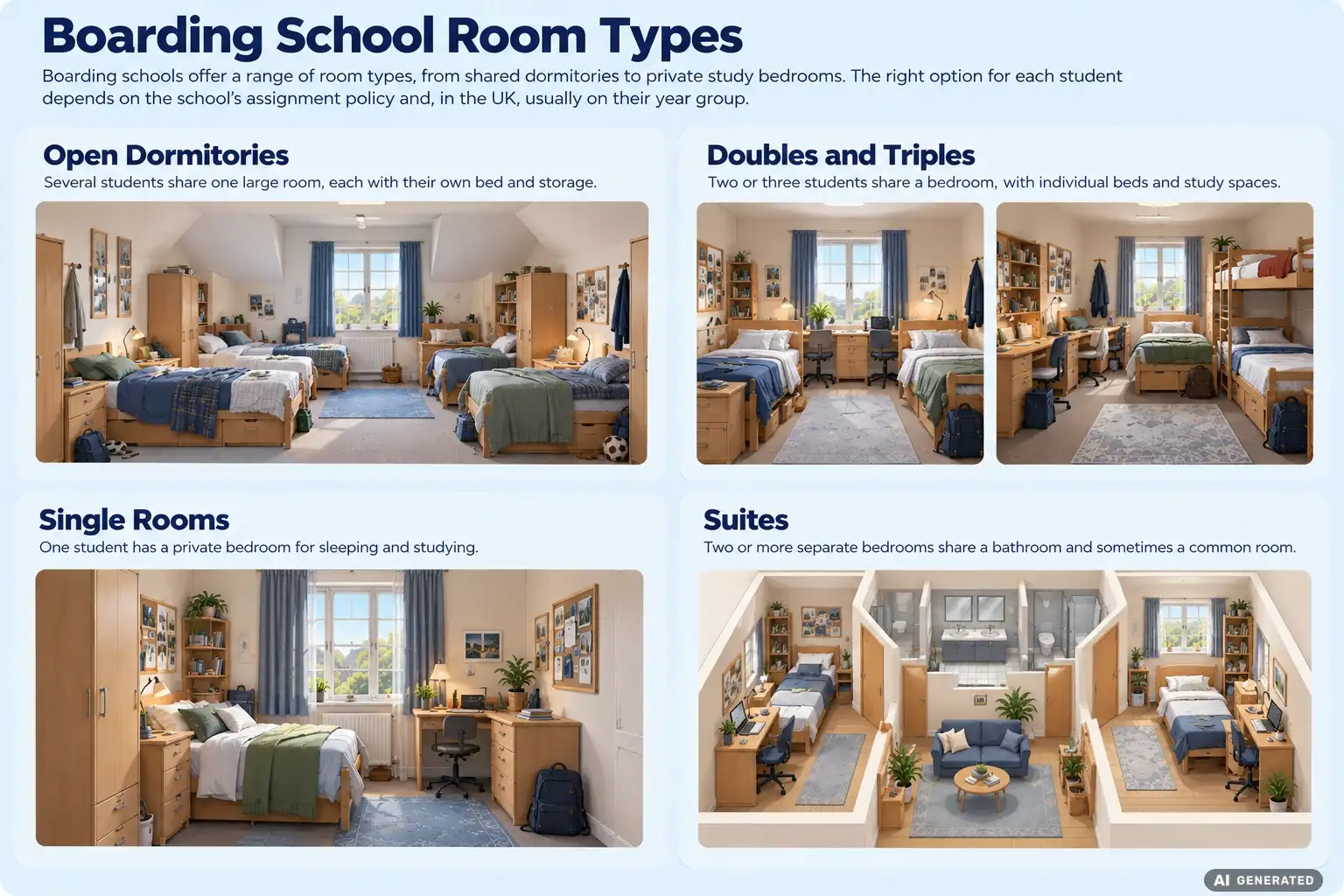
Open Dormitories
An open dormitory is a single room shared by several boarders, each with a bed and personal storage. It is the standard arrangement for younger boarders in UK schools, so the age at which a child starts boarding usually determines whether they begin in an open dormitory. At most UK schools, a student who joins at 11 or 13 starts in one, while a student who joins for sixth form moves straight into a study bedroom. Open dormitories are less common in the US, where boarding schools generally house students in doubles, triples, and singles.
Shared dormitories give younger boarders a built-in group of peers from their first night, and boarders in open dormitories usually use shared bathrooms on the corridor or floor.
Doubles and Triples
A double houses two students and a triple houses three, each with their own bed, desk, and storage, and some schools also use quads for four. At many US boarding schools, new students live in shared rooms, and living with a roommate is treated as part of the first year. In the UK, students usually move out of dormitories and into single or double study bedrooms around Year 10 or 11. A shared room asks students to work out routines, quiet hours, and personal space with someone else, which is one of the first practical lessons of boarding life.
Single Rooms
A single gives one student a private room for sleeping and study. In the UK, singles are known as study bedrooms, and sixth formers almost always have one of their own, which some schools present as preparation for university accommodation. Policies at US boarding schools vary more: some schools reserve singles for older students, while others offer them from the first year. A single room comes with a private bathroom only in buildings designed with en-suite rooms.
Suites
A suite groups two or more bedrooms around a shared bathroom and, in some buildings, a common room. Suites give a small group of students a shared space of their own within a larger dorm. Some newer UK sixth-form houses go a step further with en-suite study bedrooms, where every single room has its own bathroom. Some schools also house their oldest students in apartment-style residences with shared kitchens and living areas, run closer to a university hall of residence than a traditional dorm.
Bathrooms and Shower Privacy
Bathrooms are among the most practical questions families have about boarding school dorms, particularly showers and privacy. Most dorms use one of three layouts:
Hall bathrooms: shared by everyone on a corridor or floor.
Suite bathrooms: shared by the few students in a suite.
En-suite bathrooms: attached to an individual room.
Layouts can differ from building to building at the same school, so a student’s bathroom setup depends on the dorm they are assigned. In England, boarding schools must provide toilets and washing facilities that are readily accessible from bedrooms, with separate toilets for boys and girls from age 8, unless a facility is a lockable room for one person at a time. In the US, bathroom design is left to each school, which makes it a practical question to ask on a campus visit.
Supervision Structure in Boarding School Dorms
Behind many family conversations about boarding schools lies one question: who is responsible for a student once classes end, and who is there at night? Boarding schools answer it with a layered structure of resident adults, faculty on duty, and student leaders, each with a defined role.
The Role of Dorm Parents
A dorm parent is a faculty or staff member who lives in the dorm, in some cases with their own family, and oversees the boarders in it. Dorm parents run the dorm’s evening routine, keep track of where students are, enforce dorm rules, and are usually the first adult a boarder turns to with a problem, whether a missed assignment, a disagreement with a roommate, or a hard first week away from home. At schools where dorm parents also teach and coach, boarders see the same adults in the classroom, on the field, and in the dorm. That continuity is part of why a boarding school can also be a good home.
Live-In Faculty and Duty Rotations
Dorm supervision usually combines two roles:
Resident faculty live in apartments within or attached to the dorm and are present in the building through the school year.
Duty faculty live elsewhere on or near campus. They are assigned to the dorm on particular evenings and weekends and take charge of the building on their scheduled nights.
UK boarding houses follow a comparable pattern. The housemaster or housemistress lives on site, and assistant housemasters, tutors, and matrons share evening and weekend duties.
Student Leaders: Proctors and Prefects
Senior students play a defined part in dorm life. Proctors and prefects live alongside younger boarders, help run the evening routine, and are often the first peers a new student gets to know. They act under adult oversight. In England, the National Minimum Standards require that prefects receive adequate staff supervision and training, with measures in place to prevent misuse of the role.
Study Hall, Check-In and Lights-Out
Once classes and activities end, the dorm settles into a set sequence overseen by its adults. Study hall, called prep in UK schools, usually takes place in the dorm itself, with boarders working in their rooms or a common room while a dorm parent, a faculty member on duty, or a proctor supervises the building. Check-in later in the evening confirms that every resident is back in the dorm and accounted for, and lights-out closes the day. Each school sets its own times, and dorms housing younger boarders usually keep earlier hours.
Overnight Coverage
In England, the National Minimum Standards require at least one staff member sleeping or on duty in each boarding building at night, and boarders must be able to contact staff easily during the night. Most UK houses have at least one resident adult per corridor or floor.
The US has no national equivalent, but the structure works the same way in practice: dorm parents live in the dorm and sleep there, so an adult is in the building overnight. College-preparatory boarding schools in Massachusetts, New Hampshire, and Connecticut, for example, are exempt from residential childcare licensing, so the details of overnight staffing are set by each school’s own policies and accreditation.
Boarding School Dorm Rules
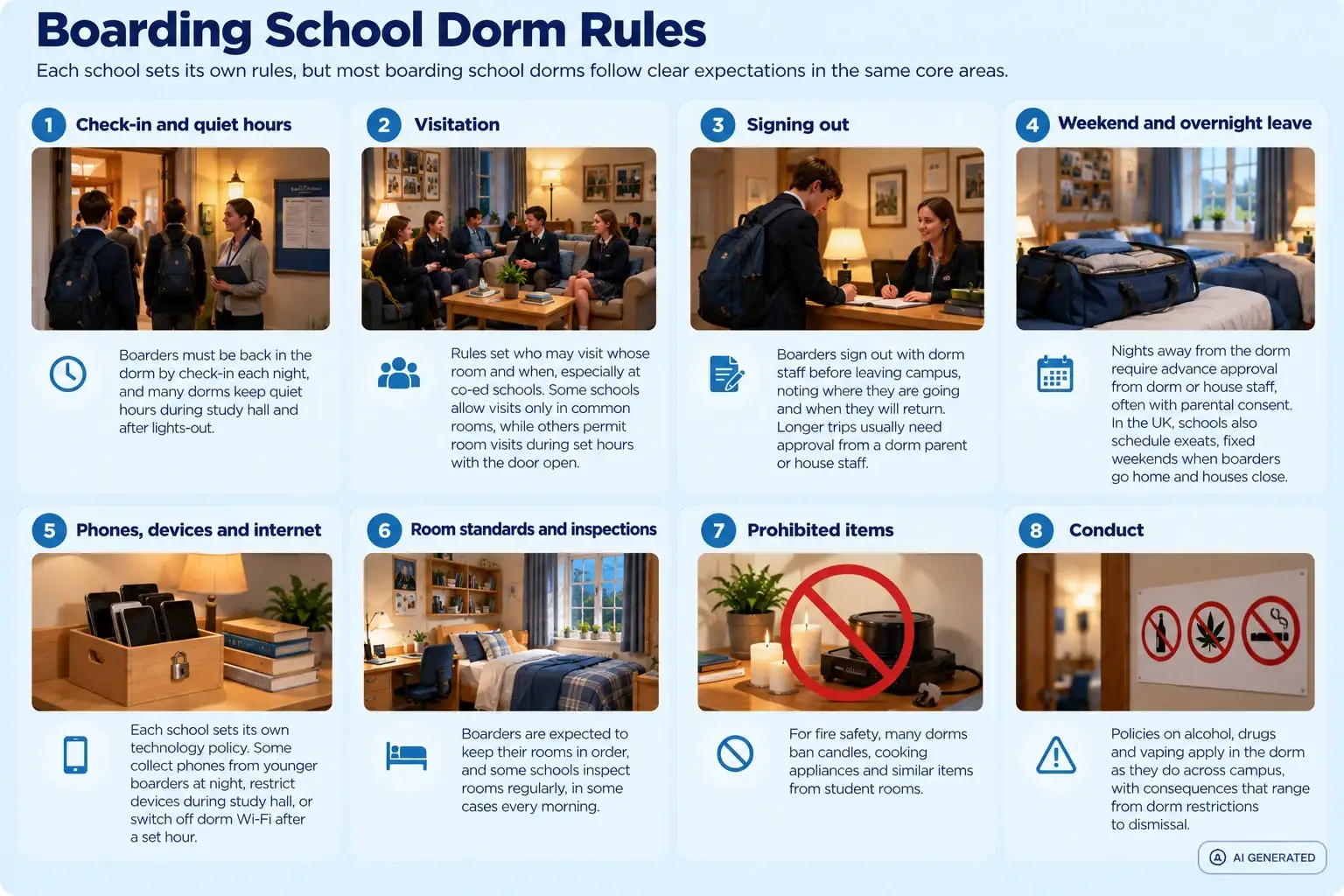
Boarding school dorm rules exist for the same reason as the nightly routine described above: a dorm houses dozens of teenagers in the care of a few adults, and clear expectations keep that arrangement safe and workable. The specific rules differ from school to school, in the US and the UK alike, and are usually set out in a student handbook that families can review before enrollment. Most boarding school dorms set rules in the same core areas:
Check-in and quiet hours: Boarders must be back in the dorm by check-in each night, and many dorms keep quiet hours during study hall and after lights-out.
Visitation: Rules set who may visit whose room and when, particularly between boys’ and girls’ dorms at co-ed schools. Some schools allow visits only in common rooms, while others permit room visits during set hours with the door open.
Signing out: Boarders sign out with dorm staff before leaving campus, noting where they are going and when they will return, and longer trips usually need approval from a dorm parent or, in UK schools, a housemaster or housemistress.
Weekend and overnight leave: Nights away from the dorm require advance approval from dorm or house staff, often with parental consent as well. In the UK, schools also schedule exeats, fixed weekends when boarders go home and houses close.
Phones, devices and internet: Each school sets its own technology policy. Some collect phones from younger boarders at night, restrict devices during study hall, or switch off dorm Wi-Fi after a set hour.
Room standards and inspections: Boarders are expected to keep their rooms in order, and some schools inspect rooms regularly, in some cases every morning.
Prohibited items: For fire safety, many dorms ban candles, cooking appliances, and similar items from student rooms.
Conduct: Policies on alcohol, drugs, and vaping apply in the dorm as they do across campus, with consequences that range from dorm restrictions to dismissal.
Adjusting to Dorm Life: Homesickness, Well-Being and Learning Needs
For most new boarders, moving into a dorm is the first time living away from home, and the adjustment takes time. How a school staffs and organizes its dorms shapes that adjustment, from the first weeks on campus to the resources available when a student is having a hard time.
Homesickness and the First Weeks
Homesickness is common in the first weeks of boarding, including among students who chose boarding school themselves, and for most it eases as routines and friendships take hold. The dorm carries much of that transition. Dorm parents check in with new residents, proctors and prefects are often a new boarder’s first friends, and at some schools first-year dorms place new students alongside classmates going through the same change. Families can ask how dorm staff approach the opening weeks and how often parents hear from a dorm parent or advisor. For the family’s side of the transition, when a child leaves for boarding school looks at the experience from home.
Well-Being and Health Resources
Because dorm parents see residents every evening, the dorm is often where a concern first becomes visible. What matters is how the dorm connects to the school’s wider resources: the hours and staffing of the health center, whether counselors work on campus, and how dorm staff refer a student when something seems wrong. These arrangements differ considerably between schools, and they are among the details experienced boarding school admissions consultants examine closely when evaluating a school, alongside the questions families can raise directly on a campus visit.
Safety in the Dorm
Beyond supervision, dorm safety comes down to who can enter the building and how emergencies are handled. Some schools keep dorms locked around the clock with entry by student ID card; many restrict visitors from outside the school community, and schools run regular fire drills, some of them at night. Families can ask how a dorm is secured and how parents are contacted in an emergency.
Learning Differences and Dorm Life
For students with learning differences, dorm life adds structure to the parts of the day that classes do not cover. Supervised study hall, adults close at hand in the evenings, and a predictable routine give organization and academic follow-through a consistent framework. Schools vary widely in the learning differences services they offer, from standard accommodations such as extra time on exams to programs built entirely around learning differences, and how far those services extend into evening study and the dorm itself also varies.
Families can browse schools in the McMillan Education Boarding School Guide by the level of learning differences services each school offers, including:
Browse schools with a learning center and small-group coaching.
Browse schools with daily one-on-one work with dedicated specialists.
Browse specialized schools with a curriculum built entirely around learning differences.
If families would like expert guidance through the process, McMillan Education’s educational consultants apply specialized expertise in learning differences within school planning.
Boarding Schools by Dorm Arrangement
Dorm arrangements differ from one school to the next, and for many families they shape the shortlist as much as academics do. The US and UK schools below, all listed in the Boarding School Guide, show how common arrangements look in practice. Families can confirm current details directly with each school.
Schools Where Students Can Live in Single Rooms
A single room gives a boarder their own space for sleeping and study, without a roommate. Schools differ widely in how many singles they offer and who gets them: at some, most rooms are singles, while at others singles depend on the student’s grade or dorm.
Examples of boarding schools offering single rooms include:
The Hotchkiss School: Most rooms are singles, though many students have a roommate for at least one year, and the school recommends that incoming students request one.
St. George’s School: About 70 percent of dorm rooms are singles.
Cate School: Long House, one of two dorms housing ninth graders, consists entirely of single rooms. From sophomore year, students have more housing options in mixed-grade dorms with singles and doubles.
Concord College: Every boarder at this UK school has a single study bedroom, and all second-year A Level students who want one are guaranteed a single en-suite room.
Schools with Small, House-Style Dorms
Some boarding schools house students in small dorms closer in scale to a large household than to a residence hall. In a dorm of a dozen students, the dorm parents and every resident know one another, and evening routines run at the pace of a family home.
Examples of boarding schools with small, house-style dorms include:
Proctor Academy: Dorms range from 4 to 18 students, with an average of twelve, and serve as extensions of the dorm parents’ homes.
Groton School: Dorms house 12 to 24 residents, and each is led by a faculty member living in an apartment inside the dorm.
The Fessenden School: At this junior boarding school for boys, dorms hold no more than 18 students, with two faculty or staff families living on each hallway.
Holderness School: Seventeen dorms house roughly 270 boarders, with an 8:1 ratio of students to dorm parents.
Schools with Dedicated First-Year Dorms
Some schools house their youngest boarders together, so new students adjust to boarding life alongside classmates going through the same transition. Others take the opposite approach: at Milton and Phillips Exeter, boarders remain in the same house or dorm throughout their time at the school.
Examples of boarding schools with dedicated first-year dorms include:
Deerfield Academy: Ninth graders live in the Ninth Grade Village, with girls and boys in separate buildings connected by a shared common room.
Episcopal High School: All ninth graders live in the Freshmen Village in Henderson Hall, which includes separate girls’ and boys’ dorms connected by a shared common room.
Northfield Mount Hermon: Ninth graders live in designated first-year housing before moving into mixed-grade dorms.
The Lawrenceville School: Houses are grouped by grade in three areas of campus: one for ninth graders, one for tenth and eleventh graders, and one for seniors. Senior prefects also live in younger students’ Houses.
The Thacher School: Ninth-grade girls live in Casa de Piedra, while ninth-grade boys live in Lower School.
Schools with All-Gender Housing Options
Co-ed boarding schools have traditionally housed boys and girls in separate dorms. A number of schools now also offer all-gender housing, open to students who choose to live there, alongside their boys' and girls' dorms.
Examples of boarding schools offering all-gender housing include:
Milton Academy: Academy House, established in 2022, is an all-gender residential option for any interested boarding student.
Phillips Exeter Academy: Two of the school’s houses are open to students of all genders.
Dublin School: Dorm options include all-gender housing, housing for generally male-identified and nonbinary students, and housing for generally female-identified and nonbinary students.
Phillips Academy Andover: All-gender housing is open to students regardless of gender. The school introduced the option in the 2017–18 school year.
UK Schools by House Arrangement
UK boarding schools organize residential life around houses, but their arrangements vary. The main differences lie in whether younger students live separately, whether houses are single-sex or co-ed, and whether older students move into dedicated sixth-form accommodation.
Examples of UK boarding schools with distinctive house arrangements include:
Dauntsey’s: Boarders in Years 7 to 9 live together in The Manor, a co-ed house set in 65 acres a short walk from the main school, before moving into one of four single-sex Upper School boarding houses.
Millfield School: The school has 19 boarding houses with separate houses for boys and girls. Year 9 boarders start in dedicated single-sex houses, and two houses are reserved for sixth formers. Bedrooms are typically shared until Upper Sixth, when students have single rooms.
Bedales School: Boarders in Years 9 to 12 live in one girls’ house and one boys’ house, sharing mixed-age dorms across year groups. In Year 13 they move into a co-ed house with separate sleeping areas and bathrooms, run closer to a university hall of residence.
St Edward’s, Oxford: Boarding houses are single-sex in Years 9–11, while several houses offer coeducational sixth forms. Each pupil has a personal tutor within their house.
Radley College: An all-boys, full-boarding school whose 11 boarding houses, known as Socials, are each run by a Tutor alongside a resident Sub-Tutor and a Pastoral Housemistress.
Find a Boarding School
Dorm life is one of the clearest differences between boarding schools, and it is worth weighing alongside academics from the start of a search. Families can begin with the boarding school matching quiz to identify schools aligned with their child’s goals, then narrow the field in the McMillan Education Boarding School Guide by location, student body, 5-day boarding, and learning differences services. The comparison tool places up to three schools side by side, and families preparing applications can turn to our articles on how to apply to US boarding schools and how to apply to UK boarding schools.
McMillan Education’s boarding school consultants bring seven decades of experience in school planning, with direct knowledge of how schools across the US and UK run their residential programs.
Families who would like to plan their search with an experienced consultant can schedule a free consultation.
Frequently Asked Questions
1. Are boarding school dorms supervised?
Yes. Dorm parents live in the building, faculty on duty cover evenings and weekends, and senior students assist under adult oversight. In England, schools must have at least one staff member sleeping or on duty in each boarding building at night, while in the US overnight staffing is set by each school.
2. Do boarding school students have roommates?
It depends on the school and the student’s age. In the UK, younger boarders usually share dormitories and sixth formers almost always have their own rooms. At many US schools, new students share a room, and singles become more common in later years.
3. Can students choose their roommates?
New students are usually placed through a rooming questionnaire about habits and preferences, and many schools let students choose roommates or take part in a housing lottery in later years.
4. Can students decorate their dorm rooms?
Most schools allow boarders to personalize their rooms with posters, photos, and personal items, within limits set by fire safety rules. Families can ask for a school’s guidelines before move-in.
5. Do boarding students go home on weekends?
It depends on the boarding arrangement:
Full boarders stay at school on weekends unless they have approved leave or a scheduled break, which UK schools call an exeat.
5-day boarders go home every weekend.
Flexi boarders, an arrangement offered by some UK schools, board on selected nights.
6. Can boarding students use phones in the dorm?
Yes, within limits set by each school, which may include collecting phones from younger boarders at night or restricting devices during study hall.
7. Can day students use the dorms?
At some schools, yes. Some affiliate each day student with a dorm, and some assign day students their own room, so they have a base on campus and take part in dorm life during the day.