What Are Quaker Schools? A Guide to Quaker Boarding Schools
A school with “Friends” in its name raises an immediate question for many families: how much does the Quaker affiliation shape a student’s education and daily life? The answer is less about religion and more about a particular culture of equality, consensus, and academic seriousness that families choose these schools for.
This article explains what Quaker schools are, how the religious affiliation works, how Quaker education and boarding life operate in practice, and where Quaker boarding schools are located today.
What Are Quaker Schools?
Quaker schools, also called Friends schools, are independent schools rooted in the values and practices of the Religious Society of Friends. They are known for a democratic, consensus-based culture, inquiry-led teaching, and rigorous academics, and they enroll students of every faith and background.
1. Where Quaker Schools Come From
The Religious Society of Friends emerged in England in the 1600s, and Quakers founded schools almost from the start, carrying the practice to the American colonies, where William Penn established Pennsylvania as a haven for religious freedom. The William Penn Charter School, founded in Philadelphia in 1689, is the oldest Quaker school in the country, and the Philadelphia region remains the center of Quaker education in the United States.
2. Quaker Schools Today
According to the Friends Council on Education, there are over 70 Quaker elementary and secondary schools in the US, serving roughly 20,000 students from pre-kindergarten through grade 12. The large majority are day schools concentrated in Pennsylvania, Maryland, and the Washington, DC area.
A smaller group of Quaker boarding schools, several of them among the most respected boarding schools in the United States, operates in Pennsylvania, New York, Ohio, Iowa, and North Carolina, while England, where Quaker education began, has its own long-established Quaker boarding schools in York, Reading, Somerset, and elsewhere.
Are Quaker Schools Religious?
Quaker schools have a religious affiliation, but they do not require students to share or practice the faith, and Quaker students can be a small share of the community. Sandy Spring Friends School, for example, reports that about 8-10% of its students identify as Quaker, and the affiliation shows up far more in how these schools operate than in what students are asked to believe.
1. The Belief Behind Quaker Schools
At the center of Quakerism is the belief that every person has an inner light, a direct connection to the divine, which Quakers describe as “that of God” in everyone. Traditional Quakerism has no clergy or church hierarchy, and Quakers have long made decisions as a community through consensus, a process that seeks agreement from the whole group so that every voice is heard. That same principle is what gives Quaker schools their democratic, non-hierarchical character, from the way teachers relate to students to the way school communities set their own rules.
2. Do Quaker Schools Require Worship or Religion Classes?
At some Quaker schools, yes, though what is required is attendance and coursework, while belief remains a personal choice. For example, George School requires all students to attend Meeting for Worship each week, and attendance in that setting means taking part in a community gathering.
Meeting for Worship itself is quiet and simple, with the school community sitting together in silence, anyone who feels moved standing to share a thought, and no sermon, liturgy, or minister leading it. Religion classes follow the same logic: George School includes coursework in religions in its graduation requirements and teaches the subject academically, with courses spanning world religions and philosophy.
Requirements for both worship and religious study differ from school to school, and comparing schools directly shows where they differ.
Quaker Education: Values and the Classroom
Quaker education rests on a set of shared values, known as the testimonies, and on a classroom built around equality and discussion, where students learn by questioning and reasoning together with their teachers.
1. The Quaker Testimonies (SPICES)
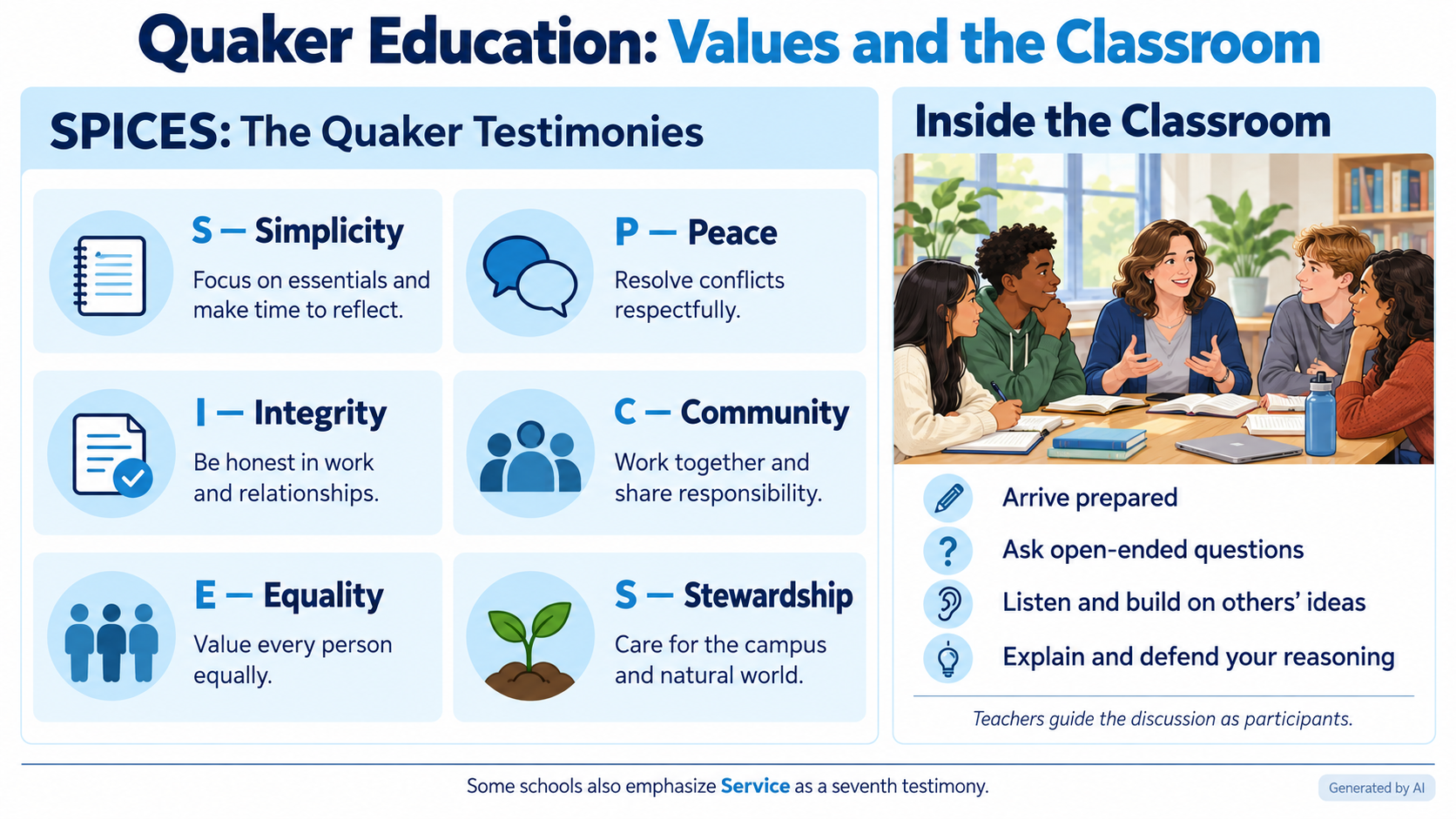
The testimonies are the principles Quakers aim to live by, and in a Quaker school they set the shared expectations for how students study, settle differences, and treat one another. They are commonly summarized by the acronym SPICES:
Simplicity: a focus on what is essential, with time set aside to step back from a crowded schedule and reflect.
Peace: students are expected to resolve conflicts directly and without hostility, and schools teach conflict resolution as a skill.
Integrity: students and teachers are held to a high standard of honesty, in academic work and in how they treat one another.
Community: students learn to work with one another and to take responsibility for the community they share.
Equality: every member of the school holds equal worth, whatever their background or role.
Stewardship: care for the campus and the natural world is part of the curriculum.
Some schools add a seventh testimony, Service, and build service learning into their programs and graduation requirements.
2. Inside a Quaker Classroom
In a classroom, those values show up in students addressing the teacher by first name, a practice at a number of Quaker schools, and in a teacher who guides the lesson as a participant in the discussion, drawing out students’ ideas while students carry much of the conversation themselves.
A class starts from a question, and students work toward answers by speaking one at a time, pausing before responding, and building on what a classmate has just said. Teachers also use queries, open-ended questions with no single correct answer, such as “What kind of classroom do we want to create together?”, to frame a discussion or a written reflection.
The discussion format is also what makes these classes academically demanding, since a seminar depends on every student arriving prepared to contribute and to defend an idea in front of peers. At Westtown School, upper school classes run 70 minutes so discussions can go deep into the material; every department offers advanced courses, many at college level, and students can pursue independent, self-designed study and research.
The approach shares a great deal with the Harkness method used at many boarding schools, where students and teachers work through material together around a single table.
Quaker Boarding Schools Beyond the Classroom
At a Quaker boarding school, the democratic culture of the classroom carries into evenings, weekends, and the shared life of the dorm, with no authoritarian structure and a community that decides for itself how things get done. That gives Quaker boarding a character of its own, on top of the benefits of boarding schools.
1. Boarding as Part of the Education
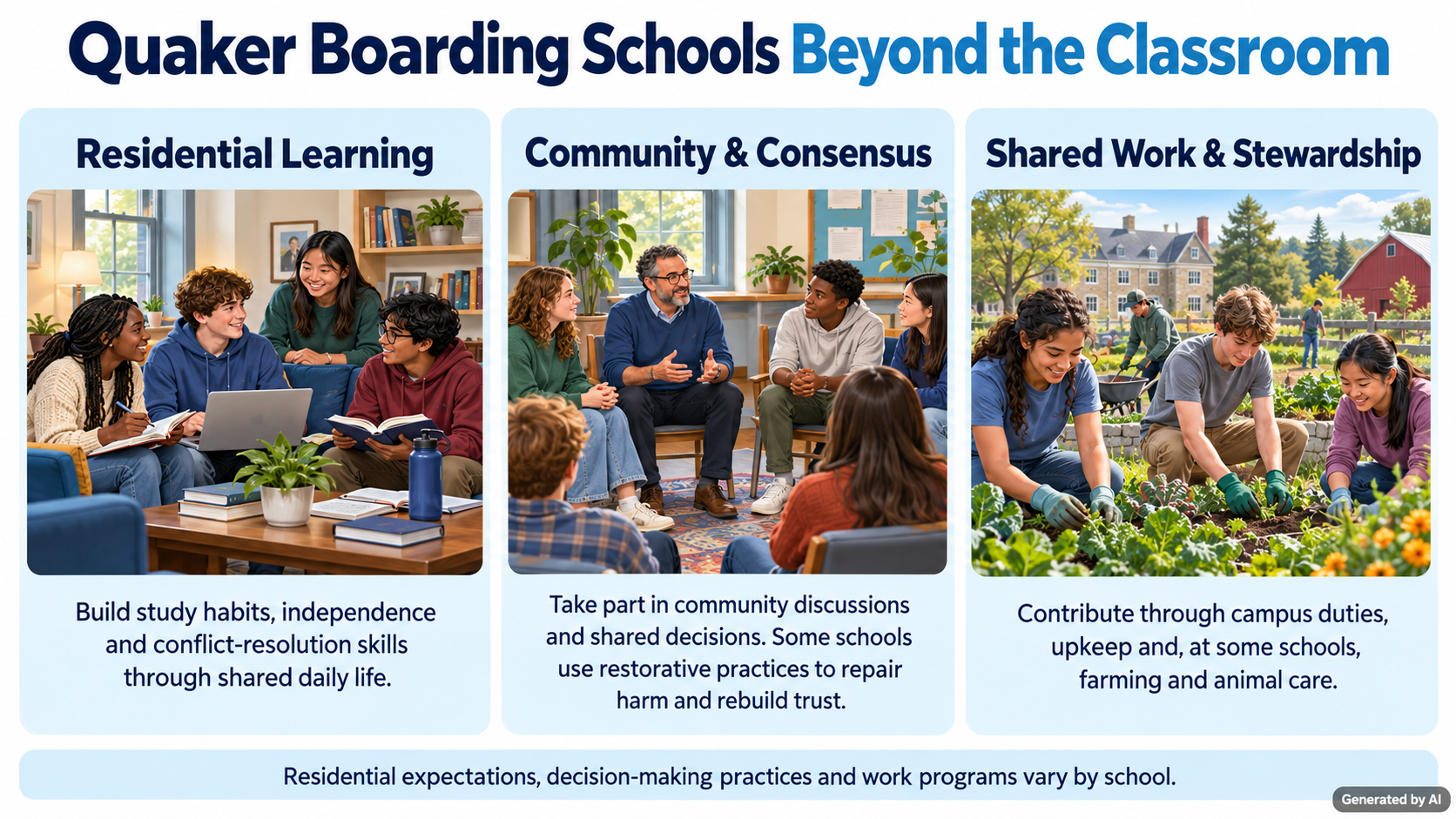
At some Quaker schools, boarding is treated as part of the education itself, and Westtown is the clearest example. The school requires every student who enters in eighth grade or later to live on campus for eleventh and twelfth grade, so day students who join in middle or upper school finish their last two years as boarders. Dorm life there follows a residential curriculum that teaches study habits, conflict resolution, and independence alongside the academic program.
2. Consensus, Community Rules, and Discipline
Quaker boarding schools are open, inclusive communities where students of different faiths, countries, and backgrounds live together, and consensus decision-making gives that community its structure. Students take part in community meetings where questions about dorm life and shared community matters are discussed until the group reaches agreement, with no majority vote. The process takes longer than a vote, but once a decision is made, everyone understands the reasoning behind it, including those who disagreed, because they were part of reaching it. Olney Friends School in Ohio runs its student government this way, and Bootham School in York conducts its student meetings by the same Quaker method.
The same thinking shapes what happens when rules are broken. Some Quaker schools draw on restorative practices, an approach to discipline that brings the people involved together to talk through what happened, repair the harm, and restore trust within the community, and Westtown handles student behavior with this focus.
3. Work Programs and Farm Life
Some Quaker boarding schools ask students to share in the work of running the school, a practice rooted in the testimonies of community and stewardship. Students take on regular duties such as kitchen work, cleaning, and campus upkeep, and at schools with their own land, the work extends to farming. At Olney, for example, students plant crops and care for livestock on the school’s 350-acre organic farm, and Scattergood builds farm experience and a shared work program into its mission.
Quaker Boarding Schools Around the World
The Quaker boarding traditions in England and the United States are directly linked, since Ackworth School in England, founded in 1779, served as the model for Westtown School in Pennsylvania twenty years later, and Quaker boarding schools also operate in Ireland, Canada, and Australia.
The schools below are illustrative examples, and families can find schools by region, size, and program in the full directory.
1. Quaker Boarding Schools in the US
Pennsylvania is home to two of the best-known Quaker boarding schools, and the examples below show the range across the country.
George School (Newtown, Pennsylvania): founded in 1893, a co-ed boarding and day school for grades 9–12 offering the IB Diploma.
Westtown School (West Chester, Pennsylvania): founded in 1799 and coeducational from the start, a pre-K–12 school on a 600-acre campus, with boarding in the upper school.
Olney Friends School (Barnesville, Ohio): founded in 1837, a boarding and day school for grades 9–12 with an average class size of seven.
Scattergood Friends School (West Branch, Iowa): founded in 1890, a small boarding and day school set on its own farm, with a post-graduate year option.
Explore more boarding schools in the US, and see how to apply to US boarding schools for the application process.
Explore Boarding Schools in the US How to Apply to US Boarding Schools2. Quaker Boarding Schools in the UK
Quaker schools in the UK, also known as Friends schools, follow the British system, which differs from American boarding in both curriculum and admissions. Examples include:
Ackworth School (West Yorkshire): founded in 1779, taking boarders from age 11.
Bootham School (York): founded in 1823 as a boarding school, with three boarding houses in Georgian buildings and full, weekly, and flexi boarding.
The Mount School (York): boarding for senior girls, for families considering single-sex education.
Find more boarding schools in the UK, and see how to apply to UK boarding schools for the application process.
Find Boarding Schools in the UK How to Apply to UK Boarding Schools3. Quaker Boarding Schools in Ireland and Canada
Beyond the US and the UK, Quaker boarding continues in Ireland and Canada, including:
Newtown School (Waterford, Ireland): 86 boarders, more than half of them from outside Ireland.
Pickering College (Newmarket, Ontario): founded by Quakers and still guided by Quaker principles, though the school describes itself as nonreligious today.
Explore more boarding schools in Canada, and see how to apply to boarding schools in Canada for the application process.
Explore Boarding Schools in Canada How to Apply to Boarding Schools in CanadaConsidering a Quaker Boarding School
McMillan Education’s boarding school consultants advise on whether this type of school is right for a particular child and guide the admissions process from school list to application, drawing on seven decades of experience and close knowledge of the schools themselves. advise on whether this type of school is right for a particular child and guide the admissions process from school list to application, drawing on seven decades of experience and close knowledge of the schools themselves.
Ready to start planning your boarding school journey?
Speak with a Boarding School Admissions ConsultantFrequently Asked Questions
1. Do you have to be Quaker to attend a Quaker school?
No. Quaker schools enroll students of every faith and background, and Quaker students can be a minority. At Sandy Spring Friends School, about 8 to 10 percent of students identify as Quaker, and at Olney Friends School the figure is roughly one-third.
2. Why are Quakers called Friends?
The formal name of the faith is the Religious Society of Friends, which emerged in England in the mid-1600s. “Quakers” began as a nickname used by outsiders, reportedly mocking members who trembled with emotion during worship, and members later adopted it themselves. Today the two names are used interchangeably, which is why Quaker schools are also called Friends schools.
3. Are Quakers the same as the Amish?
No. Quakers and the Amish are separate religious traditions with different roots and beliefs, though both value peace and simplicity. Quaker schools use the same technology and modern facilities as any other independent school.
4. Do students have to attend Meeting for Worship?
At some Quaker schools, yes. George School and Westtown both require weekly attendance for all students, and attendance means taking part in a community gathering held in silence, with no expectation that students share Quaker belief. Requirements vary from school to school.
5. Are Quaker schools academically rigorous?
Yes. Classes are built on discussion and seminar-style teaching, which depends on students coming prepared to contribute and defend their ideas. Westtown offers advanced courses in every department, many at college level, and George School offers the IB Diploma.
6. What age do Quaker boarding schools accept students?
Boarding ages vary by school. George School and Olney Friends School board students in grades 9–12, Arthur Morgan School in North Carolina boards middle school students in grades 7–9, and in England, Ackworth School takes boarders from age 11.
7. Can international students attend Quaker boarding schools?
Yes. Several Quaker boarding schools enroll international students, including George School and Scattergood Friends School, both of which accept students on F-1 visas. At Newtown School in Ireland, more than half of the boarders come from outside the country.
8. Are there Quaker boarding schools in the UK?
Yes. Quaker schools in the UK, also known as Friends schools, include Ackworth, Bootham, The Mount, Leighton Park, Sidcot, and Sibford, all of which offer boarding, and several have operated for more than two centuries.