What Is the Harkness Method? How It Works and Where Schools Use It
If you've come across the Harkness method while searching for a school for your child, you may wonder what it would mean for them day to day. Two schools can use the same name and offer very different experiences. The difference often shows up in who speaks, how teachers guide the discussion, and what happens when a student is unsure.
This article explains what the Harkness method is, how a Harkness class works, and how it adapts across subjects. It covers the strengths and challenges of the method for students, and it looks at how schools in the US, UK, Canada, and Europe apply it.
What Is the Harkness Method?
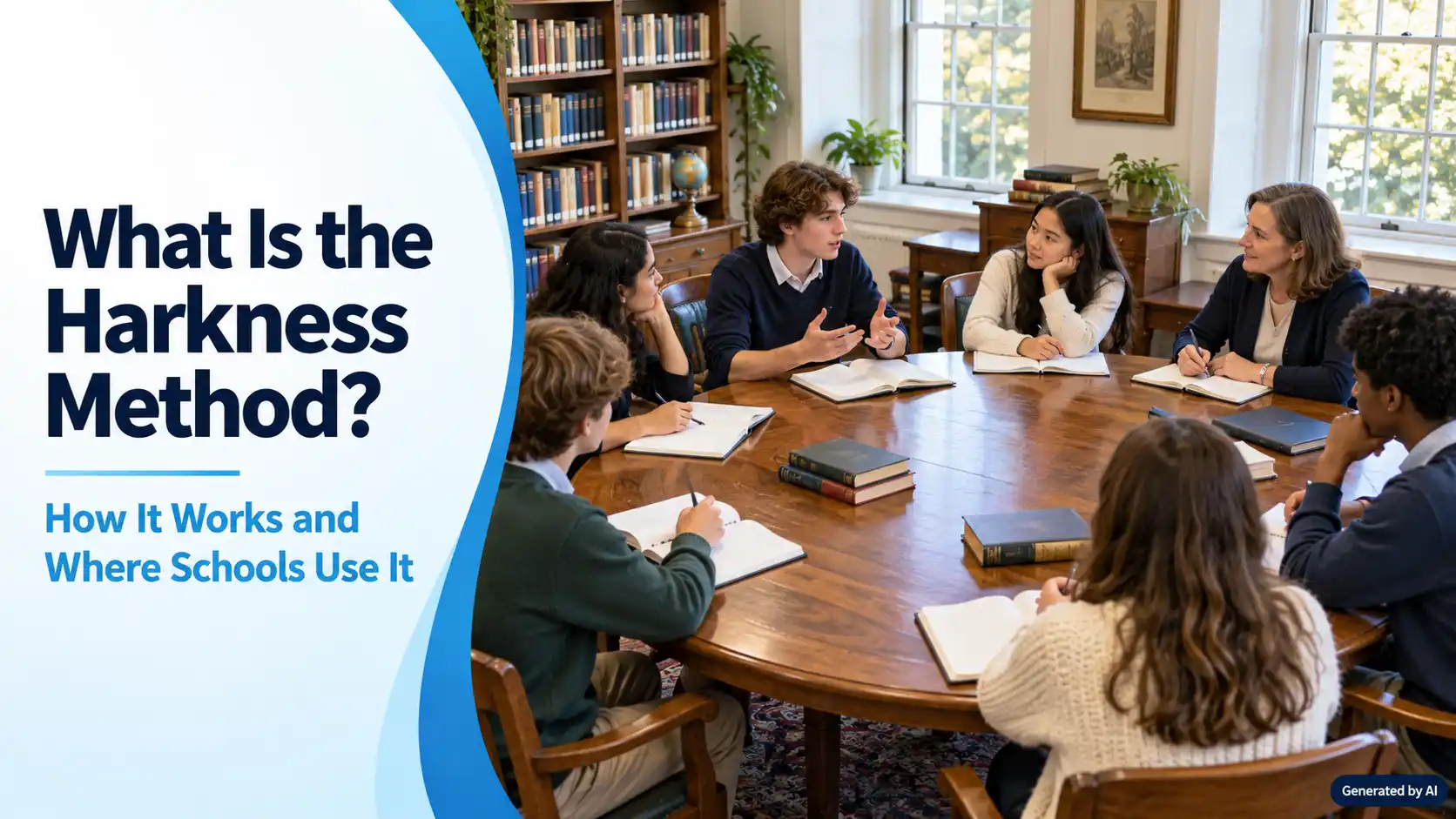
The Harkness method of teaching, sometimes called the Harkness discussion method, is an approach in which about twelve students and one teacher sit around an oval table and work through a text or problem together. Students lead the conversation, and the teacher guides it with minimal intervention. Phillips Exeter Academy in New Hampshire developed the method after a 1930 gift from philanthropist Edward Harkness, and many schools now run their own versions of it. Educators also call the approach Harkness pedagogy.
1. The Harkness Table and the Harkness Circle
Schools often use the table as shorthand for the whole Harkness method, and that table is oval, about 7 feet wide and 11 feet long, with seats for twelve students and one teacher. The oval shape lets the teacher and every student see everyone else.
Schools without oval tables sometimes arrange desks or chairs in a circle so every student can see one another, and the class runs the same student-led discussion. Teachers call this setup a Harkness circle. Larger classes sometimes split into two groups: an inner circle discusses while an outer circle watches and takes notes on the conversation, and then the groups switch.
Owning a Harkness table and practicing Harkness pedagogy are two different things. A school can install oval tables and still run most classes as lectures, while another school can run daily student-led discussion in a Harkness circle with ordinary desks. The method lives in how students prepare, how the teacher facilitates, and how the whole class shares the conversation. Families visiting a school can learn far more from how often, and in which subjects, students actually learn this way than from the furniture in the room.
How the Harkness Method Works
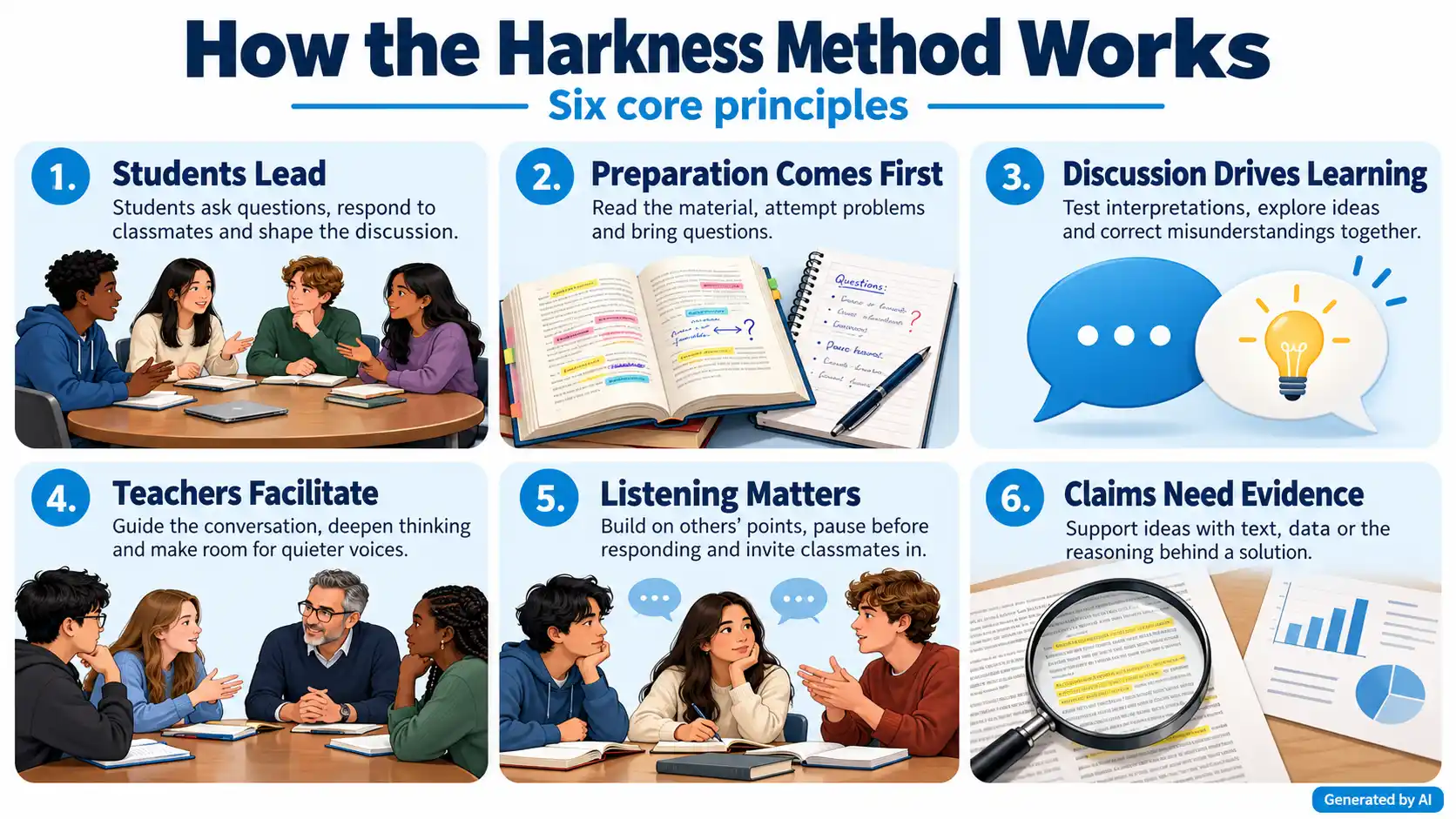
Schools adapt the Harkness method to their own schedules, subjects, and students, but a handful of principles define the Harkness philosophy. Those principles explain why a Harkness classroom feels so different from a lecture hall, and they show families what the method asks of a student every day.
1. Core Principles of Harkness Pedagogy
1.1 Students Lead the Discussion
Students pose the questions, respond to one another, and decide which ideas deserve more time. Comments travel across the table from student to student, and each speaker addresses classmates directly.
1.2 Preparation Comes First
Every student arrives having read the assigned text or attempted the assigned problems. Students mark key passages, write questions in the margins, and note where they disagree with the author or feel uncertain. The discussion depends on this work. A student who arrives unprepared has little to offer the table, and in a group of twelve, classmates notice quickly.
1.3 Discussion Carries the Lesson
Students meet new ideas, test interpretations, and correct their own misunderstandings through conversation. The discussion does the work that a lecture does in other classrooms.
1.4 The Teacher Facilitates
A facilitator guides a conversation from inside the group. The teacher chooses the material, asks an occasional question to deepen or redirect the discussion, and draws a quieter student into the conversation. Then the teacher steps back. In a well-run class, the teacher's voice is one among thirteen, and several minutes can pass without it.
Students also need to feel safe sharing an idea they have not fully worked out. A qualitative study of Harkness classrooms examined the teaching practices that make those intellectual risks possible, and it treats classroom culture as an important part of the method.
1.5 Listening Counts as Much as Speaking
A strong contribution builds on what the previous speaker said. At Exeter, students learn to pause for a moment before responding and to connect their point to the comment before it. Harkness teachers sometimes use the informal term "Harkness warrior" for a student who dominates the conversation. Learning when to hold back and invite others in is part of the skill the method develops.
1.6 Claims Rest on Evidence
Students back every claim with evidence from the text, the data, or the reasoning behind a solution. A simple teacher question keeps this habit in place: where does the text say that? In literature and history, students can reach different conclusions, provided each one holds up against the evidence. In mathematics and science, the class works toward a correct answer, and the discussion centers on the reasoning that gets there.
What a Typical Harkness Class Looks Like
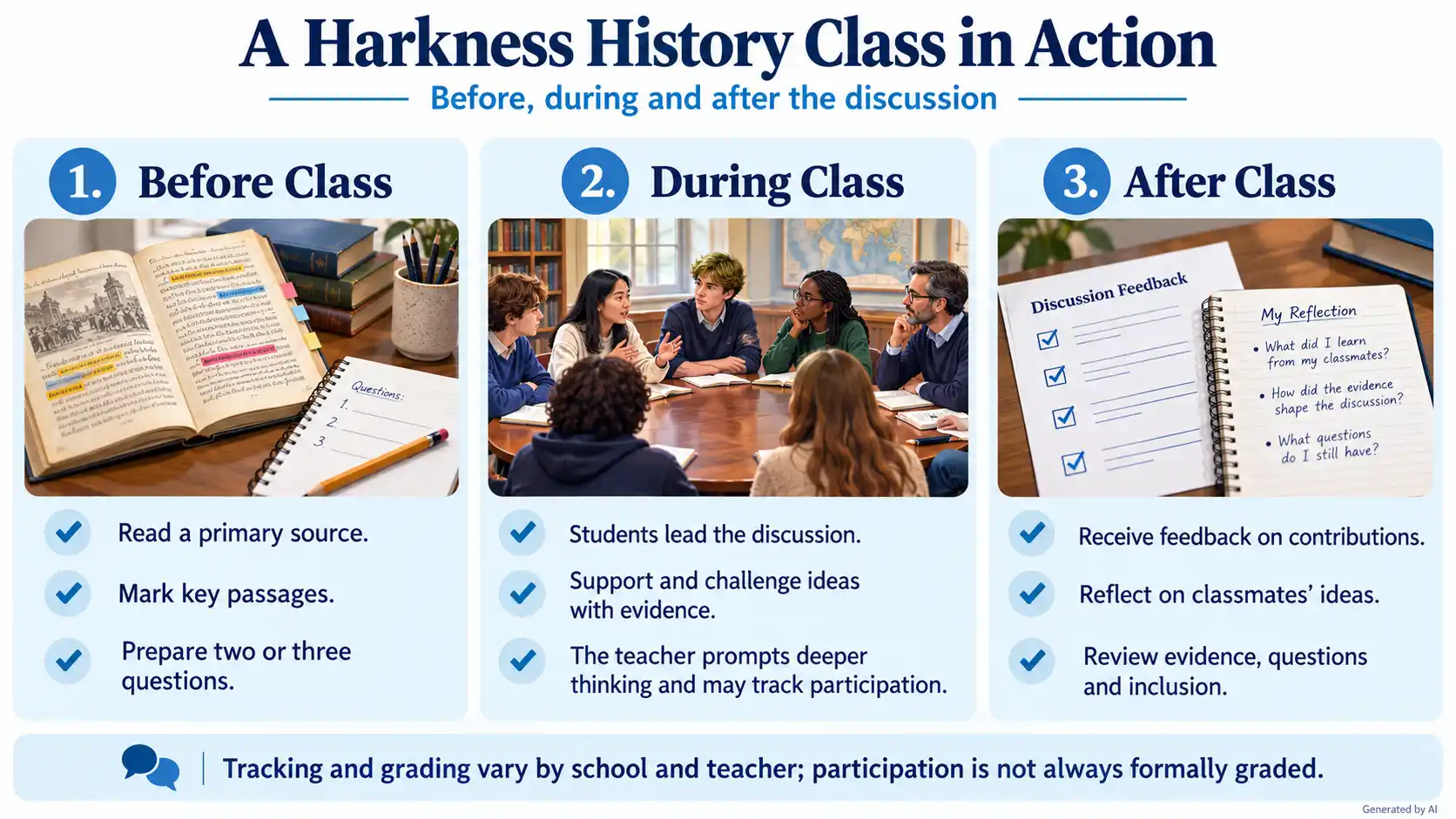
To see how these principles work together, here is one history class at a Harkness school, from the night-before reading to the feedback afterward.
1. Before Class
The night before, each of the twelve students reads a primary source, an original document from the period under study, such as a letter, speech, or treaty. Each student arrives with passages marked and two or three questions ready.
2. During Class
One student opens with a question about the author's motives. A second points to a line that complicates that reading. A third challenges both interpretations with a passage from earlier in the document. Twenty minutes in, the teacher asks a single question that pushes the class to consider how a reader at the time would have understood the document. The discussion shifts direction, and the students carry it forward.
Throughout the class, many Harkness teachers track the discussion. On a sheet of paper, the teacher sketches the table, marks where each student sits, and draws a line from each speaker to the next. Small symbols can record when a student cites the text, asks a question, or brings a classmate into the conversation. The finished diagram shows at a glance whether the conversation spreads across the class or rests on a few voices.
3. After Class
Students receive feedback on the discussion. A teacher might share the tracking diagram, score participation against a rubric, or talk with individual students about their contributions. A rubric is a scoring guide that lists the qualities a teacher looks for, such as citing evidence, asking productive questions, and drawing others into the conversation. A teacher might also ask students to reflect in writing, for example, on which classmate's point most changed their reading of the document.
Schools make separate decisions about tracking and grading. Some teachers track every discussion and grade participation formally, and others use tracking only as feedback.
The Harkness Method by Subject
The Harkness method spread across Exeter’s departments gradually. In 1973, science, music, art, and theater classes there still met in more traditional classroom settings. Today, the way Harkness works still varies by subject. A humanities discussion looks different from a lesson built around mathematical problems or a laboratory experiment.
1. Harkness in Humanities: English, History, Philosophy
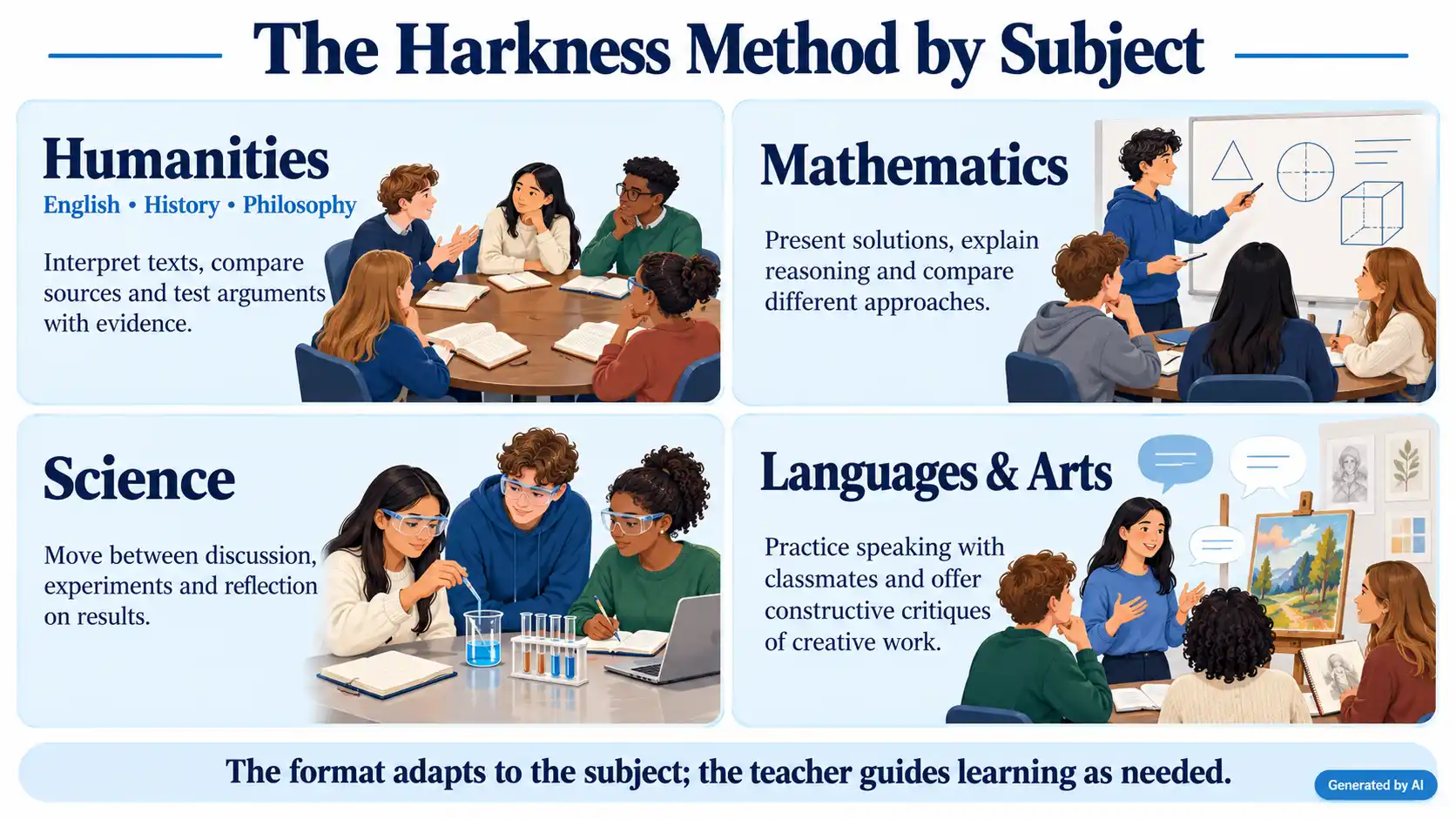
In humanities classes, discussion often centers on interpreting texts and testing arguments. An English class might spend a period on a single poem, weighing different readings of a line against the words on the page. In philosophy, students can examine an argument, identify its assumptions, and ask whether its conclusion follows. In history, they can compare sources, weigh competing accounts of an event, and build an interpretation together.
2. Harkness in Mathematics and Science
The Harkness method in math gives students problems to work through and reasoning to explain. Exeter’s mathematics faculty began developing their own problem sets in the 1990s and review and revise them each June. Students work on problems before class. During a typical geometry lesson, they present possible solutions on the board while classmates question the reasoning and compare different routes to an answer. The teacher guides the discussion and helps students connect new ideas to earlier work.
Science can move between discussion and hands-on work. At Milton Academy, for example, students move from the Harkness table to experiments and return to discuss their results. The teacher’s role can shift with the lesson: Exeter notes that introducing a new physics unit may require more direction and demonstration before students take greater ownership of the work.
3. Harkness in Languages, Arts, and Beyond
Schools also apply Harkness to languages and the arts. Exeter describes a first-year French class that holds its discussions in French, giving students practice speaking with classmates. Its drawing and painting students serve as peer critics, discussing one another’s work and offering useful analysis. These examples show how the form of discussion can change with the subject. Exeter also describes the Harkness approach as extending beyond class to the field, the stage, and common spaces.
Pros and Cons of the Harkness Method
The question for families is how a child grows within this kind of classroom. The Harkness method can give students room to develop their thinking and confidence, while also asking them to participate before they feel entirely sure of themselves.
|
Pros |
Cons |
|
Students learn to argue from evidence |
Daily preparation is required and visible across all subjects |
|
Students gain confidence in speaking |
Graded daily discussion takes adjustment for quieter or lecture-trained students |
|
Students practice active listening and building on others' ideas |
Group dynamics require active management to prevent a few voices from dominating |
|
Students take ownership of their learning |
Discussion takes more time than direct instruction; material selection matters |
|
Teachers can hear each student's reasoning directly and identify gaps in real time |
First months involve a learning curve — how to enter, disagree, and prepare |
1. Pros
Students learn to argue from evidence. Every class requires students to state a position, support it, and defend it in front of peers. Over time, that practice builds the habit of grounding claims in evidence.
Students gain confidence in speaking. In a practitioner study of Harkness lessons, students reported greater confidence, preparation, and participation over the course of the study. The researcher also emphasized that students need an environment where sharing an idea feels safe, a condition that shapes many of the method's challenges.
Students practice listening. A productive contribution depends on following the conversation closely, so students learn to hold other people's ideas in mind and build on them.
Students take ownership of their learning. With no lecture to fall back on, students take responsibility for understanding the material and for moving the discussion forward.
Teachers see understanding directly. In a group of twelve, a teacher can hear how each student reasons through a problem and identify gaps in understanding as they appear.
2. Cons
The workload is daily and visible. Each Harkness class depends on a prepared reading or problem set, so a school that uses the method across subjects asks for that preparation every night.
Speaking under assessment takes adjustment. A student who prefers to think quietly before speaking, or who comes from a school built around lectures, can find graded daily discussion difficult at first. Some teachers set explicit expectations for newer students, such as speaking a set number of times per class, to make the transition more manageable.
Group dynamics require active management. A few confident speakers can dominate a discussion, and quieter students can drift to the margins. The quality of a Harkness class depends heavily on the teacher's skill at balancing the conversation.
Discussion takes time. Working through ideas together takes longer than explaining them directly, so teachers must choose material carefully. Practice also varies by subject, and technical subjects such as math and physics adapt the method differently from humanities classes.
The first months bring a learning curve. A student new to Harkness has to learn how to enter a conversation, how to disagree respectfully, and how much to prepare. Some schools open the year with practice discussions and warm-up exercises, and the length of the adjustment varies from school to school. Families deciding when to start can read about boarding school age.
Boarding Schools That Use the Harkness Method
Boarding schools around the world use the Harkness method, and they apply it at different levels. Some teach the full curriculum around the table, while others use it in selected grades or subjects.
The McMillan Education Boarding School Guide lists schools that use the method across multiple destinations, and families can compare them side by side with the comparison tool.
1. United States
Phillips Exeter Academy, New Hampshire: developed the Harkness method and uses it across its curriculum.
The Lawrenceville School, New Jersey: adopted Harkness in 1936 and places discussion around the table at the center of its teaching.
The Masters School, New York: describes Harkness as central to classroom learning, with examples in computer science, history, and Latin.
St. Paul’s School, New Hampshire: teaches its four-year interdisciplinary humanities program in Harkness-style classes.
Browse boarding schools in the US
Families preparing applications can read how to apply to boarding schools in the US.
2. United Kingdom
Wellington College, Berkshire: describes a Harkness philosophy that encourages discussion and debate, often with students seated at round tables.
Berkhamsted School, Hertfordshire: uses boardroom-style tables in its Sixth Form classrooms to support student-led discussion based on the Harkness model.
Browse boarding schools in the UK
Families preparing applications can read how to apply to boarding schools in the UK.
3.Canada
Trafalgar Castle School, Ontario: uses Harkness discussions in Liberal Arts and Humanities courses, including a Grade 12 discussion of human rights law.
Upper Canada College, Ontario: a school-published account describes Harkness table discussions in humanities classrooms.
Browse boarding schools in Canada
Families preparing applications can read how to apply to boarding schools in Canada.
4. Switzerland
TASIS, The American School in Switzerland, Montagnola: its 2026–27 course guide includes Harkness discussions in IB English Language and Literature.
Browse boarding schools in Switzerland
Families preparing applications can read how to apply to Swiss boarding schools.
Deciding on a Harkness School
Every student responds to a school's teaching method differently, and it is one factor among several in choosing a boarding school. Considering it alongside curriculum, class size, and location takes close knowledge of how schools operate. McMillan Education has planned school placements for more than 70 years, and our boarding school consultants weigh those factors together for each student.
To plan a school list around your child, schedule a free consultation with an educational consultant.
Frequently Asked Questions
1. What are the key principles of the Harkness method?
The method rests on six principles: students lead the discussion, every student prepares in advance, discussion serves as the main vehicle for learning, the teacher facilitates with minimal intervention, listening counts as much as speaking, and every claim rests on evidence.
2. How does Harkness differ from traditional learning?
In a traditional classroom, a teacher stands at the front and presents material while students take notes. In a Harkness classroom, students sit with the teacher around a table and learn through discussion with one another. Students take responsibility for preparing the material and moving the conversation forward, and the teacher guides the discussion from within the group.
3. What is the difference between Socratic and Harkness?
A Socratic seminar is a structured class discussion organized around questions about a shared text. Both approaches can involve student discussion. In a Harkness discussion, the emphasis is on students developing questions and responding directly to one another; Socratic seminars vary in how much the teacher directs the questioning. As a general tendency, comments in a teacher-directed discussion pass through the teacher at the center, while in a Harkness discussion they run between students across the table. A class can blend elements of both, so asking who poses the questions shows which model a school follows.
4. What is the ideal class size for Harkness?
Exeter built the method around twelve students and one teacher, the number a traditional Harkness table seats. Some schools run slightly larger groups. For bigger classes, teachers often use a fishbowl arrangement: an inner circle of students discusses while an outer circle observes and tracks the conversation, and the two groups then switch.
5. Does the Harkness method work for math and science?
Yes. In math, students work through problems before class and present their solutions at the board while classmates question the reasoning. Science classes can move between the table and hands-on experiments, then return to discuss the results. Teachers sometimes give more direction when a new topic calls for it.