The Benefits of Single-Gender Education: What the Research Says About All-Boys and All-Girls Schools

Are single-sex schools still relevant? Do all-boys and all-girls boarding schools actually produce better outcomes, or is that a legacy assumption? And what about the concerns: the socialization, the stereotyping, the question of whether a single-gender education prepares students for a mixed-gender world? These are fair questions, and the answers are worth looking at carefully before making a decision that shapes several years of a child's education.
This article covers what single-gender education is, what the research shows about the benefits of single-sex schools, what all-boys and all-girls boarding schools actually produce for their students, and how to decide between a single-sex and co-educational boarding school. It also takes the common misconceptions head on, because most of them do not hold up under scrutiny.
What Are Single-Sex Schools?
Single-sex schools, also referred to as single-gender schools, are schools that educate one gender only. All-boys schools admit boys exclusively. All-girls schools admit girls exclusively. Both models exist across schools in the United States, the United Kingdom, Europe, Switzerland, Canada, and Australia, and many of the most established examples are boarding schools with long institutional histories.
Single-gender education is not the same as a co-educational school that runs single-sex classes in certain subjects. In a dedicated single-sex school, the entire institution operates around one gender: the classrooms, the sports program, the dormitories, the leadership structure, and the social life of the school. That comprehensive setting is what produces the outcomes described in this article.
In a boarding school, the effect goes further than it can in any day school. The benefits of boarding schools as a format are well documented; single-sex adds a specific layer on top. A student at a single-sex boarding school does not pass through the environment between lessons. They live in it, every day, for the duration of their time at the school.
The Advantages of Single-Sex Schools
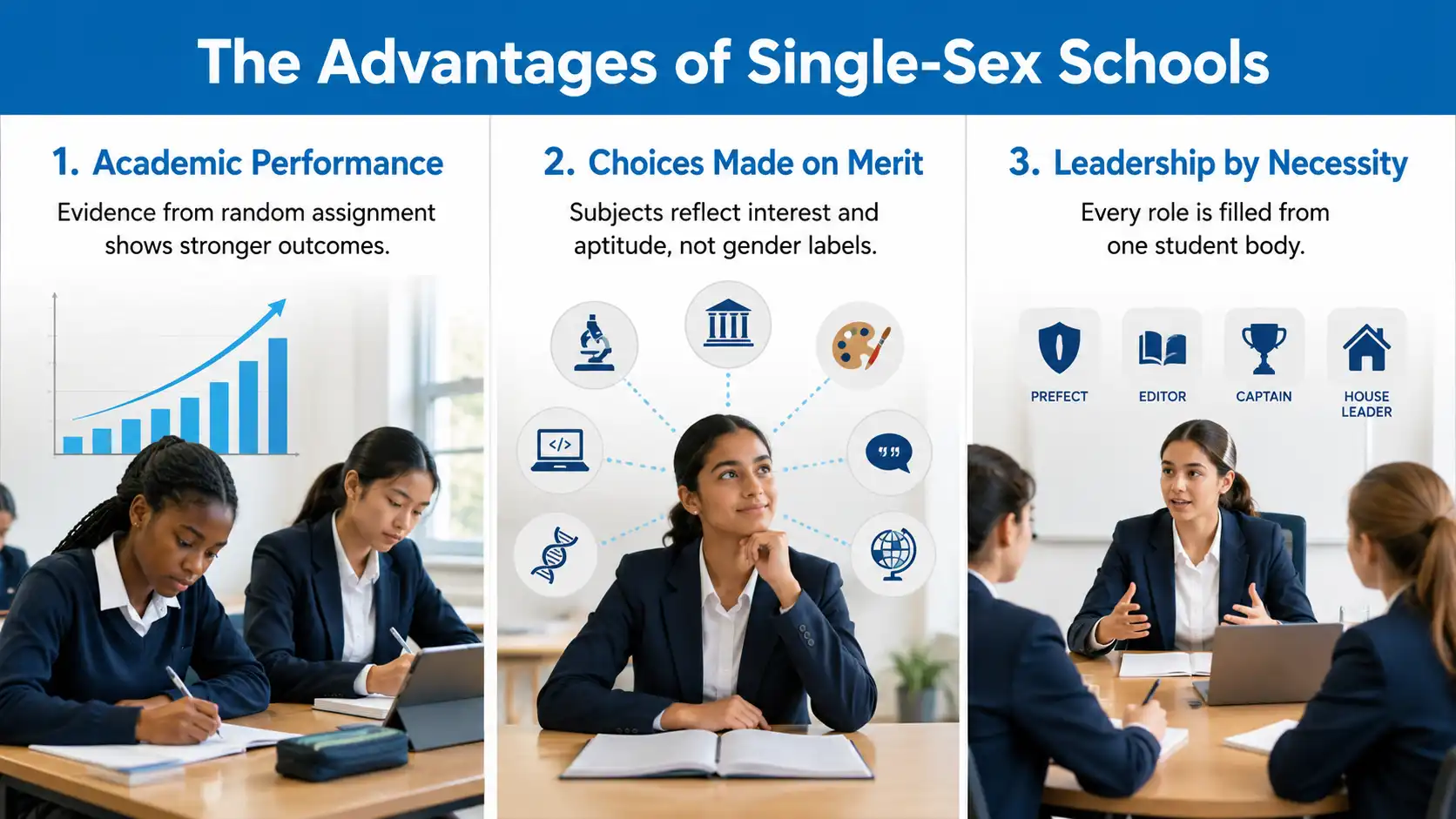
Single-sex schools work on one principle: they take gender out of the room. Once a classroom, a team, or a dormitory holds one gender, the social calculations that shape how students behave in mixed company fall away. What a student chooses to study, how freely they speak, and which roles they take on stop signaling anything about gender. In boarding schools, where the single-gender setting covers the whole of a student's life rather than the school day alone, that effect reaches further than it can anywhere else.
1. Academic Performance
Most research on single-sex schooling runs into the same difficulty. Families who choose these schools differ from families who do not, so it is hard to separate what the school did from what the student already brought. Seoul settles the question. Students there are assigned to single-sex and co-educational high schools at random, which means the outcome reflects the setting rather than the family. Students in single-sex schools outperformed their co-educated peers across subjects and year groups (Park, Behrman & Choi, 2013). When some of those schools later converted to co-educational, results fell, which pointed to the format itself as the driver rather than the students it happened to enroll.
2. Choices Made on Merit
In a mixed classroom, certain subjects arrive already labeled. Some read as subjects for boys, others as subjects for girls, and students sort themselves accordingly long before a teacher says a word. A single-sex school removes that labeling at the source. When everyone in the room shares one gender, the pull toward or away from a subject on the basis of who is expected to take it disappears, and what remains is interest and aptitude.
This is the mechanism behind much of what the gender-specific sections describe below. The school does not teach these subjects any differently. It places the decision to study them in an environment that has stopped attaching gender to the choice.
3. Leadership by Necessity
Every position a single-sex school has to offer is filled by one gender, because there is no other group to fill it. Head of house, team captain, council chair, prefect, editor of the paper. In a mixed school these roles are open to all and, in practice, often settle along familiar lines. A single-sex school has no such fallback. The full range of responsibility is distributed across one student body as a matter of arithmetic, not aspiration, and in a boarding school that responsibility extends into the residential life of the house as well as the timetable. What this produces differs for girls and for boys, and the sections that follow take each in turn.
Benefits of Single-Sex Education for Girls
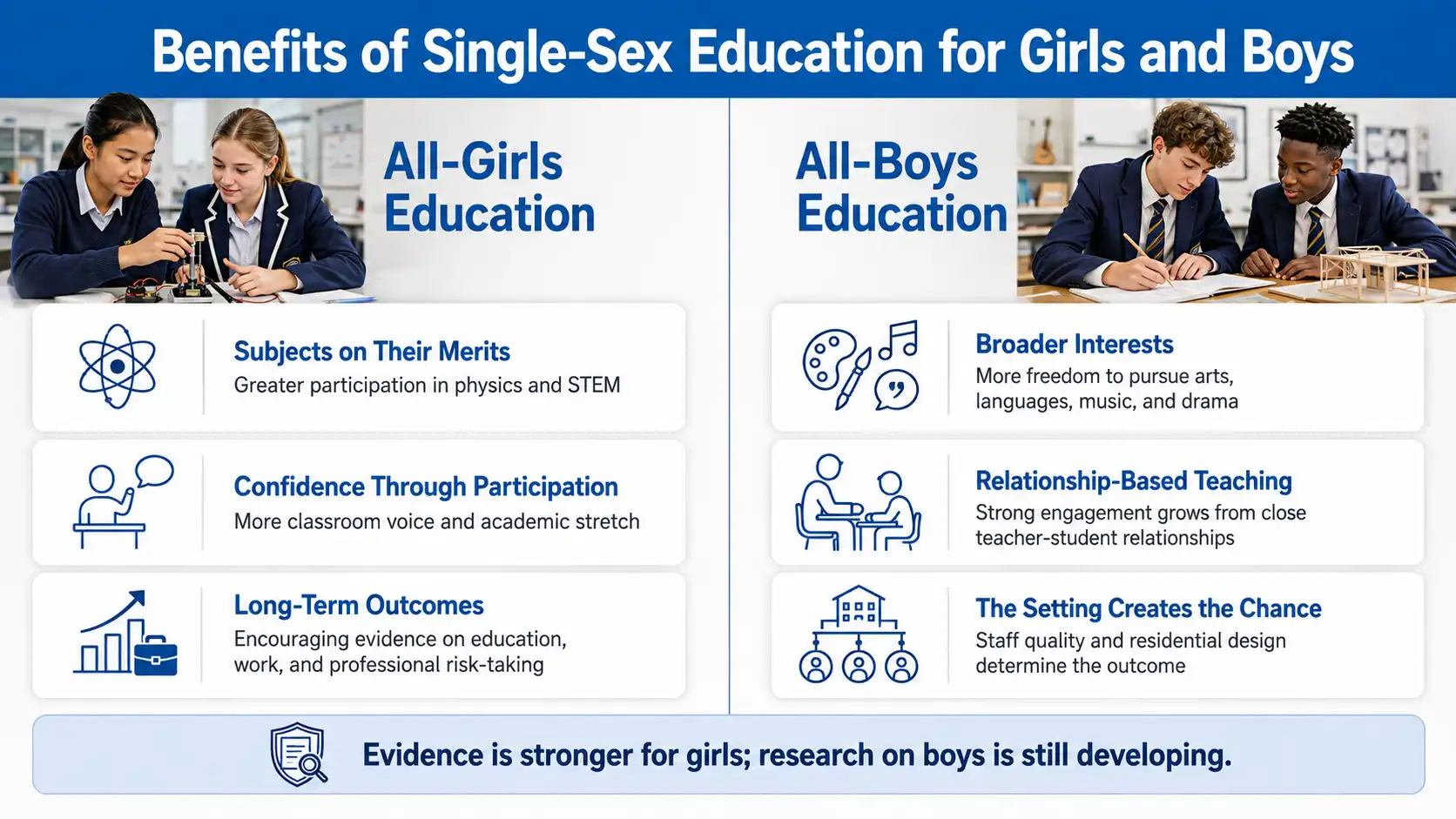
The evidence for all-girls education is the strongest and most consistent in this field, and it concentrates in two areas where the gap with co-education is widest: what girls choose to study, and where they end up as adults.
1. She Takes Subjects on Their Merits
The clearest measurable effect of an all-girls school is in the sciences. Institute of Physics research found that single-sex schools sent proportionally 2.4 times as many girls on to A-level physics as co-educational schools in England (Closing Doors, 2019). Girls' school graduates are also markedly more likely to go on to consider math, science, technology, and engineering at university.
A boarding school carries that culture through the whole of a girl's day, in the lab, the evening study session, and the ordinary conversations between students who take these subjects as a matter of course. The subject stops being a decision a girl has to justify and becomes simply one of the things her school does.
2. She Grows Into Her Confidence
Girls at all-girls schools report participating more fully in class and feeling more stretched by their work. The classroom pressures that lead some girls to hold back in mixed settings are not present, so a girl learns early that being the most driven student in the room costs her nothing.
In boarding, this runs through far more than lessons. A girl who argues a point in a morning seminar brings the same assurance to a house meeting that night. Built continuously, across every part of school life rather than a few hours of it, that assurance tends to settle in for good.
3. Her Gains Reach Into Adult Life
Some of the most compelling evidence looks well past graduation. Drawing on Seoul's random assignment, researchers followed women into their thirties and forties and found that those who had attended all-girls high schools were more likely to hold a bachelor's degree, more likely to work full-time, more willing to take professional risks, and more inclined to embrace competition than women who had attended co-educational schools (Kim, Park & Behrman, 2024). Research on long-term outcomes is still developing and results vary by measure, but the direction of this evidence is encouraging.
These are the outcomes families are really planning toward. An all-girls boarding school is not preparing a student for her next set of exams. It is helping shape the adult she becomes.
Benefits of Single-Sex Education for Boys
The research on all-boys schools is thinner than the research on all-girls schools, and worth reading with that in mind. Where it is clear, it points to a broader kind of student than the format is usually assumed to produce, and to a style of teaching built around how boys engage.
1. He Ranges More Widely
The common worry about all-boys schools is that they turn out a narrow sort of boy. The evidence points the other way. Boys from single-sex schools are more than twice as likely to pursue interests in art, music, drama, and foreign languages compared with boys at co-ed schools, and that breadth tends to stay with them well beyond school.
In a boarding school this plays out across the full day. A boy moves between the sports pitch and the recital hall without anyone weighing what either choice says about him, and the boys around him are doing the same.
2. He Is Taught the Way He Learns
Work from the International Boys' Schools Coalition points to a consistent finding: boys apply themselves most productively when a teacher knows them well and invests in a genuine working relationship. All-boys schools are built with this dynamic in view, and a boarding school extends it far past the timetable. Housemasters, tutors, and older boys form a web of relationships that runs through breakfast, the touchline, and the common room.
3. The Setting Creates the Chance
One straight point for families. The all-boys format creates the conditions for this kind of teaching and development. It does not deliver them on its own. The caliber of the staff and the design of the system decide whether the potential turns into anything. In weighing up an all-boys boarding school, look closely at how teachers are trained and how the residential structure actually works day-to-day, not at the academic record alone. A strong setting opens the chance; the school itself has to take it.
Addressing the Misconceptions About Single-Sex Schools
The concerns around single-gender education are understandable, and most families encounter at least one before making a decision. Looking closely at each, the picture is quite different from what the assumption suggests.
1. On Socialization
The most common concern about single-sex schools is that students miss the everyday experience of interacting with the opposite sex and graduate socially underprepared. Boarding schools have long since built the answer into their programs. Inter-school fixtures in sport, joint theater and music productions with partner schools, formal sister and brother school relationships, and shared weekend events are standard rather than exceptional.
The environment students learn in is single-sex. The environment they socialize in is not. For families still weighing the emotional side of this decision, our article on the reality of sending your child to boarding school addresses that directly.
2. On Gender Stereotyping
A second concern, sometimes raised with academic backing, is that separating boys and girls reinforces the idea that they are fundamentally different and should be treated differently. The most cited version of this argument, Halpern and colleagues in Science (2011), was aimed specifically at poorly run single-sex classrooms inserted into co-educational schools, where teachers used gender as an organizing label and the separation itself became a source of stereotyping.
A dedicated single-sex school with a trained faculty operates differently. The evidence from these schools cuts against the stereotyping claim in practical terms: girls at single-sex schools take physics and further math at notably higher rates than co-ed peers, and boys at single-sex schools pursue arts, music, and languages more broadly. In each case, the pattern shows students moving across expected gender lines, not being locked further into them.
3. On Academic Standing
Some families assume that selective co-educational schools produce stronger academic outcomes, and that choosing a single-gender school means accepting a trade-off in academic quality. This is one of the more clearly answerable misconceptions.
The causal research covered earlier in this article, using random school assignment to control for family and student factors, found that single-sex students outperformed co-educated peers across subjects and year groups. The academic case for single-sex schools is not that they are elite. It is that the format itself contributes something measurable to how well students do.
4. On Real-World Preparation
A related concern is that time in a single-sex environment leaves graduates ill-prepared for the mixed-gender universities and workplaces they will enter. It is worth thinking about what that concern actually assumes: that exposure to the opposite sex in a classroom is what prepares students for professional life. The more plausible preparation is confidence, subject range, leadership experience, and academic grounding – all of which single-sex boarding schools are structured to develop. Students who have held real responsibility, studied broadly, and spoken freely throughout their education tend to enter the world with a strong foundation under them.
Single-Sex vs. Co-Ed Boarding Schools: Which Is Right for Your Child?
Every child is different, and the right boarding school is the one that fits the child. Some families read the evidence on single-sex education and recognize their child in it immediately. Others feel that a co-educational environment is a better match for how their child learns and grows socially. Both are sound decisions when the school itself is strong.
A few things worth thinking through before narrowing the list.

1. Ask the Child
Older students especially should have a real say in this decision, and the age at which a child starts boarding school shapes how much weight that voice carries. A child who has a strong instinct about the kind of environment they want to be in is usually right, and that instinct is worth taking seriously alongside the research.
2. Look at the World They Have Grown Up In
A child's existing social world is a useful starting point for the conversation. Some children feel immediately at home in a single-sex environment; others warm to it gradually over the first term. A taster visit usually tells you more than any amount of reading.
3. Book a Taster Day
Many boarding schools offer short-stay or taster programs, and these are the most reliable way to gauge whether the environment suits a child before committing. A single-sex school that felt abstract on paper can become immediately clear after a child has spent a few days inside it. Ask directly whether the school offers this when making initial contact.
4. Visit With Purpose
When touring schools, watch how students interact outside lessons, how the boarding house runs in the evening, and which students take on visible responsibility. Pay attention to whether your child responds to the environment they see and whether they can picture themselves in that daily life. A good boarding school functions as a second home, and that quality is visible on a visit.
Start with our school finding tool to filter directly for all-boys, all-girls, and co-educational boarding schools and compare schools side by side on academics, support services, location, and boarding culture.
Or try our school matching quiz to get a personalized list of schools ranked by how well they fit your child across location, size, academic focus, support needs, and gender preference.
Plan Your Child's Boarding School Admission
Choosing between single-sex and co-educational boarding schools is one part of a broader admissions process that varies significantly by destination, school type, and your child's academic profile. McMillan Education has placed students at boarding schools across the United States, United Kingdom, Europe, Canada, and Switzerland for over 70 years.
McMillan Education’s boarding school admissions consultants cover the full process: identifying the right schools for your child, preparing a strong application, and drawing on decades of institutional relationships across every major boarding school destination.
Schedule a free consultation to get started.
Frequently Asked Questions
1. Do students at single-sex boarding schools miss out on social development?
Most single-sex boarding schools run regular co-educational activities: joint sport fixtures, shared productions, and formal partnerships with brother or sister schools. Students interact across gender lines throughout their school lives; the single-sex element applies to the learning environment, not the social one.
2. What are the benefits of an all-girls boarding school specifically?
Girls at all-girls schools take STEM subjects at significantly higher rates than peers at co-educational schools. They also report higher academic engagement and confidence. Long-term research shows higher rates of degree completion and full-time employment in adulthood.
3. What are the benefits of an all-boys boarding school specifically?
Boys at all-boys schools engage more broadly across subjects, including arts, music, and languages, than boys at co-educational schools. The format also tends to support stronger individual relationships between teachers and students, which research identifies as a key factor in how boys learn.
4. Do graduates of single-sex boarding schools struggle at co-ed universities?
The available evidence does not support this concern. Girls' school graduates report higher confidence at university entry and stronger leadership participation. Boys' school graduates show broader subject engagement and stronger faculty relationships that carry into university. Both tend to transition well into co-educational environments.
5. Is a single-sex boarding school right for every child?
No school type is right for every child. Single-sex boarding schools suit students who respond well to that environment, but a strong co-educational school will be the better choice for others. The specific school, the child's personality, and the family's priorities all factor into the decision.
6. At what age should a child start at a single-sex boarding school?
This depends on the child, the country, and the school. UK boarding schools commonly admit from ages 7, 11, and 13. US boarding schools most often begin at Grade 9, typically age 14. Our guide on boarding school age covers the full range of options.
7. Are there specific entrance exams for single-sex boarding schools?
Most single-sex boarding schools in the US require the same admissions tests as co-educational schools. The SSAT is the most common. UK schools typically set their own entrance examinations.
8. Are single-sex boarding schools different in the UK and the US?
Yes. The UK boarding schools have one of the longest traditions of single-sex education in the world, with many schools operating on that model for centuries. In the US, single-sex boarding schools are less common and concentrated mostly among older independent schools on the East Coast. The two systems also differ in curriculum and admissions structure, and those differences between boarding schools in the UK and the US apply to single-sex schools as much as to any other.