ISEB Common Pre-Test: How It Works, When to Sit It and What Families in the UK and Abroad Need to Know
The families best placed at the first stage of UK boarding school admissions are those who understand the ISEB Common Pre-Test before Year 6 begins, since a single result can shape an application years ahead of entry. This article explains how the ISEB pre-test works, when to sit it and how families in the UK and abroad can plan for it.
Key Takeaways
The ISEB Common Pre-Test is a set of four online entrance tests that UK independent senior schools use early in admissions for Year 7 and Year 9 entry.
The four tests cover English, mathematics, verbal reasoning and non-verbal reasoning, and take about 2 hours 15 minutes in total.
The format is multiple-choice and adaptive, so question difficulty adjusts to each answer.
The ISEB Common Pre-Test is designed for students in Year 6 or Year 7. For 11+ entry, students usually take it in Year 6, while schools using it for 13+ entry set their own testing deadlines.
Registration through ISEB’s Guardian Portal is free.
A student sits the pre-test once per academic year, and the results can be shared with every senior school the family applies to.
What Is the ISEB Common Pre-Test?
The ISEB Common Pre-Test is a set of four online, adaptive, multiple-choice tests in English, mathematics, verbal reasoning and non-verbal reasoning, which UK independent senior schools use to assess applicants for Year 7 and Year 9 entry. One sitting produces age-standardized scores that can be shared with every senior school the family applies to.
ISEB stands for the Independent Schools Examination Board, and the pre-test is the ISEB exam families meet first; the same board also sets the Common Entrance examinations sat in Year 8 for 13+ entry. ISEB now refers to the assessments as the ISEB Pre-Tests and notes that families also call them “the 11+” or simply “the ISEB.”
For families accustomed to American boarding school admissions, the pre-test occupies a position comparable to that of the SSAT in US boarding school applications: a standardized measure that schools read early, alongside reports and interviews, when deciding which applicants to take forward.
Families researching UK boarding schools will find the pre-test listed among the entry requirements at a number of selective senior schools.
How Does the ISEB Common Pre-Test Work?
The ISEB Common Pre-Test consists of four separate online tests, each made up of multiple-choice questions that adapt in difficulty to the student’s previous answers. Students sit the tests under supervision at an approved invigilation center, either in a single day or across separate sessions, and the full set takes about 2 hours 15 minutes.
| Test | Time | What it assesses |
|---|---|---|
| English | 40 minutes | Reading comprehension, spelling, punctuation, grammar and vocabulary |
| Mathematics | 40 minutes | Number, calculation and problem solving based on the National Curriculum to the end of Year 5 |
| Verbal reasoning | 25 minutes | Word, letter and code puzzles that test language-based logic |
| Non-verbal reasoning | 30 minutes | Shape, pattern and spatial puzzles that test visual logic |
Format, Adaptive Questions and Test Day
Each test is adaptive, which means it adjusts as the student goes: a correct answer leads to a slightly harder question, and a wrong answer leads to a slightly easier one. This way the test settles quickly on the level that suits each student, so no two students see exactly the same questions, and harder questions partway through simply mean the student is answering well.
On test day, students take the tests on a computer at a supervised test center, which ISEB calls an invigilation center. Each question has one correct answer to select, and once an answer is submitted, the student moves on and cannot go back to it. Students can use pen and paper to work out answers; the on-screen timer can be hidden, and the text size and background color can be adjusted. The real test includes no practice questions, so seeing the format beforehand gives a student the full time for the questions that count.
What the Four ISEB Tests Cover
English (40 Minutes)
The ISEB English test checks how well a student reads and understands a short passage, along with spelling, punctuation, grammar and vocabulary. Sample ISEB test questions in English ask students to answer questions about a passage, pick the word that best completes a sentence, or spot the line with a spelling or punctuation mistake. The test uses British spelling, so a student from a US school will see “colour,” “organise” and “centre” marked as correct, which is worth practicing in advance.
Mathematics (40 Minutes)
The mathematics test covers what UK students learn up to the end of Year 5, which is roughly the level of US 4th grade. Typical questions include word problems with money in pounds and pence or measurements in centimeters and kilograms, sums with fractions, decimals and percentages, and reading information from tables and charts. Students from US or IB schools may have learned some topics in a different order, so checking the Year 5 content early is a sensible step, particularly given the wider differences between British and American schools.
Verbal Reasoning (25 Minutes)
The ISEB verbal reasoning test uses word and letter puzzles to see how well a student spots patterns in language. A typical question might ask for the missing word in “hot is to cold as early is to ___,” ask which word does not belong in a group, or ask the student to work out a word written in a simple letter code. Many questions depend on knowing the meaning of words, so regular reading in British English pays off here as well as in the English test.
Non-Verbal Reasoning (30 Minutes)
The ISEB non-verbal reasoning test uses shapes and patterns in place of words. A typical question might ask which shape comes next in a sequence, which shape is the odd one out, or how many blocks make up a 3D figure. Because the questions rely so little on English, this test is the one least affected by the school system a student comes from.
How Is the ISEB Pre-Test Scored?
The ISEB Common Pre-Test has no pass mark. Senior schools receive the results as age-standardized scores, which are adjusted for the student’s age and compared with other children applying to independent schools, with 100 as the average.
Adjusting for age means that a younger child in the year group, or a child who takes the test early in the autumn, is measured fairly against older children or those who test in the spring. The ISEB results are shared with the senior schools the family applies to, and each school reads them alongside school reports, references, interviews and its own assessments. Schools may use pre-test results alongside school reports, references and interviews to decide which applicants progress to the next stage. Final offers depend on the school's full admissions process.
When Do Students Take the ISEB Pre-Test?
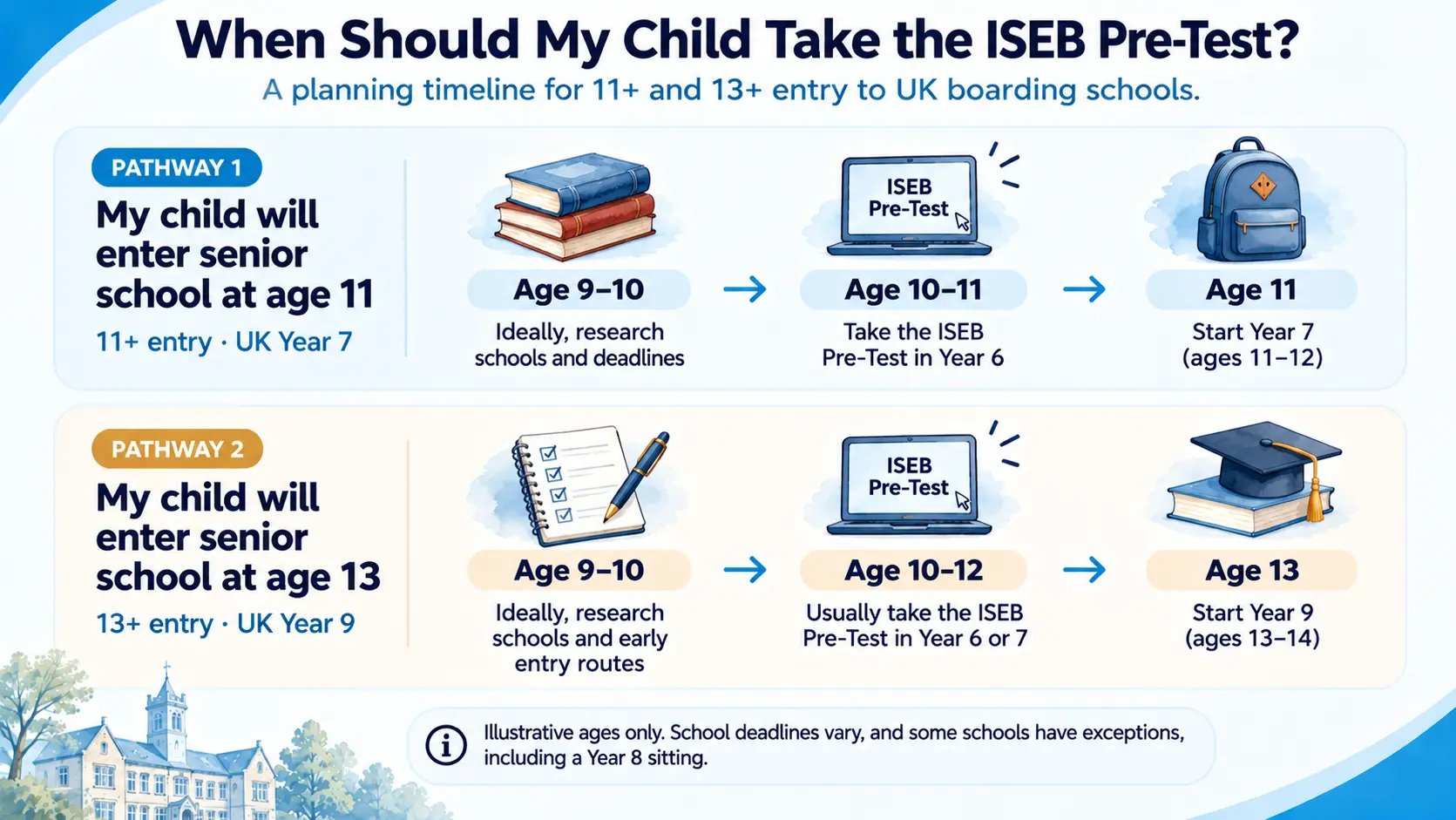
For the 2026-27 admissions cycle, the ISEB testing window runs from September 1, 2026, through late May 2027, and each senior school sets its own deadline within that window. Students usually sit the test in Year 6 for 11+ entry. For 13+ entry, schools typically arrange testing in Year 6 or Year 7, although families should confirm each school's requirements.
For families outside the UK, Year 6 is the equivalent of US 5th grade, Year 7 of 6th grade and Year 9 of 8th grade, and our guide to boarding school age explains when students can start at each stage.
The timeline looks quite different depending on whether a student is applying for Year 7 or Year 9, as the two entry points below show.
Entry at 11+ (Year 7)
For entry into Year 7, students sit the ISEB pre-test in Year 6, the same school year in which the family applies, and ISEB notes that this is the entry point for which most children take the tests. Registration, booking a test center and the first school deadline therefore all fall within a few months of each other.
Entry at 13+ (Year 9)
Year 9 entry follows a much longer timeline. Students typically sit the ISEB pre-test in Year 6 or Year 7, depending on the school. Schools use the results in different ways. On a standard route, the score decides which students go on to the school’s own assessments and interviews. On an early route, a strong result can secure a Year 9 place two or three years before entry. A family that starts planning in Year 8 may find that early-route deadlines have already passed, which is why the 13+ timeline deserves attention from Year 5 onward.
Which UK Boarding Schools Use the ISEB Pre-Test?
UK independent senior schools use the ISEB Common Pre-Test for both 11+ and 13+ entry, and each school sets its own route. The schools listed here all use the ISEB pre-test in their admissions process. They are illustrative examples, with many more UK boarding schools using the test, and the way each school applies it varies widely, so the details below are worth confirming with each admissions office before registering.
Schools Using the ISEB Pre-Test at 11+
St Swithun’s School
St Swithun’s is a girls’ school in Winchester that uses the ISEB pre-test at both of its main entry points.
Route: UK-based applicants sit the pre-test; overseas applicants whose first language is English may also sit it, and those whose first language is not English take UKiset in its place
When: By mid-November of Year 6 for Year 7 entry, and by mid-November of Year 8 for Year 9 entry
What follows: The school’s own papers, in English and mathematics for Year 7 entry, and in English, mathematics, science and a language for Year 9 entry
Caterham School
Caterham is a co-educational day and boarding school in Surrey that uses the ISEB pre-test for Year 7 entry, with half weekly boarding (two or three nights a week) available from 11+ and full and weekly boarding from 13+.
Route: All Year 7 applicants sit the pre-test; families based overseas contact the admissions office for guidance
When: At Caterham on November 14, 2026, or at the student’s current school in November or December, for 2027 entry
What follows: An informal interview, a reference from the current school, and the EDGE Experience Day in January with assessed papers in mathematics and in writing, critical thinking and problem solving
Wycombe Abbey
Wycombe Abbey is a girls’ boarding school in Buckinghamshire that uses the ISEB pre-test as the first stage of entry at 11+ and 13+.
Route: Taken at the student’s current school, a UK test center or a local British Council office
When: In the autumn of Year 6 for Year 7 entry
What follows: An assessment day in Year 6 with an interview, group activities, and English and mathematics exams
King Edward’s School, Witley
King Edward’s is a co-educational boarding school in Surrey for students aged 11 to 18 that uses the ISEB pre-test for Year 7 entry.
Route: Every registered applicant is invited to sit the pre-test
When: At the student’s current school on a date that school sets, or at King Edward’s in the December before the year of entry
What follows: School reports and an interview with the head or a senior teacher
Epsom College
Epsom College is a co-educational day and boarding school in Surrey for students aged 11 to 18 that uses the ISEB pre-test for Year 7 entry.
Route: All Year 7 applicants sit the pre-test; overseas applicants can take it at their own school, a British Council office or another approved test center
When: In the autumn of Year 6, usually at the student’s current school
What follows: An Engagement Day in January of Year 6 with no further exams, then offers in early February
Schools Using the ISEB Pre-Test at 13+
Radley College
Radley is a boys’ boarding school in Oxfordshire that uses the ISEB pre-test as the first step for Year 9 entry.
Route: Standard
When: By the end of November of Year 6
What follows: An interview for shortlisted students and a report from the current head
Harrow School
Harrow is a boys’ boarding school in northwest London that uses the ISEB pre-test for Year 9 entry.
Route: Standard; applicants at overseas schools follow the same key dates
When: Before November 30 of Year 6
What follows: The school’s own assessments; applicants from Hong Kong and mainland China register through Harrow’s representatives
Lancing College
Lancing is a co-educational boarding school in West Sussex that uses the ISEB pre-test for its early Year 9 offers.
Route: Early, through the school’s Advance Programme
When: Year 6
What follows: The pre-test is used alongside CAT4 results, and the school offers an alternative entry route for applicants who miss the Advance Programme deadline.
Shrewsbury School
Shrewsbury is a co-educational boarding school in Shropshire that offers the ISEB pre-test as an optional early route to a Year 9 place.
Route: Early and optional
When: Year 7 for 2027 entry, and Year 6 from 2028 entry
What follows: The ISEB pre-test forms part of the school's early admissions route, alongside other requirements such as interviews and school references. Students following the standard route sit Shrewsbury's own English and mathematics assessments in November of Year 8.
St Edward’s, Oxford
St Edward’s is a co-educational boarding school in Oxford that uses the ISEB pre-test as its main route into Year 9.
Route: Main route, with UKiset accepted from overseas applicants whose first language is not English
When: October or November of Year 6
What follows: Late applicants sit the school’s own online test and English and mathematics papers in Year 8
Browse more UK boarding schools that require entrance testing on the McMillan Education Boarding School Guide.
For the full application process, read our guide on how to apply to UK boarding schools, which covers each stage from registration to offers.
How to Register for the ISEB Pre-Test
Parents and guardians register for the ISEB Common Pre-Test through ISEB’s Guardian Portal, which opened for the 2026-27 cycle on June 9, 2026. Registration is free and includes choosing the test center where the student will sit the tests.
Registering Through the Guardian Portal
The registration form asks for the child’s legal name, date of birth and current school, the chosen test center, and whether the child has any special educational needs or speaks English as an additional language. Once registered, each child receives a unique Applicant ID, which families share with the senior schools they are applying to so those schools can access the results, and registration details can be changed later in the cycle. Before selecting a test center, families should contact it directly, as a center not yet listed must register with ISEB before it can be chosen. Each school sets its own deadline, and some fall early in the autumn of Year 6. ISEB recommends completing registration and sharing the Applicant ID with each senior school at least two weeks before its test deadline.
Booking a Test Center in the UK or Abroad
In the UK, students sit the pre-test at their current school or at one of the senior schools they are applying to. Students abroad sit it at an ISEB-approved test center, which can be their current school, a senior school, a British Council office or another registered educational location, and families should contact a center before selecting it.
Overseas routes also vary by school and by applicant. St Swithun’s boarding school offers a clear example: UK-based applicants sit the pre-test, overseas applicants whose first language is English may also sit it, and overseas applicants whose first language is not English take UKiset, a separate entrance test for international students, in its place, while all applicants also sit the school’s own papers.
Families applying from abroad can find more on McMillan Education’s planning for UK boarding school admissions.
How Should Students Prepare for the ISEB Pre-Test?
ISEB states that extra practice for the pre-test is not required, and its own advice focuses on getting to know the format, reading and reasoning activities at home, and a small number of approved resources. The goal is a student who arrives on test day comfortable with the online format and able to perform at their true level.
ISEB offers a free online walkthrough of the test, which shows the style of questions and how to select answers, and suggests home activities such as reading aloud, memory games and building toys.
For structured practice, ISEB approves one platform, Bond Online Premium Plus, which includes practice questions supplied by ISEB. For students coming from outside the British system, the most useful preparation is reading widely in British English and reviewing any UK Year 5 mathematics their current school has not yet covered, so that the test measures ability without penalizing differences in curriculum.
Access Arrangements for Learning Differences
When a learning difference is part of an application, the arrangements are best put in place at registration. ISEB offers access arrangements for applicants with special educational needs or disabilities, such as 25% extra time, supervised rest breaks, a prompter, a reader or read-aloud option, and a separate room, all of which must be agreed in advance with the senior schools and the test center. Some schools also ask for supporting evidence, such as a specialist assessor’s report, before their closing date.
The McMillan Education Boarding School Guide’s school finder includes a learning differences filter for shortlisting schools with the right provision, and McMillan Education’s consultants bring specialized expertise in learning differences to the planning process.
Applicants with English as an Additional Language
Families should record English as an additional language during registration. ISEB may permit reasonable adjustments for eligible applicants, including the use of a standard bilingual paper dictionary where approved. Each senior school decides how it assesses applicants whose first language is not English, with some using UKiset or their own English assessments instead of the pre-test. Families should contact each admissions office early to confirm the applicable route.
What Happens After the ISEB Pre-Test?
After the ISEB pre-test, each school runs its own next stage, which can include its own tests, an interview, an assessment day and a reference from the current school, before making offers. At 13+, some schools also require Common Entrance or scholarship papers in Year 8. Schools may use pre-test results alongside other application materials to decide which students progress to these later stages, where final admissions decisions are made.
Common Entrance, also set by ISEB, is a separate set of subject exams sat in Year 8, and some schools use Common Entrance or their own papers without the pre-test at all. As a result, a broad and diverse school list can involve several different testing routes at once, each with its own timeline.
Admissions teams read the pre-test score as one piece of evidence among several, and once a group of applicants has cleared a school’s threshold, the interview, the school report and the school’s own assessments carry the weight in deciding who receives an offer.
The later stages are where applicants with similar pre-test scores begin to separate, and McMillan Education’s boarding school consultants plan each application around what those later stages require.
Planning a UK Boarding School Application
The ISEB pre-test is one step in a UK boarding school application that also covers school selection, entry points, registration deadlines, interviews and offers, frequently across several schools with different admissions routes. McMillan Education’s boarding school admissions consultants bring seven decades of experience and institutional insight to that planning, from building a balanced school list to timing each stage of every application.
Frequently Asked Questions
Is the ISEB pre-test the same as the 11+?
ISEB notes that families sometimes call the ISEB pre-test “the 11+,” because most children sit it in Year 6 for Year 7 entry. The term “11+” also covers grammar school selection tests and schools’ own entrance exams at 11, however, and the ISEB pre-test is also used for 13+ entry.
Is the ISEB test hard?
The ISEB test adjusts to each answer, so it is designed to stretch every student: correct answers lead to harder questions and wrong answers to easier ones. The final score compares each student with applicants of the same age, so the test measures ability across a wide range without one fixed level of difficulty.
How much does the ISEB pre-test cost?
Registering for the ISEB pre-test through ISEB’s Guardian Portal is free. Preparation resources are optional and paid, and families testing at a third-party center should confirm whether that center charges an administrative fee.
Are there ISEB pre-test past papers?
ISEB does not list past papers among its preparation resources for the ISEB pre-test, and because the test adjusts to each answer, no two students see the same set of questions. ISEB’s own resources are a free online walkthrough, its Prep Pack and the approved Bond Online Premium Plus platform, while past papers and ISEB exam papers sold online are practice material written by prep companies.
What is the difference between the ISEB pre-test and Common Entrance?
Both are ISEB exams. The ISEB pre-test is an online test of English, mathematics and reasoning, designed for pupils in Years 6 and 7 so that schools can assess applicants early. Common Entrance is a separate set of subject exams sat in Year 8 for 13+ entry, and some schools use one, the other or both.
Do families see ISEB pre-test results?
ISEB pre-test results are shared directly with the senior schools a family applies to, which access them through the child's unique Applicant ID. Parents cannot view results directly in the ISEB Guardian Portal. Families who want feedback on their child's scores should contact the relevant senior school, which decides what information it shares.
Can a child retake the ISEB pre-test?
A child can sit the ISEB pre-test only once in a school year, because the results are shared with every senior school the family applies to. ISEB’s test framework states that if a child sits the tests more than once in the same school year, the first set of results stands.
Do international applicants always take the ISEB pre-test?
International applicants can sit the ISEB pre-test at an approved test center abroad, and Harrow, for example, applies the same key dates to applicants at overseas schools. Other schools set different routes: St Edward’s, Oxford, for example, accepts UKiset from overseas applicants whose first language is not English.