The SSAT Explained: Levels, Format, Scoring, and What It Means for Boarding School Admission
For the boarding school admissions process, the SSAT is typically the first standardized test families encounter and one of the more misunderstood. This article works through exactly that confusion: the three levels, the format, the scoring, and what a given score actually signals once it reaches an admissions committee.
What Is the SSAT?
The SSAT, or Secondary School Admission Test, is a standardized admission exam administered by E3n (formerly the Enrollment Management Association) and used by private and independent schools across the United States and internationally to evaluate applicants for entry into grades 4 through post-graduate. Schools use it alongside transcripts, recommendations, and interviews to compare applicants across a common, grade-normalized benchmark. It is not tied to any single school's curriculum. It tests verbal reasoning, quantitative reasoning, and reading comprehension – skills schools treat as a proxy for how a student is likely to perform in their specific academic environment.
SSAT Levels: Elementary, Middle, and Upper
The SSAT has three levels: Elementary, Middle, and Upper. Level assignment is based on the grade a student currently attends, not the grade they're applying into. That distinction is where most families get confused when registering.
1. Elementary Level
The Elementary Level SSAT is for students currently in grades 3 and 4, applying for entry into grades 4 and 5.
2. Middle Level
The Middle Level SSAT is for students currently in grades 5 through 7, applying for entry into grades 6 through 8. A student finishing 7th grade takes the Middle Level, not the Upper Level.
3. Upper Level
The Upper Level SSAT is for students currently in grades 8 through 11, applying for entry into grades 9 through 12, or the post-graduate year.
Families can request to test a student up or down a level in specific circumstances. A student repeating a grade can register one level lower to align with new grade-level peers, and a student skipping a grade can register one level higher for the same reason. This option applies to specific situations; the standard current-grade rule applies otherwise.
SSAT Format: Sections and Timing
Once a family knows which SSAT level applies, the next question is what test day actually looks like: how many sections, how long each one runs, and how much total time to plan for. Elementary Level and Middle/Upper Level follow separate structures, so the breakdown below covers each on its own.
1. Elementary Level Format
Elementary Level runs three scored sections in 2 hours 5 minutes.
|
Section |
Duration |
Questions |
Scored |
|
Quantitative |
30 min |
30 |
Yes |
|
Verbal |
20 min |
30 |
Yes |
|
Reading |
30 min |
28 |
Yes |
|
Writing Sample |
15 min |
1 prompt |
No |
|
Experimental |
15 min |
15–17 |
No |
Middle Level and Upper Level Format
Middle and Upper Level share the same six-section structure, running 3 hours 10 minutes total, with two 10-minute breaks.
|
Section |
Duration |
Questions |
Scored |
|
Writing Sample |
25 min |
— |
No |
|
Quantitative 1 |
30 min |
25 |
Yes |
|
Reading |
40 min |
40 |
Yes |
|
Verbal |
30 min |
60 |
Yes |
|
Quantitative 2 |
30 min |
25 |
Yes |
|
Experimental |
15 min |
16 |
No |
Section order and timing stay fixed from one test date to the next, so once a family knows the format for their child's level, they know exactly what to expect walking in.
SSAT Sample Questions
The questions below are examples written to illustrate each section's format at a difficulty appropriate to each level. They are not actual SSAT questions; students who want authentic practice material should use the SSAT's own free Mini-Practice Test.
1. Math Sample Questions
Elementary Level:
There are 24 crayons in a box. If 4 friends share them equally, how many crayons does each friend get?
(A) 4
(B) 5
(C) 6
(D) 7
(E) 8
1.1 Middle/Upper Level:
If x + 7 = 15, what is the value of x?
(A) 6
(B) 7
(C) 8
(D) 9
(E) 22
2. Verbal Sample Questions
2.1 Elementary Level (synonym):
HAPPY most nearly means
(A) tired
(B) joyful
(C) angry
(D) quiet
(E) confused
2.2 Middle/Upper Level (synonym):
PATIENT most nearly means
(A) hurried
(B) tolerant
(C) careless
(D) nervous
(E) forgetful
2.3 Middle/Upper Level (analogy):
Thermometer is to temperature as scale is to
(A) numbers
(B) balance
(C) weight
(D) measurement
(E) size
3. Reading Comprehension Sample Question
3.1 Elementary Level
Maria loved visiting her grandmother's garden every summer. Rows of tomatoes, peppers, and sunflowers stretched across the yard. Her favorite part was picking blueberries early in the morning, before the sun grew too hot. She always ate a handful before bringing the rest inside for breakfast.
What is Maria's favorite part of visiting the garden?
(A) Planting sunflowers
(B) Picking blueberries in the morning
(C) Eating breakfast
(D) Watching the tomatoes grow
(E) Playing outside
3.2 Middle/Upper Level
For centuries, sailors relied on the stars to navigate the open ocean. Long before satellites and radios, a captain looked to the night sky to determine a ship's position relative to shore. Navigators memorized the positions of dozens of constellations and used instruments called sextants to measure the angle between a star and the horizon. This method, known as celestial navigation, remained standard practice until the mid-twentieth century, when electronic systems made star-gazing largely unnecessary for finding one's way at sea.
What is the main idea of the passage?
(A) Sailors used stars, and later technology, to navigate the ocean
(B) Sextants are difficult instruments to use
(C) Sailors preferred traveling at night
(D) Constellations are important to a sailor's safety
(E) Electronic systems replaced traditional astronomy entirely
Understanding Your SSAT Score
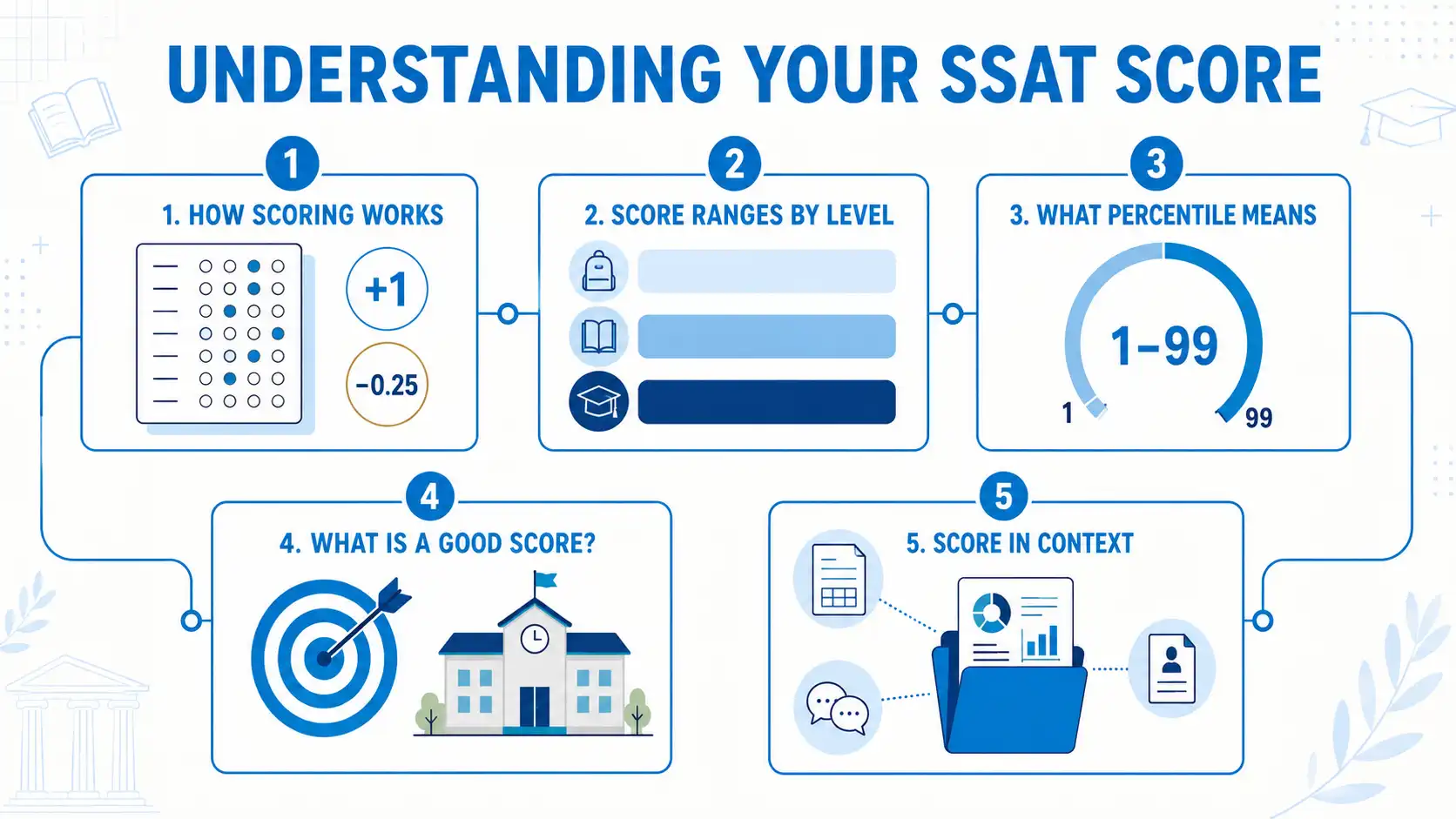
A completed SSAT produces two numbers: a scaled score and a percentile. Both start from a raw score, the mechanical count of correct and incorrect answers, which the section below explains first. From there, this section covers the ranges those scaled scores fall into by level, what percentile actually measures, and how admissions officers weigh it.
1. How Is the SSAT Scored
Scoring the SSAT starts with a raw score, which is calculated differently at each level:
Middle and Upper Level: +1 point for each correct answer, −0.25 for each incorrect answer, 0 for each question left blank.
Elementary Level: +1 point for each correct answer, 0 for each incorrect or blank answer. No penalty for wrong answers.
The quarter-point penalty on Middle and Upper Level is designed to make random guessing a breakeven proposition rather than an advantage. Guessing blindly across five choices produces an expected score of zero over time.
The raw score is then converted into a scaled score through a process called score equating. Different SSAT forms vary slightly in difficulty from one test date to the next, and score equating adjusts for that variation so a scaled score from one form is directly comparable to a scaled score from any other form. This is what allows a school to compare two applicants who tested on different dates using different test forms.
2. SSAT Score Ranges by Level
The SSAT produces a scaled score for each of the three scored sections, and a composite score that adds all three together. Each level has its own scale, so the numbers below apply only to that level.
|
Level |
Per-Section Range |
Composite Range |
Composite Midpoint |
|
Elementary |
300–600 |
900–1800 |
1350 |
|
Middle |
440–710 |
1320–2130 |
1725 |
|
Upper |
500–800 |
1500–2400 |
1950 |
3. What Do SSAT Percentiles Mean
An SSAT percentile is a ranking that shows how a student's scaled score compares to other first-time SSAT test-takers in the same grade, based on Standard test administrations in the United States and Canada over the prior three years. It runs from 1 to 99.
For example, a student at the 70th percentile scored at or above 70 percent of that comparison group.
Scaled score and percentile measure different things. Official SSAT guidance points to the scaled score as the more precise, consistent figure, since it reflects an equated result on a fixed scale rather than a ranking that shifts with the comparison group. Percentile adds useful context on top of that: it shows where a score sits relative to other students who tested in the same window, though that comparison group is the broader national norm group, not the applicant pool at any specific school.
One thing worth knowing before reading a score report: the SSAT norm group consists entirely of students who chose to sit for an independent school admission test, an already self-selected, academically motivated population. A percentile should be read with that context in mind, not against general population expectations.
4. What Is a Good SSAT Score
There is no single good SSAT score. A competitive score depends on the grade the student is in, the schools they are applying to, the strength of that school's applicant pool, and how much weight a given school places on testing in its admissions process.
What matters in practice is whether a score is competitive for a specific set of schools. Percentile offers a useful general orientation for that comparison, though it reflects the national norm group rather than any single school's applicant pool, and the scaled score remains the more precise measure of actual performance.
There is no universal SSAT cutoff. Schools differ substantially in how selective they are and how heavily they weigh testing relative to transcripts, recommendations, essays, and interviews. A percentile that is strongly competitive at one school can fall short of another school's typical admitted range, and a lower percentile does not rule a student out where other parts of the application are strong.
5. Putting Your SSAT Score in Context
A percentile answers where a student stands against other test-takers. It doesn't answer whether that standing helps or hurts at any particular school, since the ranges above are general orientation, not a school-by-school read. A 75th percentile can sit comfortably inside one school's typical admitted range and fall short of another's, independent of the selectivity tier a family expected going in.
Getting from a general percentile range to a real answer for a specific school list requires familiarity with individual schools' admissions profiles and practices, the kind built through direct relationships with admissions offices. McMillan Education works with families to weigh a score against a built school list, rather than reading a percentile in isolation.
SSAT Testing for Boarding School Families
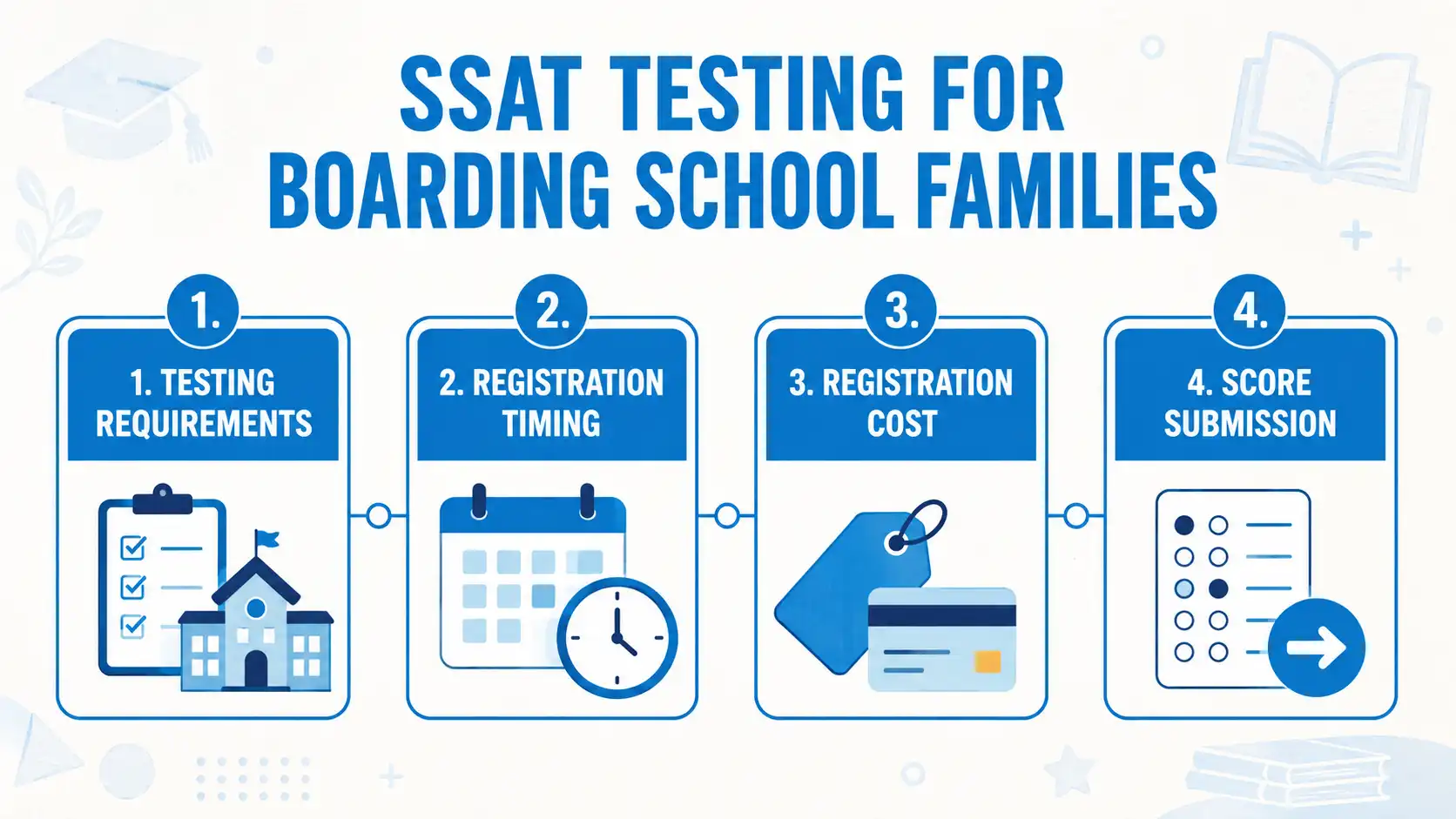
The SSAT test itself is one part of the boarding school admissions process. Deciding whether to sit for it, when to register, and what to do with a score once it arrives is a separate, more practical set of questions, and one that differs from school to school.
1. Testing Requirements
Testing requirements are not uniform across boarding schools, and policies shift as school admission trends evolve. Some require the SSAT outright, some accept it alongside alternatives such as the ISEE, and a growing number have made testing optional, weighing transcripts and interviews more heavily instead. A family building a list of six or eight schools can end up tracking six or eight separate policies. School profiles on the McMillan Education Boarding School Guide list each school's testing requirement directly, and the school comparison tool lays those requirements side by side.
2. Registration Timing
Registration runs through E3n at ssat.org. Standard paper tests are offered on set Saturday dates across a testing year that runs from August through July. Scores from paper tests typically take about two weeks to release. SSAT at Home offers a faster turnaround for families working against a tighter window, and is available only to students physically located in the United States, U.S. territories, or Canada on test day, based on location at the time of testing rather than home address. International families should plan around paper testing or Prometric instead. E3n is transitioning SSAT at Home to a new platform for the 2026-27 testing season, with full details expected by late September 2026, so families considering that option should confirm current requirements directly on ssat.org before registering.
January 15 is the deadline most often associated with boarding school admission, and it applies at a number of highly selective schools. It is not universal. Other schools set earlier or later dates, and some use rolling admission instead of a fixed deadline. A testing plan built around a single assumed deadline can leave a family exposed if even one school on the list follows a different calendar.
Many students improve on a second attempt, which is one reason families often keep a retest date in reserve rather than treating the first sitting as final. Coordinating test dates against an actual list of schools, each carrying its own deadline and testing policy, is precisely the kind of scheduling a boarding school admissions consultant manages on a family's behalf.
3. Registration Cost
SSAT fees vary by level and format. In the United States and Canada, Elementary Level registration runs $112 for standard or school Flex testing. Middle and Upper Level registration runs $177 for standard or school Flex testing, $263 for SSAT at Home, and $250 for Prometric. International testing carries additional cost. Fee waivers are available through participating schools for qualifying families and are separate from financial aid, which families apply for directly through each school.
4. Score Submission
Whether a given score gets submitted is a separate call, and one worth making with the schools on the list in mind. McMillan Education's SSAT: To Test or Not to Test? covers that decision in full.
Score in Hand, What Comes Next
A scaled score, a percentile, a testing calendar: each piece covered here answers a specific question, but none of them, on its own, turns an SSAT score into a plan. That takes placing the score against the schools on a family's actual list, weighing requirements and deadlines that differ from one institution to the next, and deciding what belongs in an application and when. It is exactly the kind of coordination that comes from decades spent inside boarding school admissions offices, not from a single test date considered in isolation.
McMillan Education has guided families through this process since 1955. Families ready to move from an SSAT score to a strategy can schedule a free consultation with an educational consultant to build a testing and application plan suited to their specific school list.
Families still building that list can use the McMillan Education Boarding School Guide to search schools across the United States, the UK, Canada, and Europe, then place candidates side by side using the comparison tool to see testing requirements, deadlines, and academic focus in one view.
Frequently Asked Questions
1. Can You Take the SSAT More Than Once?
Yes. Elementary Level students may take up to two Standard tests and one Flex test per testing year. Middle and Upper Level students may take every Standard test date offered, plus up to one Flex test. Computer-based retakes are governed by separate limits for Prometric and SSAT at Home rather than a shared cap, and the Prometric limit is currently being adjusted for the 2026–27 testing year. Families planning multiple computer-based attempts should confirm the current limits directly on ssat.org before registering.
2. Do All Boarding Schools Require the SSAT?
No. Requirements vary by school, and a growing number have made testing optional or accept alternative assessments such as the ISEE. School profiles on the McMillan Education Boarding School Guide list each school's testing requirement directly.
3. What's the Difference Between the SSAT and the SAT?
The SSAT is an admission test used for entry into independent and boarding schools, typically taken by students in grades 3 through 11. The SAT is a college admission test, typically taken by students in grades 11 and 12. The two serve different stages of the admissions process and are not interchangeable.
4. What's the Difference Between the SSAT and the PSAT?
The SSAT is an admission test used by independent and boarding schools to evaluate applicants for grades 4 through post-graduate. The PSAT is administered by the College Board as a preliminary version of the SAT, used primarily to prepare for college admission testing and to qualify for National Merit recognition in grades 10 and 11.
5. What Is a Good SSAT Score?
There is no single good score. Competitiveness depends on the grade a student is in, the schools on their list, the strength of that school's applicant pool, and how heavily a given school weighs the SSAT. A percentile of 85 and above is generally competitive at highly selective schools; a percentile of 60 to 84 is generally competitive at moderately selective schools.
6. How Long Is the SSAT?
Elementary Level runs 2 hours and 5 minutes. Middle and Upper Level run 3 hours and 5 minutes on paper, or 3 hours and 10 minutes on computer.
7. Is the SSAT Hard?
Difficulty is relative to grade level and preparation. The test is built to differentiate a self-selected group of applicants who are already academically motivated, rather than a general student population, which is why a raw percentile should be read in that context. Familiarity with the format and pacing has more influence on performance than the test's inherent difficulty.