British Schools vs American Schools: Key Differences for Boarding School Families
The British and American school systems share a language and, across a wide range of institutions, a serious commitment to academic quality. In many other respects, however, they differ substantially. Both those differences and the points of genuine overlap are the subject of this article, with particular attention to what they mean for families considering boarding schools in the United States or the United Kingdom.
For a general overview of how the two education systems compare outside the boarding context, see our guide to the American vs. UK education system.
UK vs US School Glossary
Several terms used in British and American school systems mean completely different things, so before the two of them can be compared with any precision, a terminology problem needs to be addressed. The table below clarifies the most common sources of confusion before the comparisons that follow.
|
Term |
In the UK |
In the US |
|
Public school |
A historically prestigious, fee-paying independent school (for example, Eton, Harrow, Winchester) |
A free, state-funded school |
|
Independent school |
A fee-paying private school independent of government control |
A fee-paying private school independent of government control; used interchangeably with private school |
|
Private school |
A fee-paying school; often used interchangeably with independent school |
A fee-paying school used interchangeably with independent school |
|
State school |
A free, government-funded school |
The equivalent is usually called a public school |
|
Prep school |
A fee-paying preparatory school for children up to about age 13, preparing pupils for senior independent school entry |
A college-preparatory secondary school, often private/independent |
|
College |
A Sixth Form college, further-education college, or a constituent part of a university |
An institution providing undergraduate higher education; often used broadly alongside university |
|
Sixth Form |
The final two years of secondary school (ages 16–18), leading to A-Levels or equivalent qualifications |
No direct equivalent; used sparingly at some historic US boarding schools to refer to 12th grade |
|
Year (Year 7, Year 9) |
The UK term for a school year group or grade level |
Not used for school year levels |
|
Grade (Grade 9, Grade 11) |
Not used for school year levels; used for exam results (GCSE and A-Level grades) |
The term for a school year level |
|
Freshman, Sophomore, Junior, Senior |
Not used for school years |
The four years of high school (Grades 9–12) |
Key takeaways:
UK "public school" = US "elite private school"
UK "state school" = US "public school"
UK "Year 10" = US "Grade 9"
UK "Sixth Form" ≈ US Grades 11-12 in age, but not in curriculum
How the British and American School Structures Compare
Both the American and British systems run compulsory education from age 5 to 18. How students progress through those years, and how the stages are named and organized, differs substantially between the two.
1. School Levels in the UK: Prep, Senior School, and Sixth Form
British schooling moves through three stages:
Preparatory schools cover the primary years, typically through to age 11 or 13.
Senior schools run through to age 16.
Sixth Form covers the final two years, from 16 to 18, and concludes with the qualifying examinations that determine university entry.
The UK system is designed as a progression toward increasing specialization: students study broadly in the earlier years and narrow significantly by the end. Many UK boarding schools operate within the independent sector and follow this same three-stage structure.
2. School Levels in the US: Elementary Through High School
The American system divides into elementary school (ages 5 to 11), middle school (ages 11 to 14), and high school (ages 14 to 18). The logic runs in the opposite direction from the UK. Rather than narrowing toward specialization, students maintain a broad range of subjects throughout high school, and their performance is assessed cumulatively across all four years rather than through a single set of terminal examinations.
American boarding schools sit within this structure, known as K-12 (Kindergarten through Grade 12), drawing students primarily at the high school stage. Because most US boarding schools admit at the Grade 9 entry point, families often engage a US boarding school admissions consultant a year or two in advance to plan applications, testing, and school selection around that timeline.
American Grades to British Years: Side-by-Side
American and British schools number their years differently and use different names for each stage. The table below maps the two systems directly, age by age.
|
Typical Age |
UK School Year |
US Grade |
7–10 |
Years 3–6 |
Grades 2–5 |
11–12 |
Year 7 |
Grade 6 |
12–13 |
Year 8 |
Grade 7 |
13–14 |
Year 9 |
Grade 8 |
14–15 |
Year 10 |
Grade 9 |
15–16 |
Year 11 |
Grade 10 |
16–17 |
Year 12 |
Grade 11 |
17–18 |
Year 13 |
Grade 12 |
18–19 |
N/A |
Postgraduate (optional) |
The table above covers general age and grade equivalencies. For families researching boarding schools specifically, entry ages follow their own logic in each country. For a detailed breakdown of boarding school entry ages in the UK and US, and how they compare with Switzerland, Canada, and Europe, see our article about boarding school ages around the world.
British vs American Curriculum
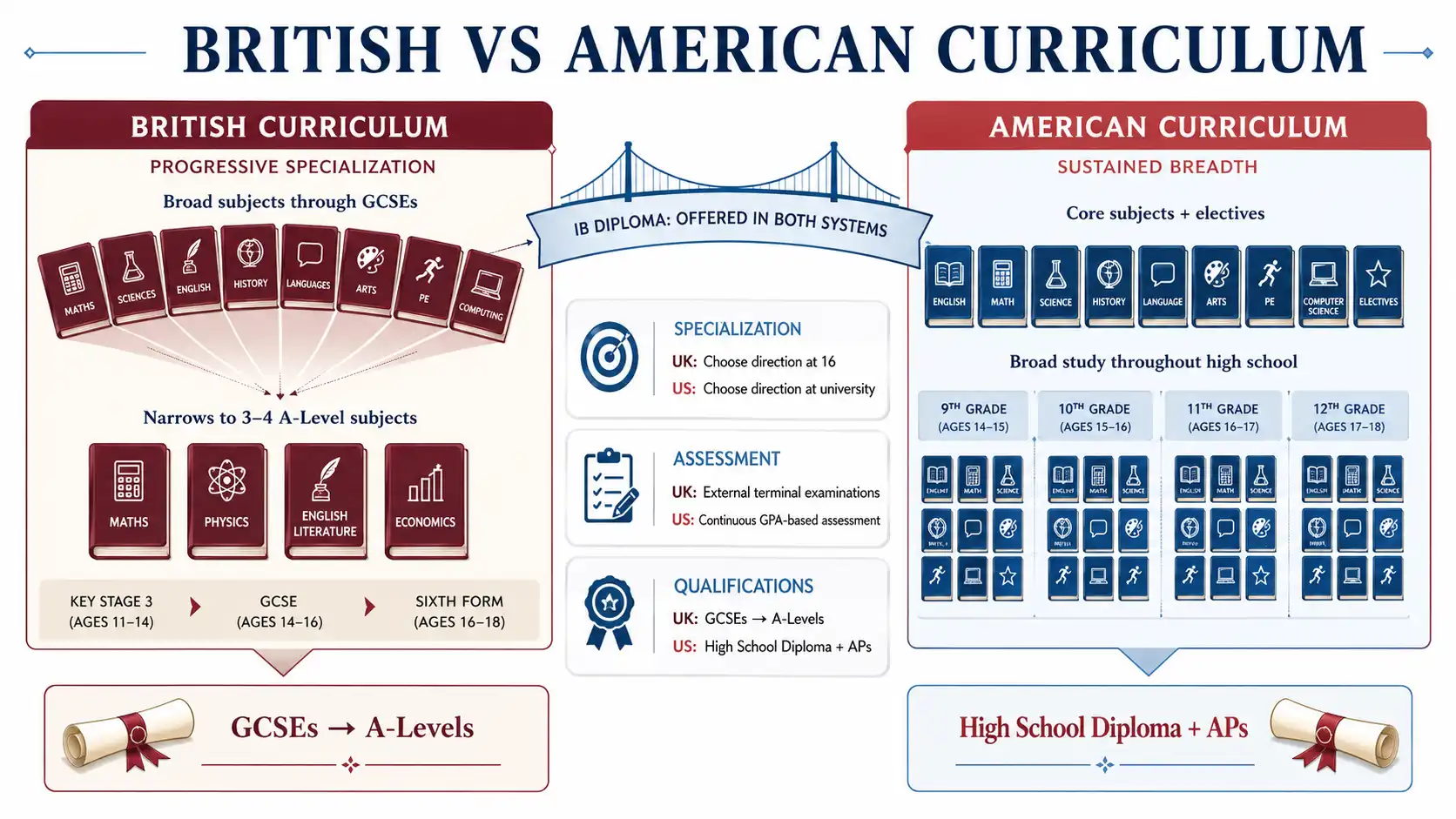
The most fundamental difference between the two systems is not what students study but how much of it, and for how long. British education is built around progressive specialization; American education around sustained breadth. Both approaches produce strong academic outcomes through different routes. The sections below examine each in detail.
Key curriculum differences at a glance:
Specialization vs breadth: British students narrow to 3-4 subjects by Sixth Form; American students maintain a broad curriculum throughout high school
Assessment: Terminal external examinations in the UK; continuous GPA-based assessment in the US
Decision timing: The UK asks students to choose their academic direction at 16; the US defers that decision to university
1. The UK Curriculum
British students cover a broad range of subjects through their preparatory and senior school years, but the curriculum is explicitly designed to narrow over time. By the time a student reaches Sixth Form, they are studying three or four subjects almost exclusively. The final two years of British schooling look less like a general education and more like the beginning of a university degree. That concentration is intentional. The British system operates on the premise that depth of knowledge in a chosen field is more valuable, at least for university preparation, than continued breadth across many disciplines.
The curriculum at every stage is anchored to external examinations. Teachers teach toward those examinations, and students are assessed primarily on their performance in them. Coursework exists in some subjects, but terminal examinations carry the decisive weight.
2. The US Curriculum
American students maintain a broad curriculum across all four years of high school. Core subjects: mathematics, English, science, and history, are pursued across all four years, with students adding electives alongside them. The system does not ask a fifteen-year-old to decide whether she is a scientist or a humanist. It defers that decision until university, and sometimes beyond.
Qualifications: GCSEs, A-Levels, IB, and APs
The British and American systems produce different credentials at the end of secondary school, and those credentials are not directly interchangeable. Four qualifications define the landscape: GCSEs and A-Levels on the British side, the High School Diploma and Advanced Placement courses on the American side. The International Baccalaureate Diploma, offered at boarding schools in both countries as an internationally recognized alternative to A-Levels and APs, sits across both systems and deserves its own consideration for families weighing options on either side of the Atlantic. For families specifically evaluating the IB, see our articles about:
3. UK Qualifications: GCSEs and A-Levels
British students earn two sets of credentials over the course of their school years.
GCSEs are subject-specific qualifications sat across eight to eleven subjects at the end of Year 11, age 16. They are the standard measure of broad secondary attainment in the UK and a prerequisite for Sixth Form entry at most independent schools. A strong GCSE profile, particularly in the subjects a student intends to pursue at A-Level, carries significant weight in Sixth Form admissions.
A-Levels are the qualification that concludes a student's school years in the UK. Sat across three or four subjects at the end of Year 13, they are the primary academic record a school produces for each student and, in turn, the credential UK universities use to make admissions decisions
4. US Qualifications: The High School Diploma and APs
American students graduate with a High School Diploma, awarded upon completing the required credit hours across core and elective subjects over four years of high school. It represents the completion of secondary education and is the standard credential that American schools confer at graduation. The diploma itself does not differentiate between students on the basis of subject-specific depth. What differentiates applicants in US university admissions is the course record that sits behind it.
Advanced Placement (AP) courses are the primary mechanism for demonstrating that depth. Each AP course is a college-level class taken within the high school curriculum, ending in a standardized examination graded 1 to 5. AP courses do not constitute standalone qualifications in the way A-Levels do, but a strong AP record is the closest American equivalent to the subject-specific credential that A-Levels provide. At US boarding schools, students typically have access to a wide range of AP courses across their high school years.
For a full breakdown of how AP courses work, see our AP classes explained guide.
5. UK and US Qualification Equivalencies
Families moving between the two systems, and universities on either side evaluating applicants from the other, encounter a structural mismatch with no exact resolution. The table below maps the main qualifications against each other as a starting point;
|
UK Qualification |
US Comparison |
Notes |
|
GCSE (grades 9–4) |
US High School Diploma / GED |
Broadly comparable in academic level; neither US credential covers the full GCSE syllabus |
|
A-Levels (3–4 subjects) |
3–4 AP courses, scores of 4–5 |
Treated as roughly equivalent by UK universities assessing US applicants |
|
IB Diploma |
IB Diploma |
Accepted directly by universities in both countries; no conversion required |
The table maps credentials at the level of general comparability, which is useful as a reference point but can obscure real differences in how each qualification is structured, assessed, and received. Two subjects worth clarifying:
5.1 Is there a GCSE equivalent in the US?
There is no direct GCSE equivalent in the American system. UK ENIC, the national body for comparing international qualifications, treats the US High School Diploma as broadly comparable to GCSE grades 9 to 4, reflecting general academic level rather than subject-by-subject equivalence. For families on a standard school or boarding track, the High School Diploma is the relevant comparison point.
5.2 How do US qualifications translate for UK university entry?
For UK universities assessing American applicants, three to four AP courses with scores of 4 or 5 are treated as broadly equivalent to A-Levels. For a detailed breakdown of how American credentials translate in the UK university context, see the A-Level equivalent in the USA guide.
Grading Systems: American vs UK
Day-to-day grading works differently in the two systems, both in how schools assess student work and in how that performance is reported to families.
1. Grading in British Schools
There is no single national system for how British schools grade classroom work and term reports. Independent boarding schools set their own internal marking conventions, and these vary from school to school. Many report performance on a numeric or letter scale for attainment, alongside a separate effort grade that reflects a student's engagement and application rather than the quality of the work itself. End-of-term reports typically combine these grades with a written narrative from each subject teacher.
The GCSE and A-Level grades covered earlier in this article sit above this internal system. They are external qualification grades, set by national examination boards rather than by the school, and they only apply at the end of Year 11 and Year 13. For most of a student's school career, the grades that appear on their reports are the school's own internal marks, not GCSE or A-Level grades.
One feature of the British system that consistently surprises American families is the role of predicted grades. In Year 13, before A-Level examinations are sat, teachers issue a grade prediction for each subject based on the student's work over the two preceding years. Universities make conditional offers based on these predictions rather than waiting for final results, which means the prediction a school issues carries real consequences beyond the classroom.
2. Grading in American Schools
American schools grade continuously throughout the school year. Individual assignments, tests, essays, and class participation all contribute to a course grade, reported as a letter from A through F on a report card issued each quarter or semester.
Those letter grades convert into a Grade Point Average, typically on a scale where an A equals 4.0 and each lower grade earns fewer points, down to an F earning zero. The result is a cumulative figure, updated as final grades are recorded each semester, that reflects performance across every course a student has taken rather than a single test or exam.
The distinction between weighted and unweighted GPA is a common source of confusion for families reading American school reports. An unweighted GPA caps at 4.0 regardless of course difficulty. A weighted GPA assigns additional points to AP and Honors courses, allowing a student who takes demanding coursework to report a GPA above 4.0. Two students with identical letter grades may therefore show different GPAs depending on which system their school uses.
Boarding Life: UK vs US Boarding Schools
Having compared how the two school systems work in general, it is worth turning specifically to how boarding schools themselves are structured in each destination. Where a student sleeps, eats, studies, and spends their evenings is shaped by decisions each country's boarding system makes very differently, from the rhythm of the week to who is responsible for a student's wellbeing outside the classroom. These structural differences sit on top of the academic, developmental, and social benefits of boarding schools that draw families to the model in the first place, regardless of which country they ultimately choose.
Find and explore boarding schools in the UK and US here.
1. The Shape of the Day and Week
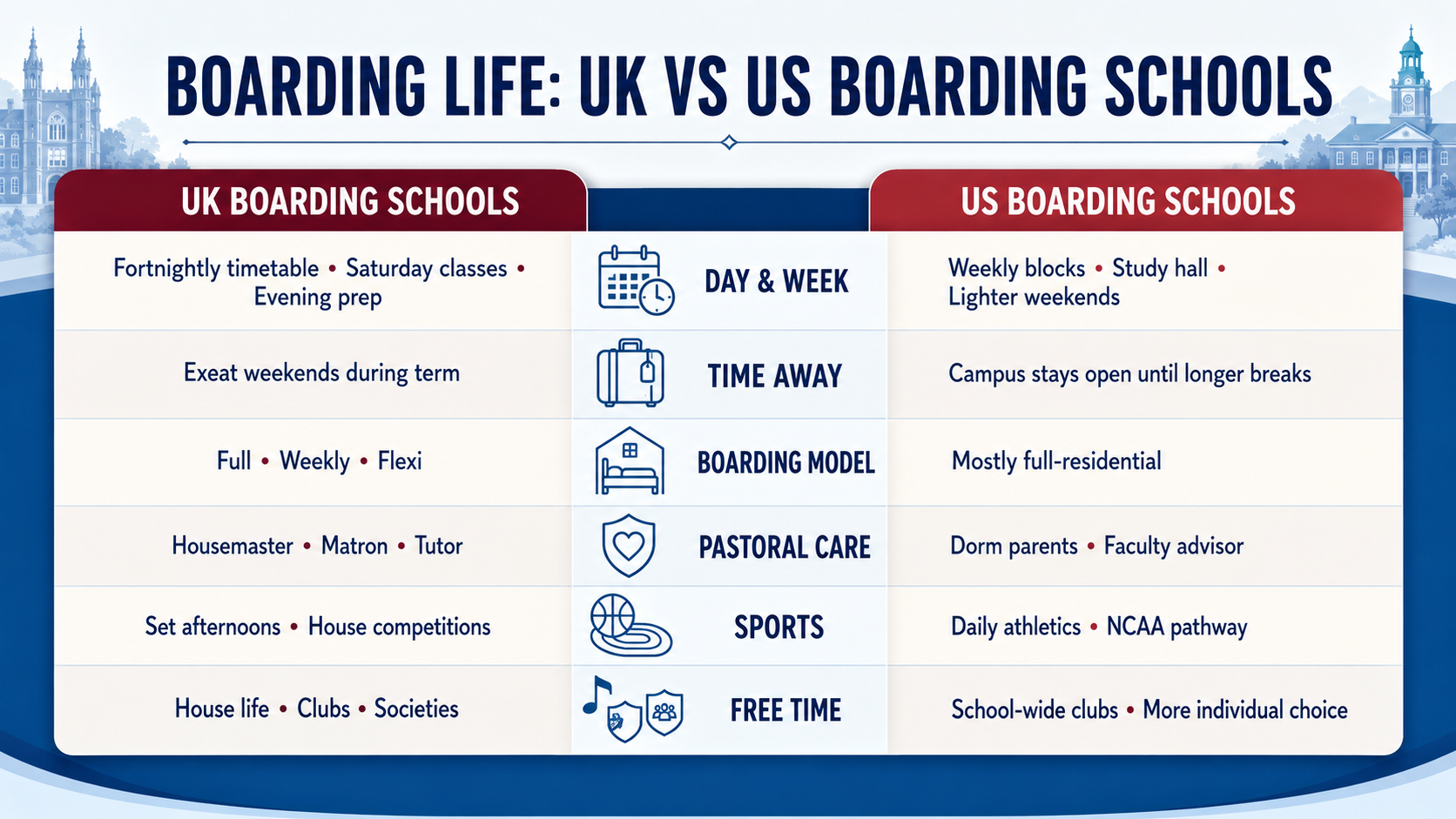
In the UK: Many schools run on a fortnightly timetable, so the schedule repeats every two weeks rather than every week. Saturday morning school is still common at traditional boarding schools. Prep, a supervised evening study period, usually happens in the boarding house.
In the US: Most schools use a weekly schedule with block periods, typically 50 to 80 minutes long. Study hall serves the same purpose as UK prep and is usually supervised in the dorm. Weekends are generally lighter academically, though sports, activities, and occasional academic commitments still happen.
2. Exeats and Time Away From Campus
In the UK: Many schools schedule exeat weekends several times a term, when boarders leave campus, and families new to the UK system often consult a UK boarding school admissions consultant to understand how these breaks affect travel planning and term-time commitments.
In the US: Campus generally stays open through the term. Students typically remain until scheduled breaks like Thanksgiving or spring break, which are longer and allow travel home.
3. Boarding Models: Full, Weekly, and Flexi Boarding
In the UK: Schools commonly offer full boarding, weekly boarding, and flexi boarding. Full boarding means living at school for the whole term. Weekly boarding means returning home each weekend. Flexi boarding allows more variable arrangements. Weekly and flexi boarding are generally impractical for international families, making full boarding the default.
In the US: Boarding is mostly full-residential. Weekly or flexi arrangements are uncommon and, where they exist, tend to be informal rather than a standard offering.
4. Pastoral Care: House and Dorm Life
In the UK: What's known as pastoral care sits primarily at the house level. Boarding houses often function as their own communities, led by a Housemaster or Housemistress responsible for student wellbeing. Many houses also have a Matron for day-to-day health and welfare, and a tutor system for academic and personal guidance. Meals are often more formal, with set sittings. Sundays commonly include chapel, house meetings, or organized activities.
In the US: The equivalent pastoral structure runs through the dorm rather than the house. Dorms are usually supervised by faculty dorm parents, with faculty advisors providing guidance similar to a UK tutor. Dining is typically centered on one dining hall with more flexible timing. Sundays tend to be less structured, often used for homework and downtime.
5. Sports and Athletics Culture
In the UK: Sport is built into the week on set afternoons, often centered on a smaller number of core sports like rugby, cricket, and rowing. House competitions matter, but many schools also compete regularly against other schools.
In the US: Athletics are usually a required part of the daily schedule, with practice and competition on weekday afternoons. The range of sports tends to be broader, and competitive athletics can be a real pathway into NCAA recruitment, more developed than the UK's club and academy route.
6. Clubs, Societies, and How Students Spend Free Time
In the UK: The house remains a central social unit at many schools, but students also take part in whole-school clubs, societies, music, drama, and volunteering.
In the US: Students typically choose from a wide range of school-wide clubs and activities, with more individual latitude in building their own extracurricular involvement.
For a school-by-school comparison, explore our directory here.
How to Decide: Which System Suits Your Child?
Comparing the British school system vs the American system ultimately depends less on which country is 'better' and more on how a specific child learns, and on the kind of community they would thrive in.
Academically, a child who commits early to a subject area and finds real motivation in the weight of a single set of terminal exams often flourishes within the UK's structure. A child who benefits from more time before narrowing academically, and shows steadier form across ongoing assessment than in high-pressure moments, often finds the US system a more natural home.
The boarding experience itself matters just as much. A child who wants a close-knit community built around one house for several years may find the UK model a natural fit, while a child drawn to a broader range of sports, more flexible dorm life, and a wider menu of school-wide clubs may feel more at home within the US system. The rhythm of the week matters too: some children settle well into the UK's structured terms and regular breaks away from campus, while others thrive in the US's steadier, more continuous term structure.
These are broad patterns, not rules, and every school brings its own character to them. A boarding school is not a system on paper. It is a living community shaped by its people, its traditions, and the particular way it cares for the students in it, and that character can matter more than which country the school happens to be in. A school-by-school comparison will always tell you more than a comparison of systems ever can.
We Can Help You Decide
Comparing two entire school systems is a lot to hold in your head at once, and the right answer for your child won't come from a table or a checklist. It comes from someone who knows both systems well and takes the time to understand your child and what matters most to your family.
Our international boarding school consultants work with families weighing the UK against the US every day, and they can help translate everything in this article into something specific: which system, and which individual school, would genuinely suit your child.
For a more personalized starting point, take our school matching quiz, or schedule a free consultation with one of our consultants.
Frequently Asked Questions
1. At what age do students start boarding school in the UK vs the US?
UK boarding typically begins earlier, with some prep schools offering boarding from age 7 and many from age 8, while senior boarding usually starts at 11 or 13. In the US, boarding is concentrated later, with most students entering in Grade 9 at around age 14, although a small number of junior boarding schools accept students from Grade 4 onward.
2. What is the difference between British public schools and American public schools?
The term means almost the opposite in each country. A British “public school” is a prestigious fee-paying independent school, such as Eton, Harrow, or Winchester. An American “public school” is a free government-funded school. The British equivalent of an American public school is a state school.
3. What is the UK equivalent of American middle school?
There is no exact equivalent. American middle school covers Grades 6 through 8, roughly ages 11 to 14. In the UK, that same age range spans the final years of prep school and the beginning of senior school, split across two different institutions rather than one middle school stage.
4. What is grade 12 called in the UK?
Year 13, the final year of Sixth Form. Grade 11 in the US corresponds to Year 12 in the UK, and Grade 12 corresponds to Year 13.
5. Is Sixth Form the same as US high school?
Not quite. Sixth Form covers Years 12 and 13, ages 16 to 18, which overlaps in age with US Grades 11 and 12. The curriculum is very different, however. Sixth Form students have already narrowed to three or four A-Level subjects, while US students at the same age continue studying a broad range of subjects.
6. Can a UK boarding school student apply to American universities?
Yes. GCSEs and A-Levels are widely recognized by American universities, and UK students apply through the standard US admissions process alongside domestic and other international applicants.
7. Can a student at a US boarding school apply to UK universities?
Yes. UK universities consider AP courses and scores as the closest equivalent to A-Level study for American applicants. Competitive universities often expect several APs with strong scores, while the exact requirements vary by institution and course.
8. Do British schools have a GPA system?
No. British schools do not use a cumulative GPA. Internal school marks vary by school, and the two formal national scales, GCSEs and A-Levels, are qualification grades awarded at specific points, not a running average across a student's school career.